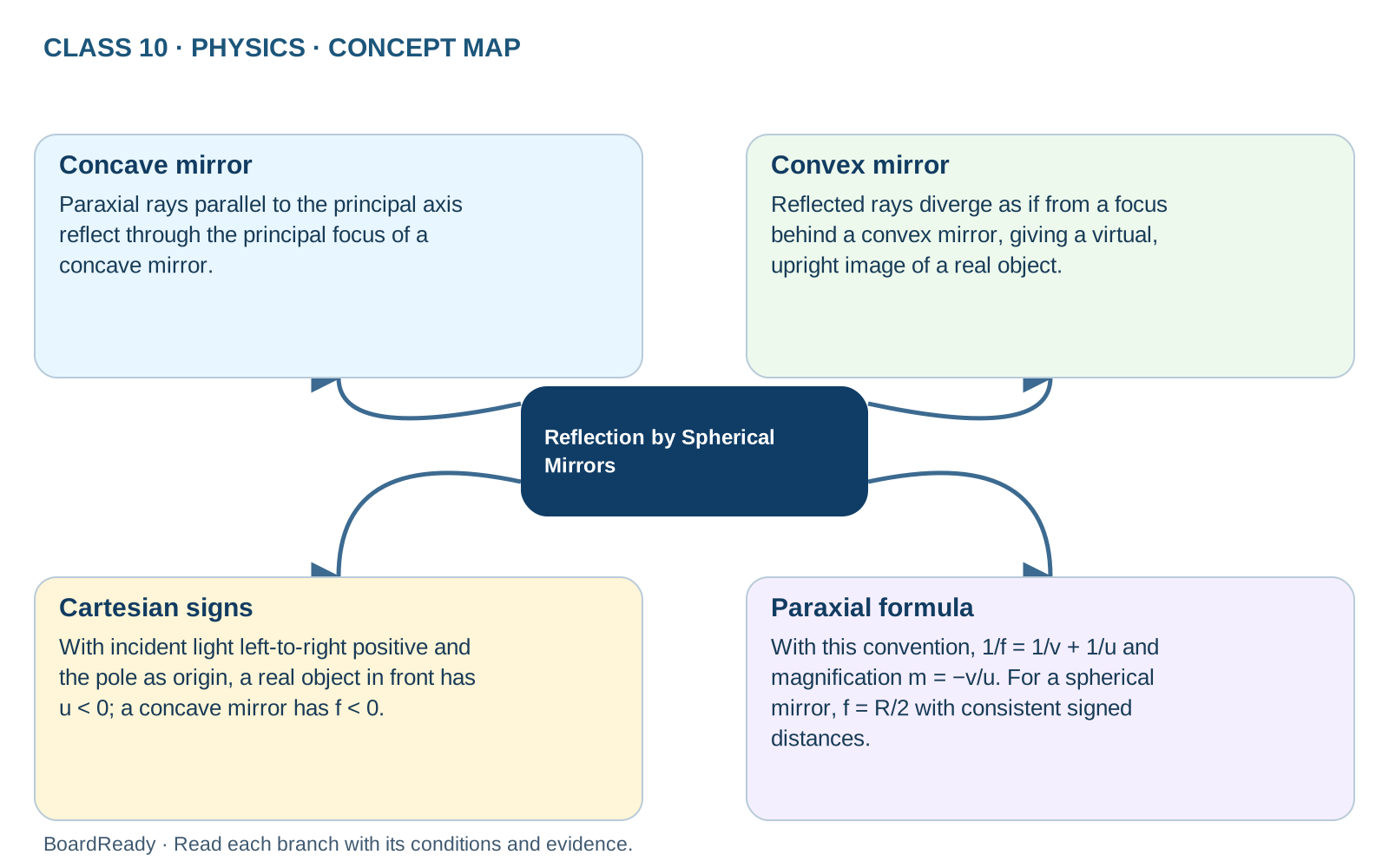
DiagramReflection by Spherical Mirrors
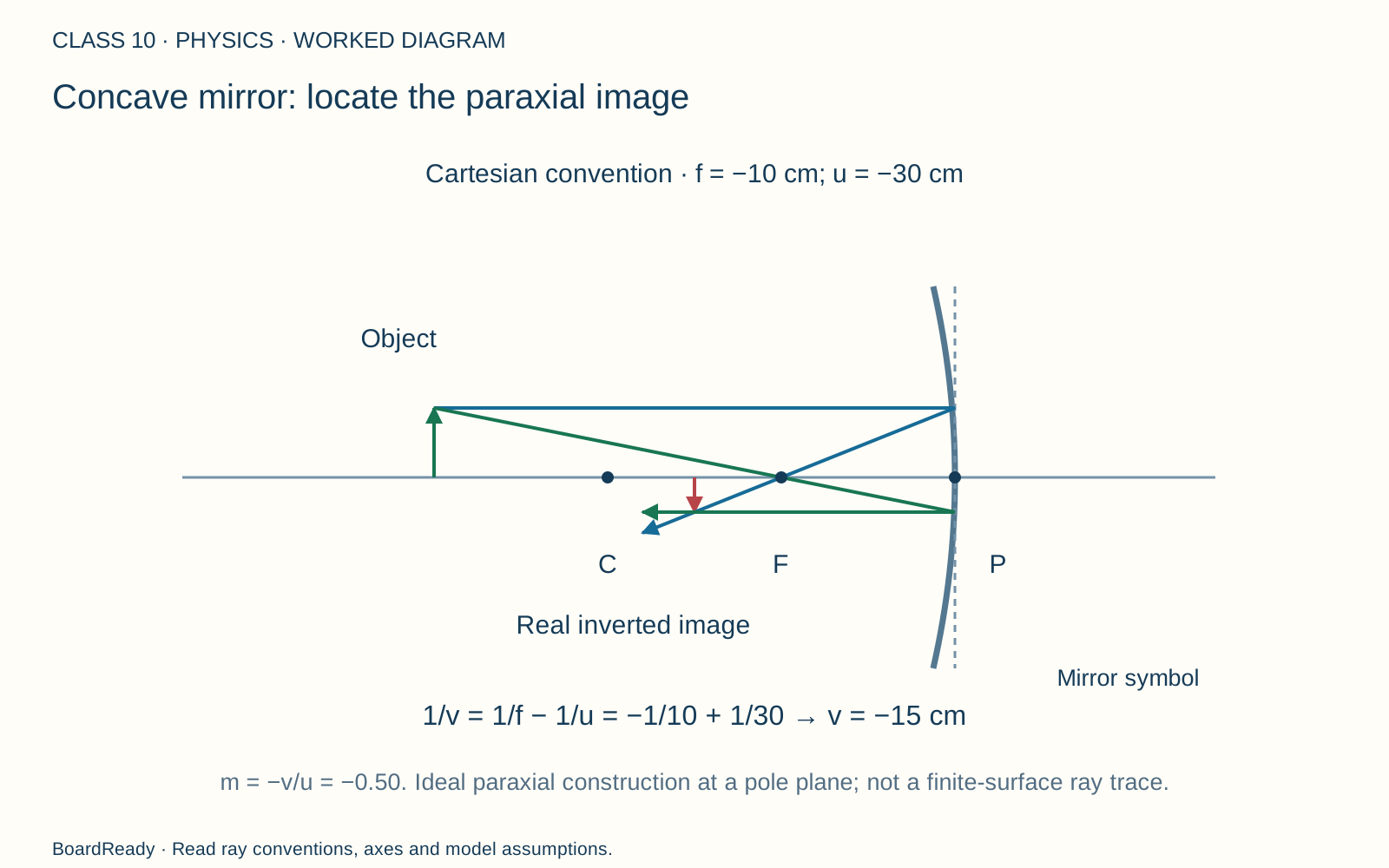
Concave mirror: locate the paraxial image
Two construction rays meet in a real inverted image between F and C. An ideal concave mirror has Cartesian focal length −10 cm. An object at u = −30 cm gives v = −15 cm and mirror magnification −v/u = −0.50. One incident ray is parallel to the axis and reflects through F; a second goes through F and reflects parallel to the axis. The reflected rays meet 15 cm in front of the mirror in an inverted half-height image. Longitudinal distances share a scale. The curve is a mirror symbol; ray changes are drawn at an ideal paraxial pole plane, not ray-traced at a finite curved surface.Read the worked diagram
An ideal concave mirror has Cartesian focal length −10 cm. An object at u = −30 cm gives v = −15 cm and mirror magnification −v/u = −0.50. One incident ray is parallel to the axis and reflects through F; a second goes through F and reflects parallel to the axis. The reflected rays meet 15 cm in front of the mirror in an inverted half-height image. Longitudinal distances share a scale. The curve is a mirror symbol; ray changes are drawn at an ideal paraxial pole plane, not ray-traced at a finite curved surface.Check: For mirrors use 1/f = 1/v + 1/u and m = −v/u. Do not substitute the lens magnification sign rule.