Comparison map
Spectrum, Dispersion, and Electromagnetic Spectrum: relationships and examples
Visible light is one part of the electromagnetic spectrum. Frequency, wavelength and photon energy change across it, but vacuum speed does not.Exam cue: Both travel at c in vacuum. Their frequencies, wavelengths and photon energies differ.
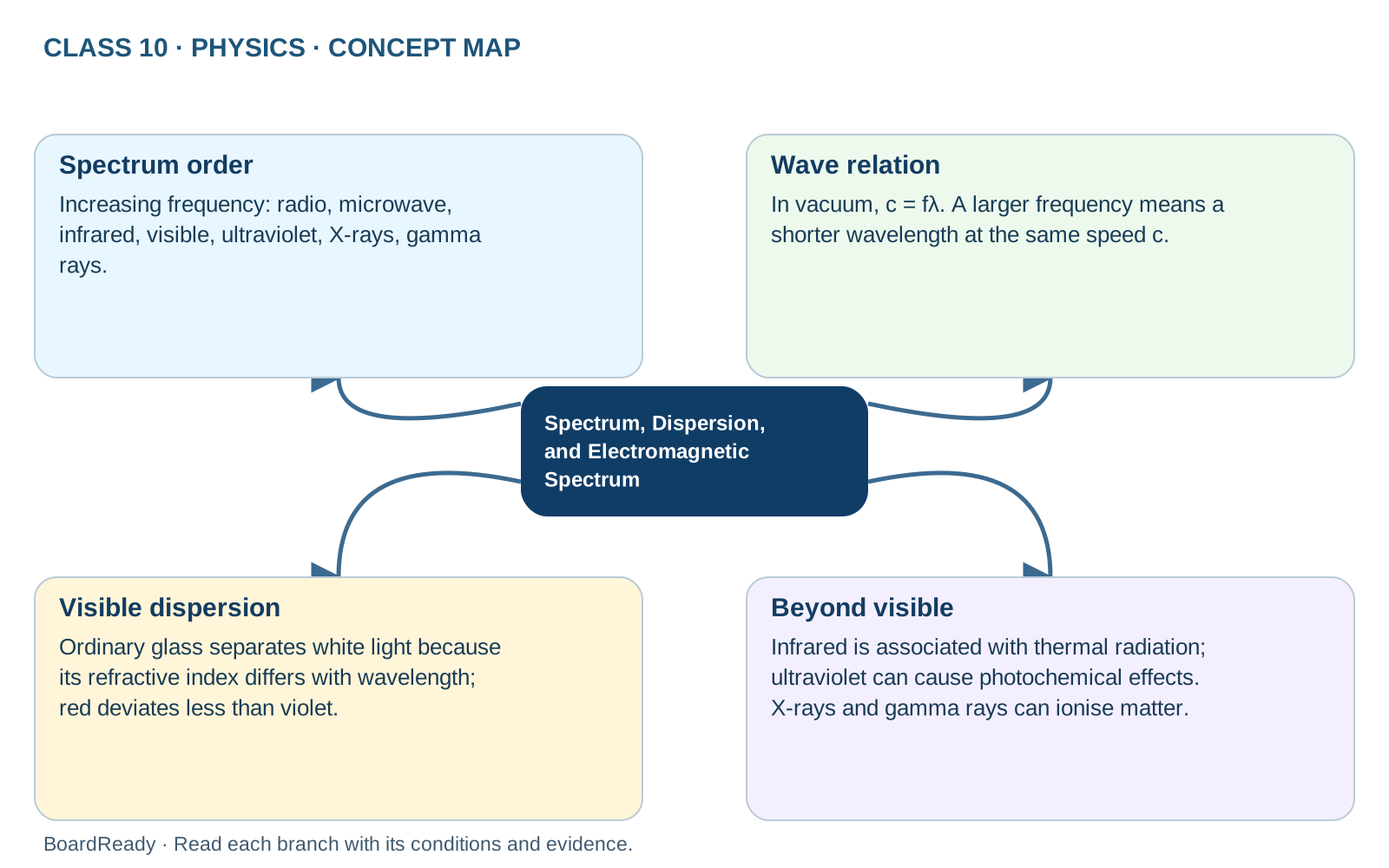
- 1Spectrum, Dispersion, and Electromagnetic Spectrum -> Spectrum order: Increasing frequency: radio, microwave, infrared, visible, ultraviolet, X-rays, gamma rays.
- 2Spectrum, Dispersion, and Electromagnetic Spectrum -> Wave relation: In vacuum, c = fλ. A larger frequency means a shorter wavelength at the same speed c.
- 3Spectrum, Dispersion, and Electromagnetic Spectrum -> Visible dispersion: Ordinary glass separates white light because its refractive index differs with wavelength; red deviates less than violet.
- 4Spectrum, Dispersion, and Electromagnetic Spectrum -> Beyond visible: Infrared is associated with thermal radiation; ultraviolet can cause photochemical effects. X-rays and gamma rays can ionise matter.