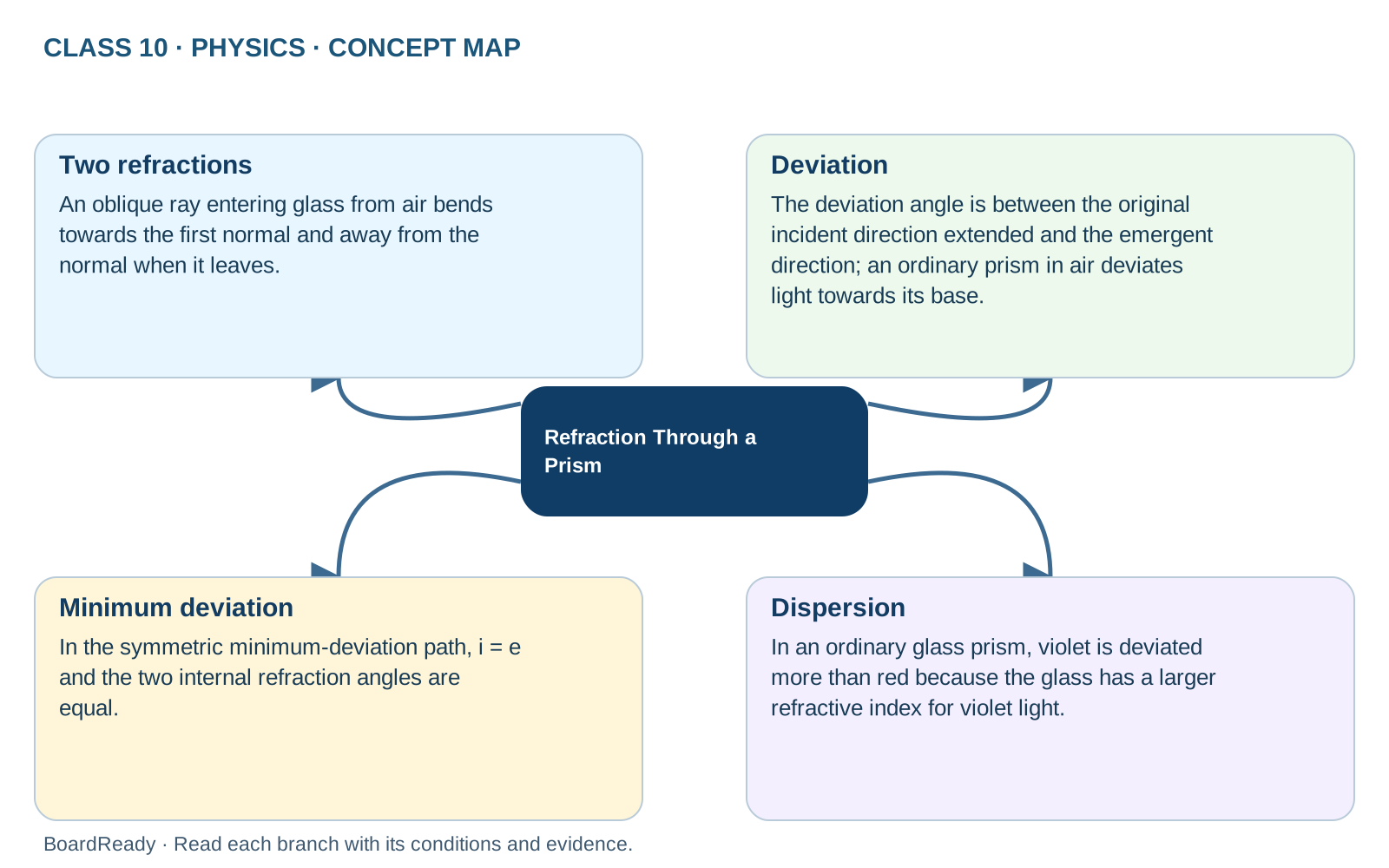
Comparison map
Refraction Through a Prism: relationships and examples
A prism's non-parallel faces produce an overall deviation. For ordinary visible-light dispersion, refractive index depends on colour.Exam cue: All visible colours travel at the same speed in vacuum. Their different speeds and refractive indices in glass produce dispersion.
- 1Refraction Through a Prism -> Two refractions: An oblique ray entering glass from air bends towards the first normal and away from the normal when it leaves.
- 2Refraction Through a Prism -> Deviation: The deviation angle is between the original incident direction extended and the emergent direction; an ordinary prism in air deviates light towards its base.
- 3Refraction Through a Prism -> Minimum deviation: In the symmetric minimum-deviation path, i = e and the two internal refraction angles are equal.
- 4Refraction Through a Prism -> Dispersion: In an ordinary glass prism, violet is deviated more than red because the glass has a larger refractive index for violet light.