Comparison map
Refraction Through a Glass Slab: relationships and examples
A parallel-sided glass slab bends a ray at both faces. With the same external medium on both sides, the emergent ray is parallel to the incident ray.Exam cue: Refraction occurs at both faces; the changes in direction cancel overall while a sideways displacement remains.
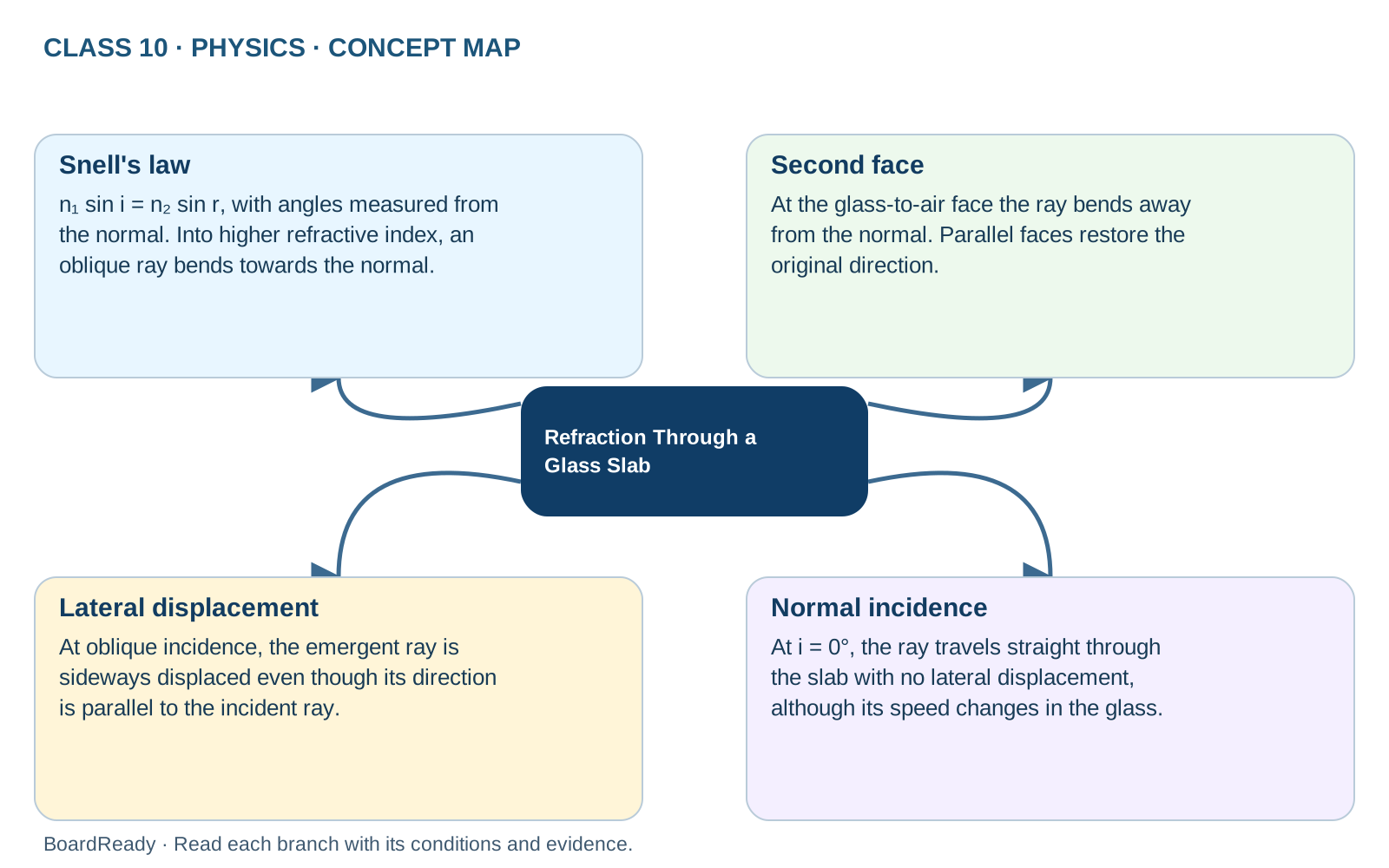
- 1Refraction Through a Glass Slab -> Snell's law: n₁ sin i = n₂ sin r, with angles measured from the normal. Into higher refractive index, an oblique ray bends towards the normal.
- 2Refraction Through a Glass Slab -> Second face: At the glass-to-air face the ray bends away from the normal. Parallel faces restore the original direction.
- 3Refraction Through a Glass Slab -> Lateral displacement: At oblique incidence, the emergent ray is sideways displaced even though its direction is parallel to the incident ray.
- 4Refraction Through a Glass Slab -> Normal incidence: At i = 0°, the ray travels straight through the slab with no lateral displacement, although its speed changes in the glass.