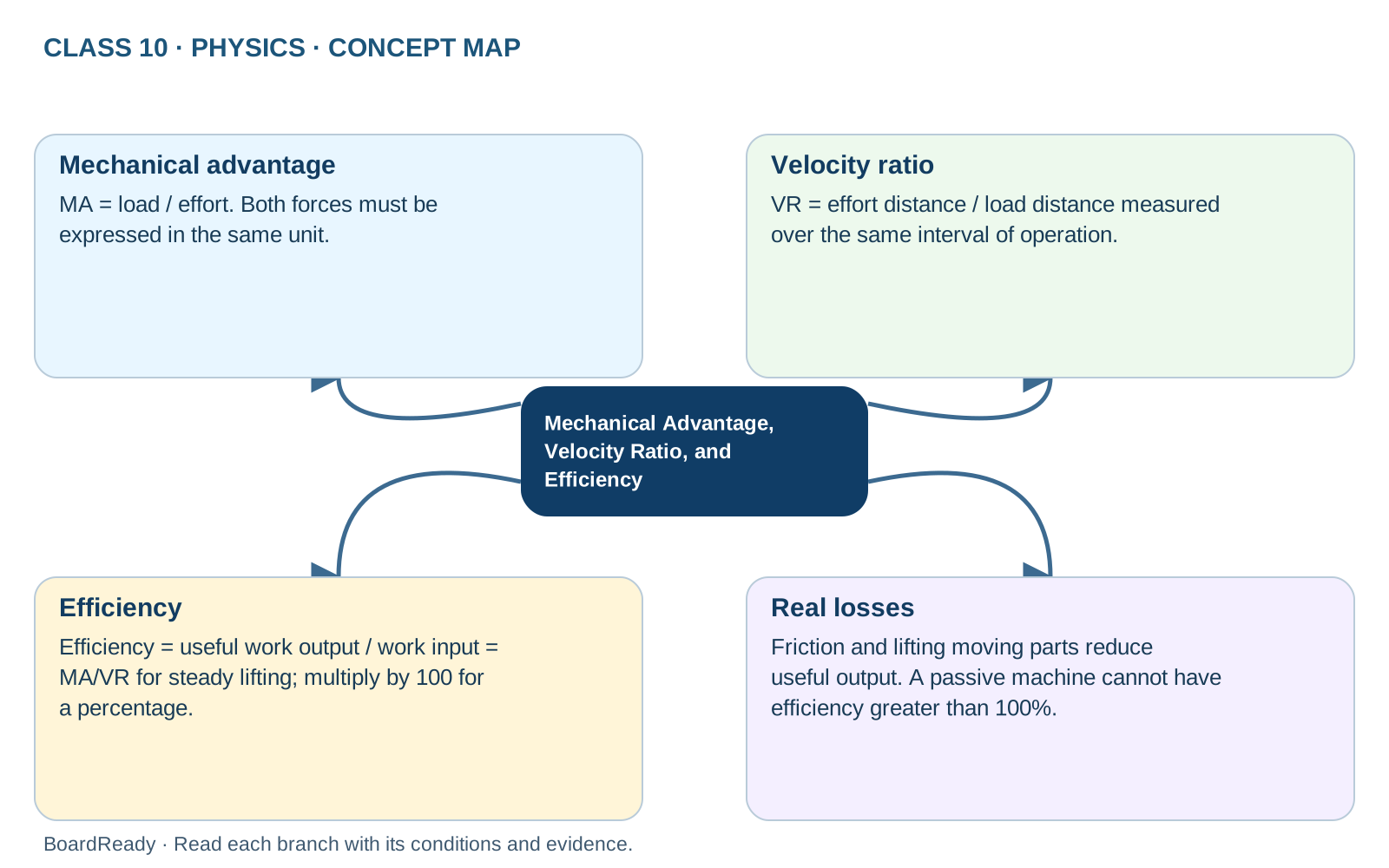
Comparison map
Mechanical Advantage, Velocity Ratio, and Efficiency: relationships and examples
Mechanical advantage compares forces; velocity ratio compares distances. Their ratio gives efficiency under the usual steady-lifting assumptions.Exam cue: MA is a force ratio and can exceed 1. Efficiency is an energy ratio and cannot exceed 1 for this passive machine.
- 1Mechanical Advantage, Velocity Ratio, and Efficiency -> Mechanical advantage: MA = load / effort. Both forces must be expressed in the same unit.
- 2Mechanical Advantage, Velocity Ratio, and Efficiency -> Velocity ratio: VR = effort distance / load distance measured over the same interval of operation.
- 3Mechanical Advantage, Velocity Ratio, and Efficiency -> Efficiency: Efficiency = useful work output / work input = MA/VR for steady lifting; multiply by 100 for a percentage.
- 4Mechanical Advantage, Velocity Ratio, and Efficiency -> Real losses: Friction and lifting moving parts reduce useful output. A passive machine cannot have efficiency greater than 100%.