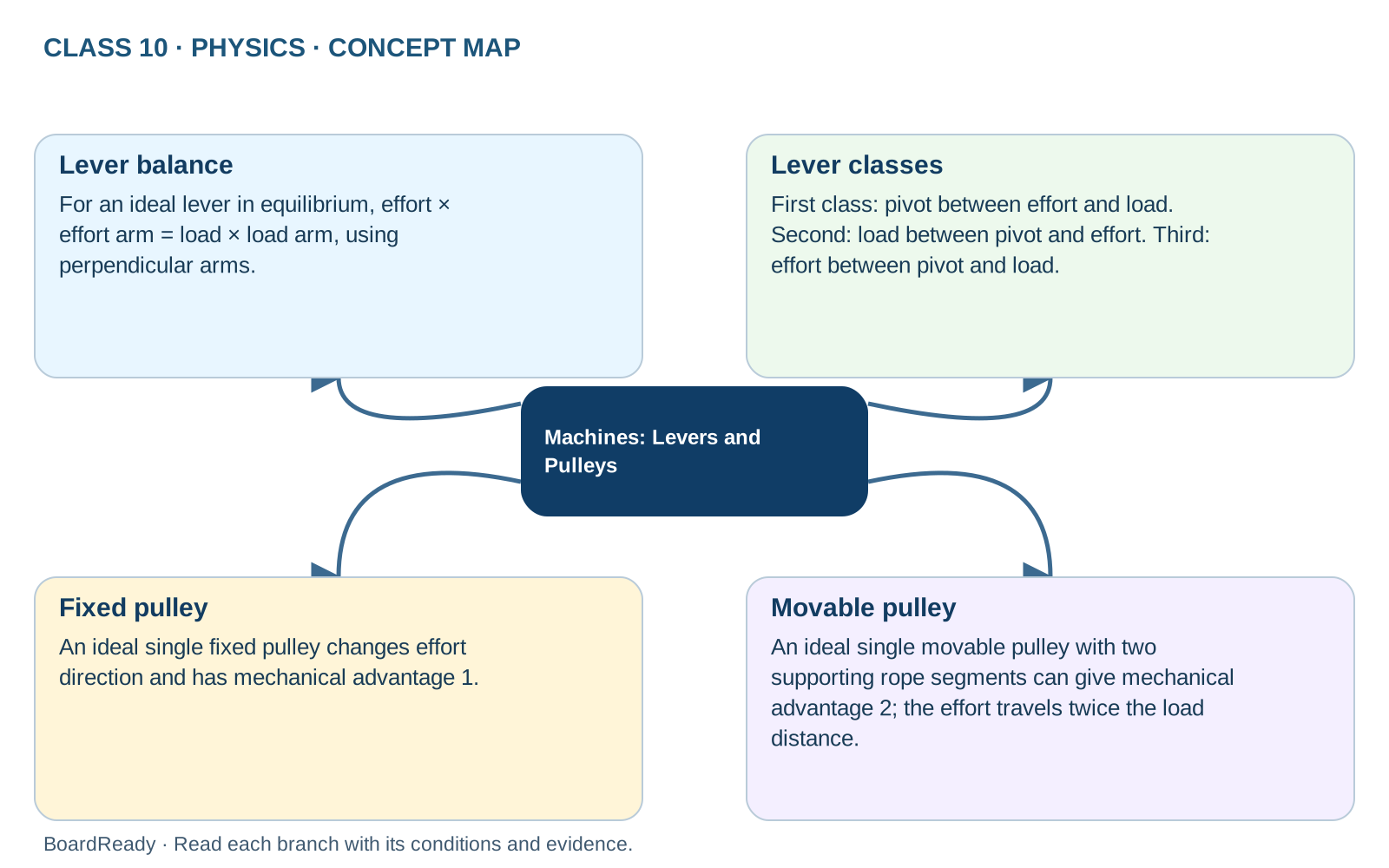
Comparison map
Machines: Levers and Pulleys: relationships and examples
A simple machine can trade effort distance for effort force or change force direction; it cannot create energy.Exam cue: Force advantage depends on the arm lengths. A third-class lever commonly gives a speed or distance advantage instead.
- 1Machines: Levers and Pulleys -> Lever balance: For an ideal lever in equilibrium, effort × effort arm = load × load arm, using perpendicular arms.
- 2Machines: Levers and Pulleys -> Lever classes: First class: pivot between effort and load. Second: load between pivot and effort. Third: effort between pivot and load.
- 3Machines: Levers and Pulleys -> Fixed pulley: An ideal single fixed pulley changes effort direction and has mechanical advantage 1.
- 4Machines: Levers and Pulleys -> Movable pulley: An ideal single movable pulley with two supporting rope segments can give mechanical advantage 2; the effort travels twice the load distance.