CompareLines, Angles, and Shapes
Lines, Angles, and Shapes: relationships and examples
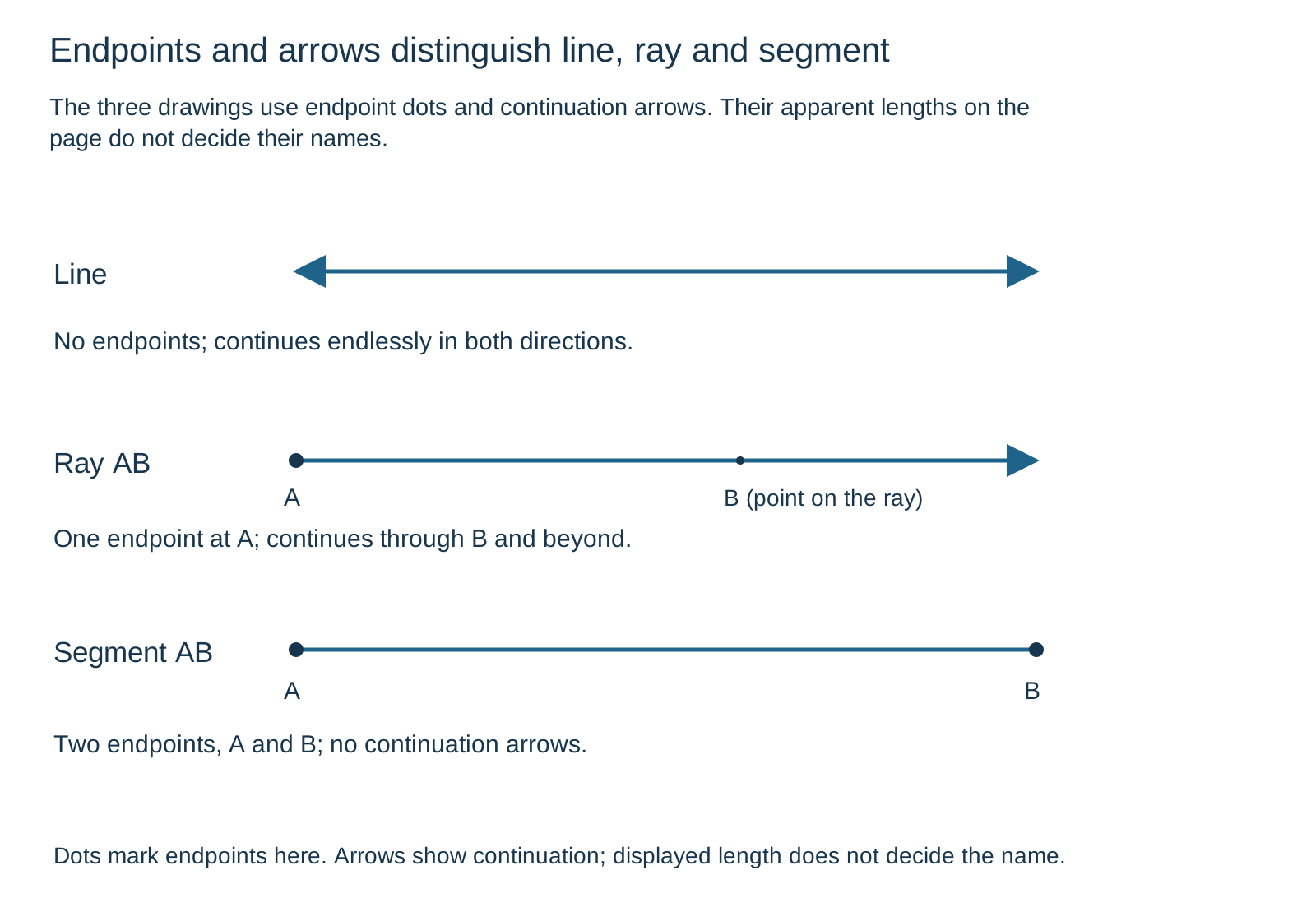
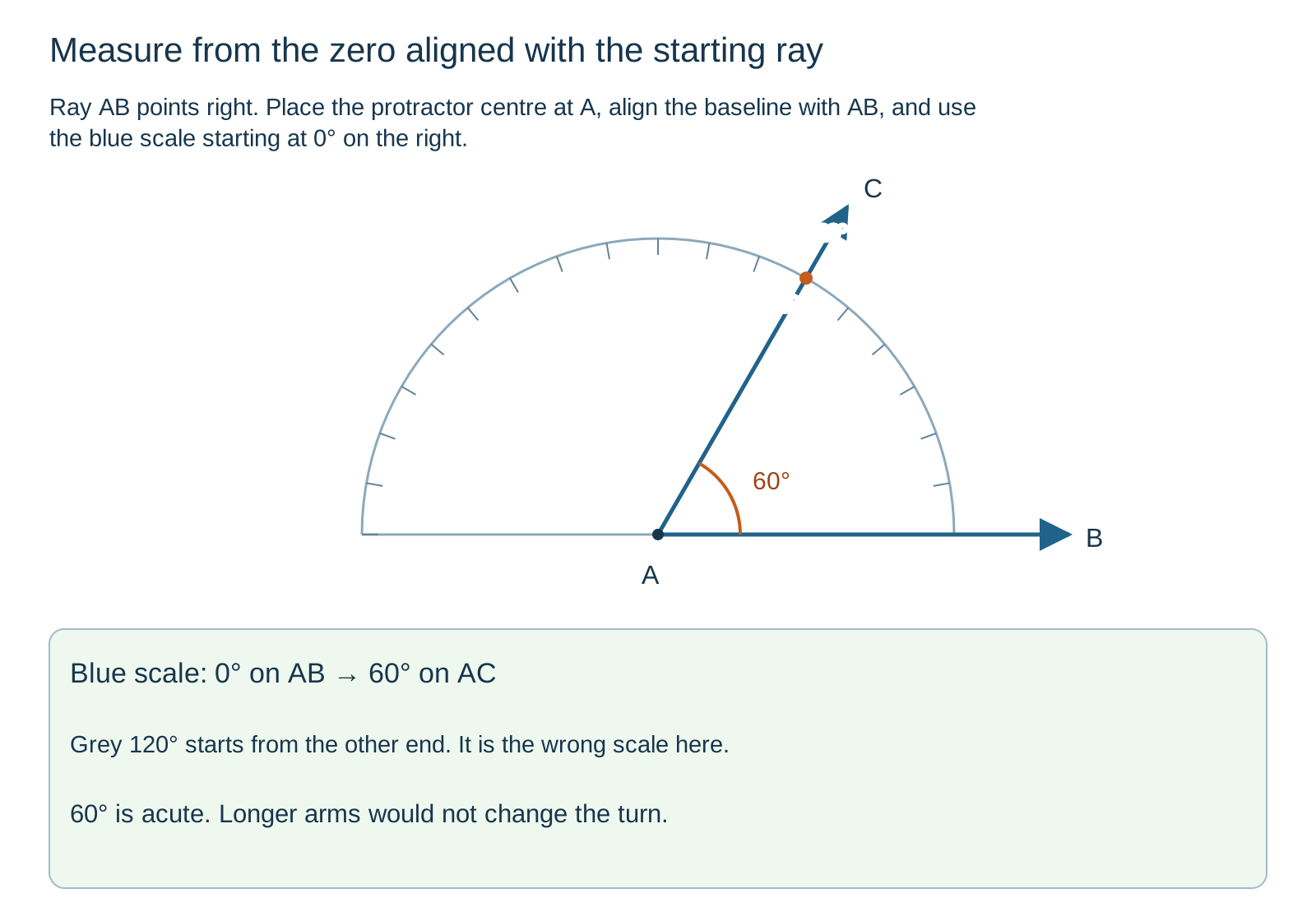
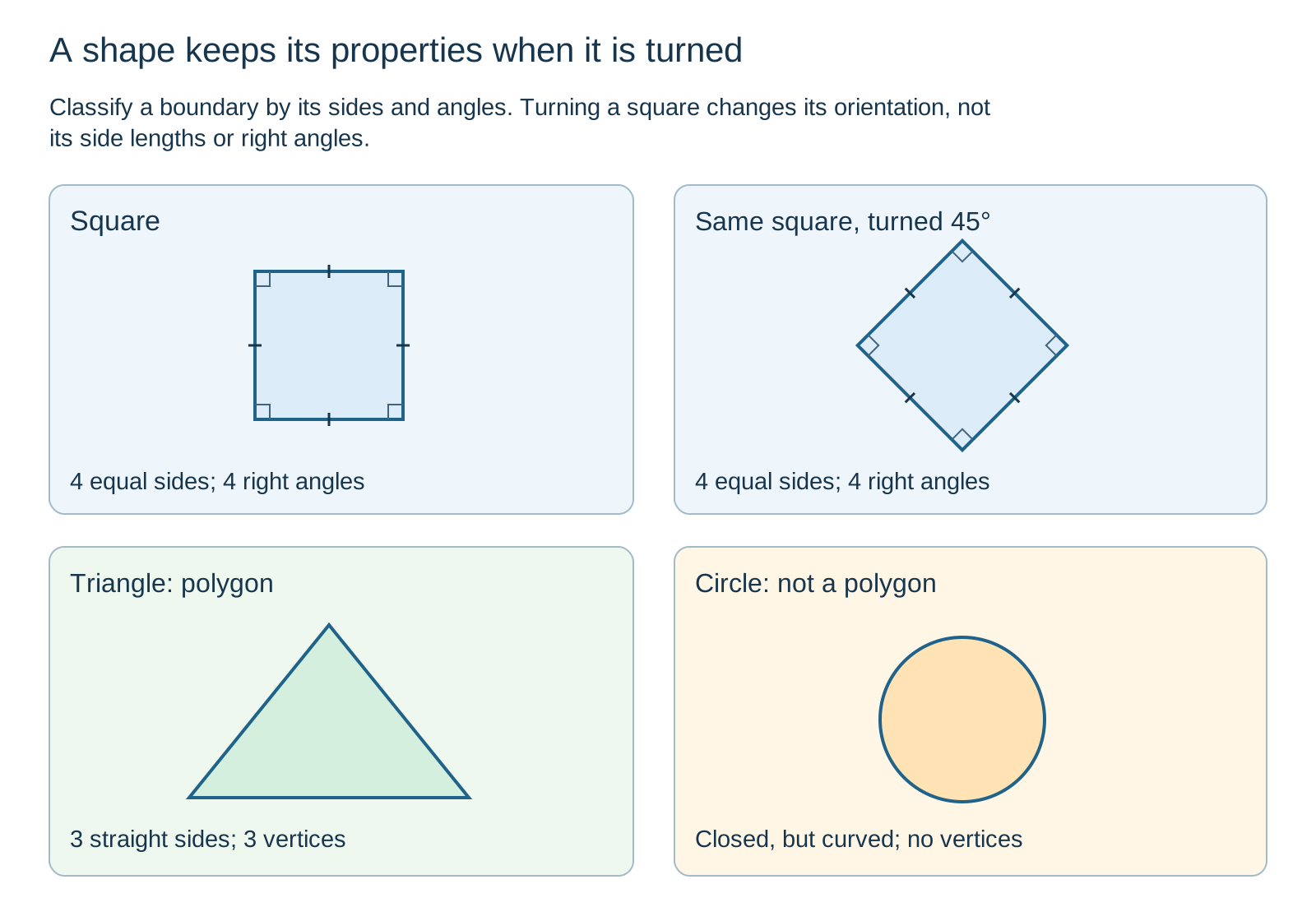
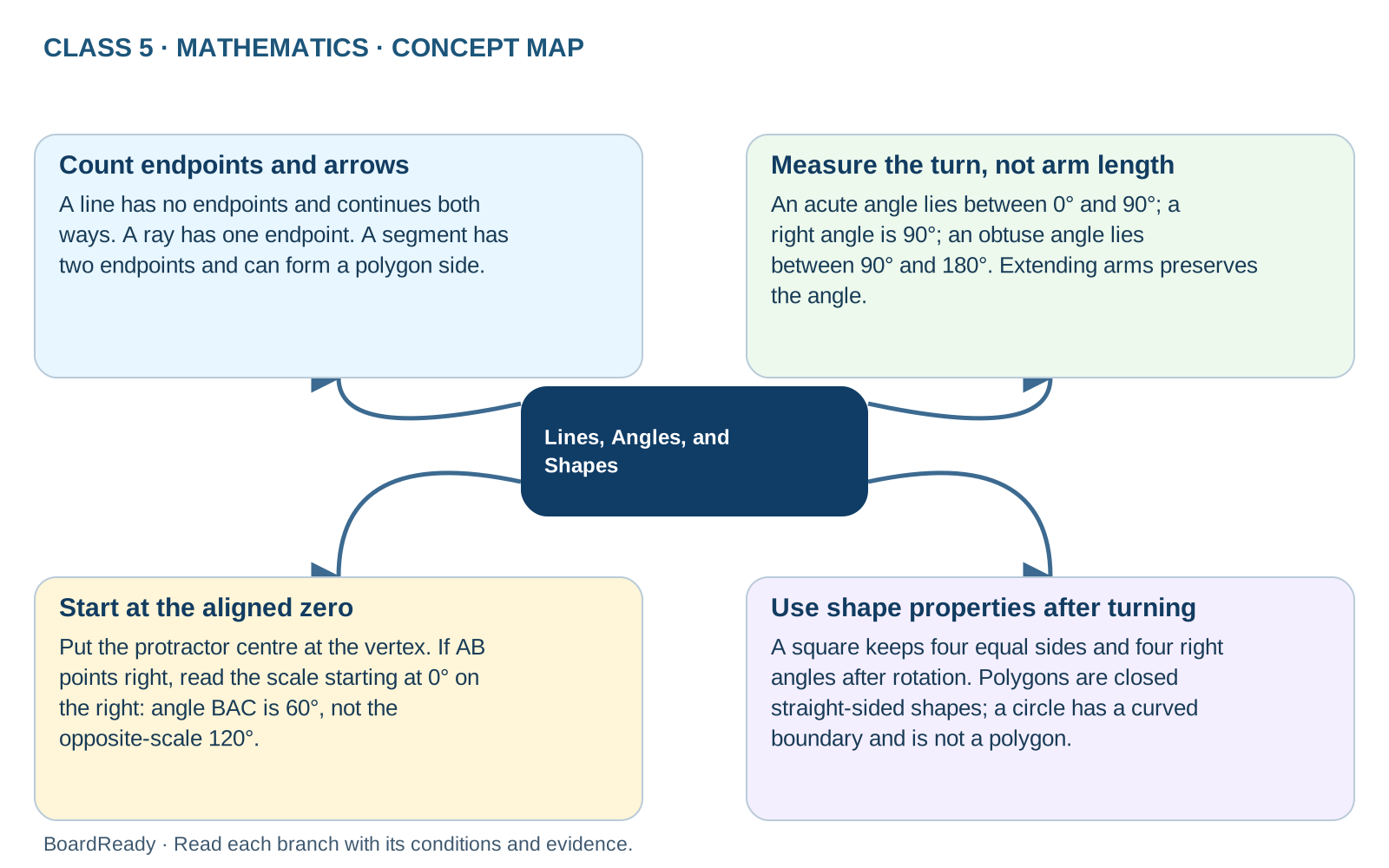
Use endpoints, angle turns and boundary properties to identify geometry; page orientation and arm length do not determine the answer. Count endpoints and arrows: A line has no endpoints and continues both ways. A ray has one endpoint. A segment has two endpoints and can form a polygon side. Measure the turn, not arm length: An acute angle lies between 0° and 90°; a right angle is 90°; an obtuse angle lies between 90° and 180°. Extending arms preserves the angle. Start at the aligned zero: Put the protractor centre at the vertex. If AB points right, read the scale starting at 0° on the right: angle BAC is 60°, not the opposite-scale 120°. Use shape properties after turning: A square keeps four equal sides and four right angles after rotation. Polygons are closed straight-sided shapes; a circle has a curved boundary and is not a polygon.Count endpoints and arrows
A line has no endpoints and continues both ways. A ray has one endpoint. A segment has two endpoints and can form a polygon side.Measure the turn, not arm length
An acute angle lies between 0° and 90°; a right angle is 90°; an obtuse angle lies between 90° and 180°. Extending arms preserves the angle.Check: State the property that justifies the name. For angles, estimate acute or obtuse before reading the protractor.