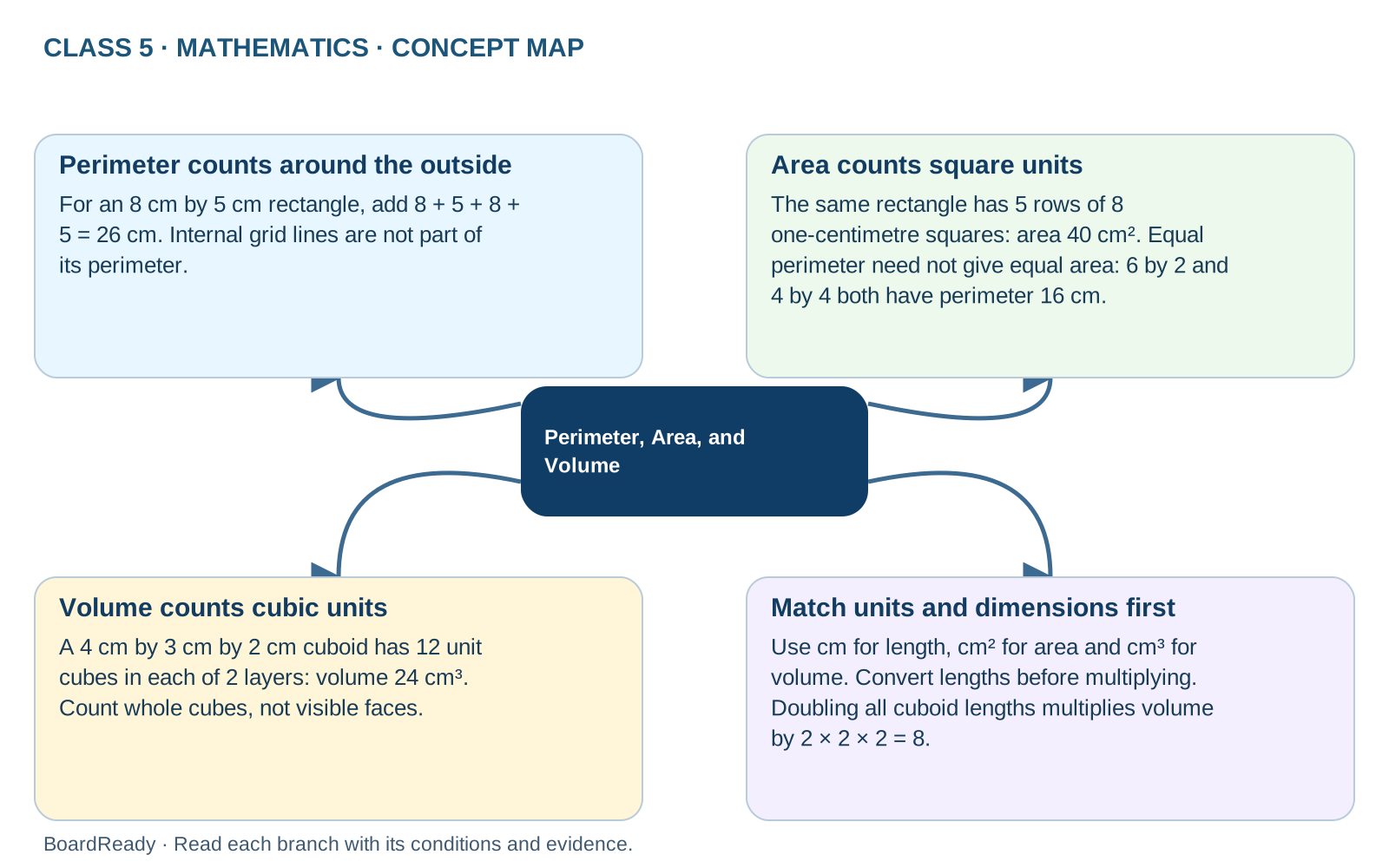
Comparison map
Perimeter, Area, and Volume: relationships and examples
Identify whether the question asks for boundary length, surface covering or occupied space, then count the matching kind of unit. Perimeter counts around the outside: For an 8 cm by 5 cm rectangle, add 8 + 5 + 8 + 5 = 26 cm. Internal grid lines are not part of its perimeter. Area counts square units: The same rectangle has 5 rows of 8 one-centimetre squares: area 40 cm². Equal perimeter need not give equal area: 6 by 2 and 4 by 4 both have perimeter 16 cm. Volume counts cubic units: A 4 cm by 3 cm by 2 cm cuboid has 12 unit cubes in each of 2 layers: volume 24 cm³. Count whole cubes, not visible faces. Match units and dimensions first: Use cm for length, cm² for area and cm³ for volume. Convert lengths before multiplying. Doubling all cuboid lengths multiplies volume by 2 × 2 × 2 = 8.Exam cue: Choose the measure before choosing the formula. Keep linear, square and cubic units distinct.
- 1Perimeter, Area, and Volume -> Perimeter counts around the outside: For an 8 cm by 5 cm rectangle, add 8 + 5 + 8 + 5 = 26 cm. Internal grid lines are not part of its perimeter.
- 2Perimeter, Area, and Volume -> Area counts square units: The same rectangle has 5 rows of 8 one-centimetre squares: area 40 cm². Equal perimeter need not give equal area: 6 by 2 and 4 by 4 both have perimeter 16 cm.
- 3Perimeter, Area, and Volume -> Volume counts cubic units: A 4 cm by 3 cm by 2 cm cuboid has 12 unit cubes in each of 2 layers: volume 24 cm³. Count whole cubes, not visible faces.
- 4Perimeter, Area, and Volume -> Match units and dimensions first: Use cm for length, cm² for area and cm³ for volume. Convert lengths before multiplying. Doubling all cuboid lengths multiplies volume by 2 × 2 × 2 = 8.