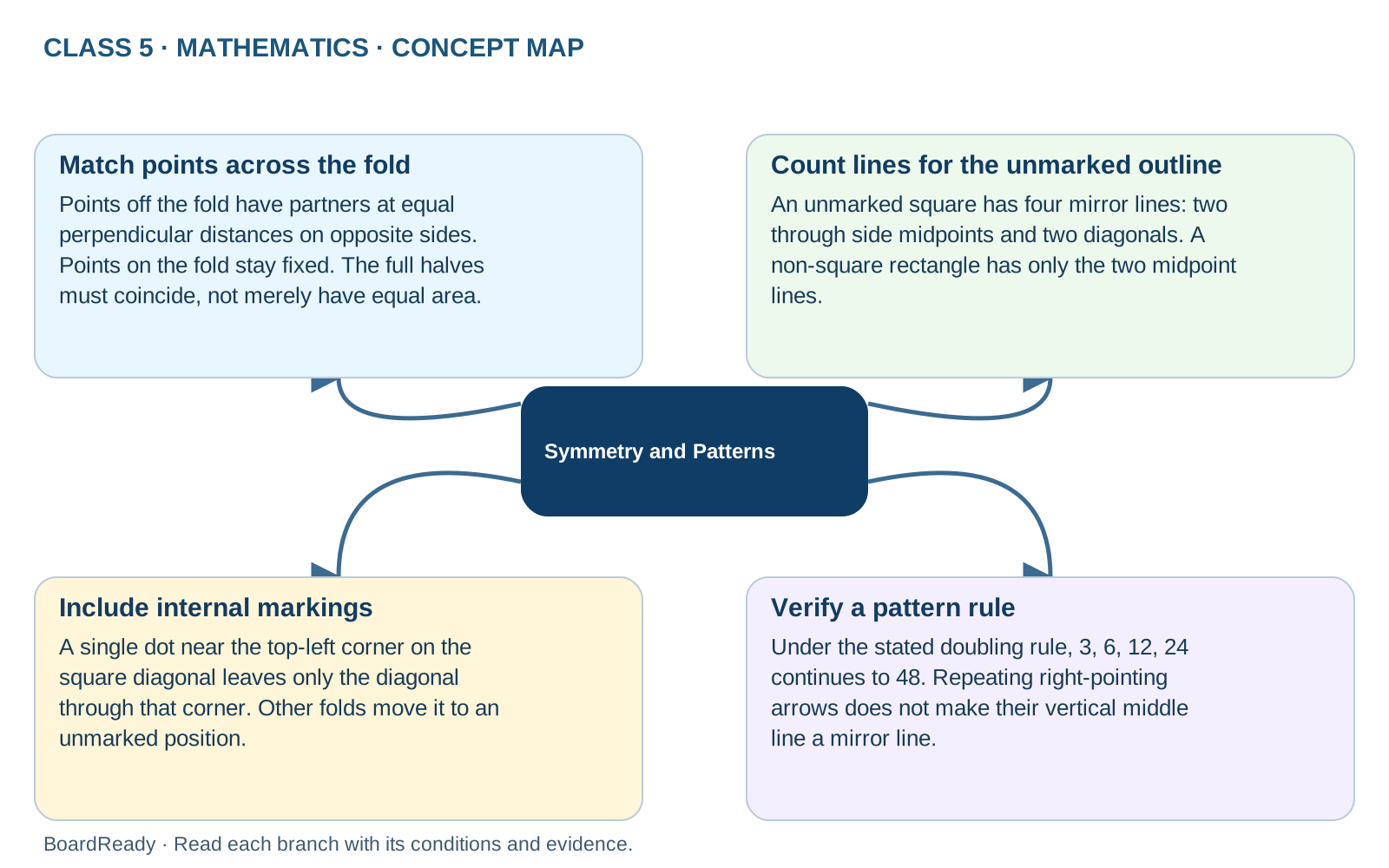
Comparison map
Symmetry and Patterns: relationships and examples
A mirror line must preserve the entire design. A pattern rule must explain every stated step; repetition alone does not prove reflection symmetry. Match points across the fold: Points off the fold have partners at equal perpendicular distances on opposite sides. Points on the fold stay fixed. The full halves must coincide, not merely have equal area. Count lines for the unmarked outline: An unmarked square has four mirror lines: two through side midpoints and two diagonals. A non-square rectangle has only the two midpoint lines. Include internal markings: A single dot near the top-left corner on the square diagonal leaves only the diagonal through that corner. Other folds move it to an unmarked position. Verify a pattern rule: Under the stated doubling rule, 3, 6, 12, 24 continues to 48. Repeating right-pointing arrows does not make their vertical middle line a mirror line.Exam cue: For symmetry, test every part of the design. For patterns, state the rule and check it at every step.
- 1Symmetry and Patterns -> Match points across the fold: Points off the fold have partners at equal perpendicular distances on opposite sides. Points on the fold stay fixed. The full halves must coincide, not merely have equal area.
- 2Symmetry and Patterns -> Count lines for the unmarked outline: An unmarked square has four mirror lines: two through side midpoints and two diagonals. A non-square rectangle has only the two midpoint lines.
- 3Symmetry and Patterns -> Include internal markings: A single dot near the top-left corner on the square diagonal leaves only the diagonal through that corner. Other folds move it to an unmarked position.
- 4Symmetry and Patterns -> Verify a pattern rule: Under the stated doubling rule, 3, 6, 12, 24 continues to 48. Repeating right-pointing arrows does not make their vertical middle line a mirror line.