Comparison map
Measurement and Unit Conversion: relationships and examples
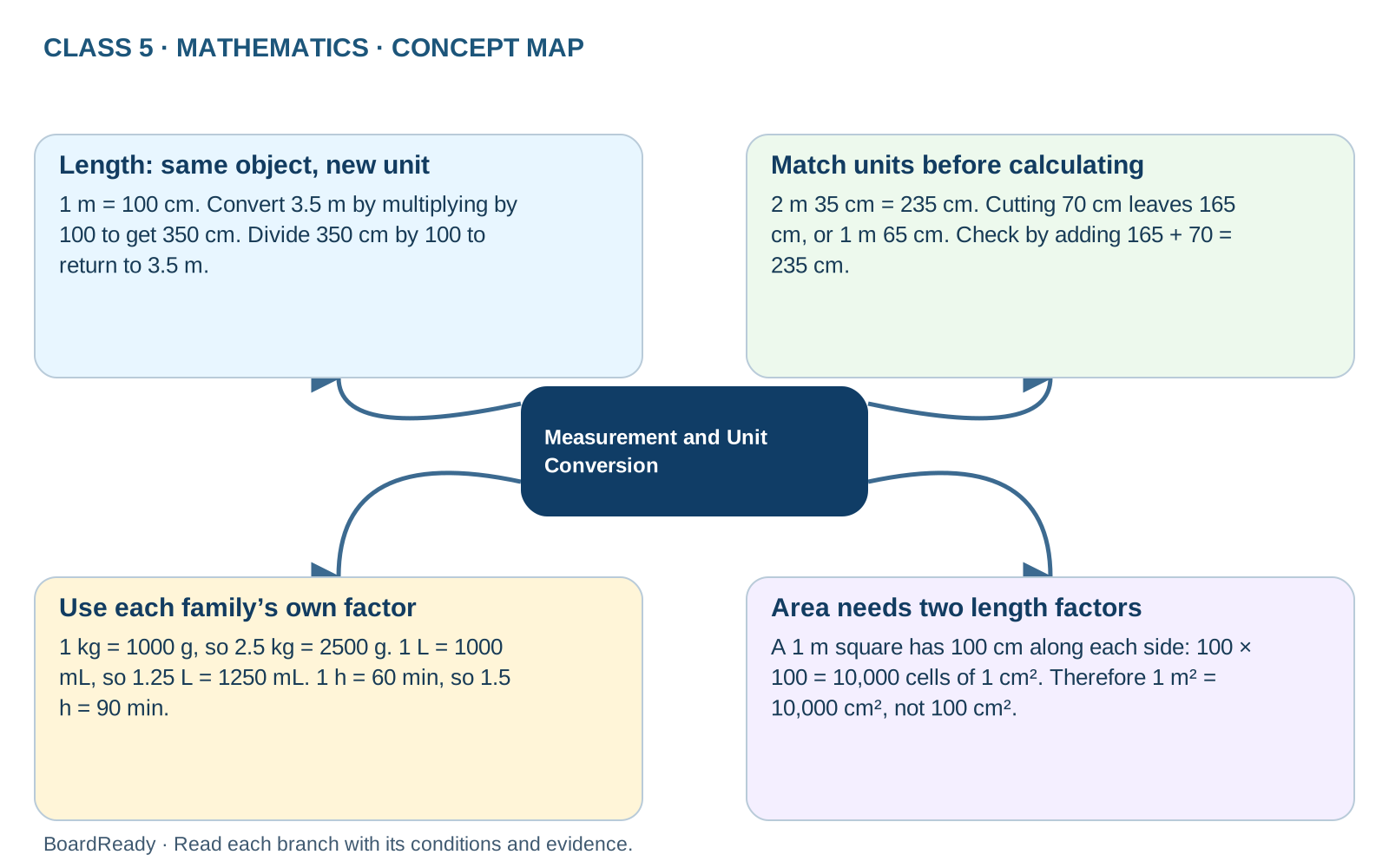
Keep the physical quantity fixed, use its correct unit relationship, and match units before adding, subtracting or comparing. Length: same object, new unit: 1 m = 100 cm. Convert 3.5 m by multiplying by 100 to get 350 cm. Divide 350 cm by 100 to return to 3.5 m. Match units before calculating: 2 m 35 cm = 235 cm. Cutting 70 cm leaves 165 cm, or 1 m 65 cm. Check by adding 165 + 70 = 235 cm. Use each family’s own factor: 1 kg = 1000 g, so 2.5 kg = 2500 g. 1 L = 1000 mL, so 1.25 L = 1250 mL. 1 h = 60 min, so 1.5 h = 90 min. Area needs two length factors: A 1 m square has 100 cm along each side: 100 × 100 = 10,000 cells of 1 cm². Therefore 1 m² = 10,000 cm², not 100 cm².Exam cue: State the relationship first. A smaller unit gives a larger numerical count for the same positive quantity; area needs the factor twice.
- 1Measurement and Unit Conversion -> Length: same object, new unit: 1 m = 100 cm. Convert 3.5 m by multiplying by 100 to get 350 cm. Divide 350 cm by 100 to return to 3.5 m.
- 2Measurement and Unit Conversion -> Match units before calculating: 2 m 35 cm = 235 cm. Cutting 70 cm leaves 165 cm, or 1 m 65 cm. Check by adding 165 + 70 = 235 cm.
- 3Measurement and Unit Conversion -> Use each family’s own factor: 1 kg = 1000 g, so 2.5 kg = 2500 g. 1 L = 1000 mL, so 1.25 L = 1250 mL. 1 h = 60 min, so 1.5 h = 90 min.
- 4Measurement and Unit Conversion -> Area needs two length factors: A 1 m square has 100 cm along each side: 100 × 100 = 10,000 cells of 1 cm². Therefore 1 m² = 10,000 cm², not 100 cm².