DiagramConventional Sources of Energy
A thermal station transfers energy through several stages
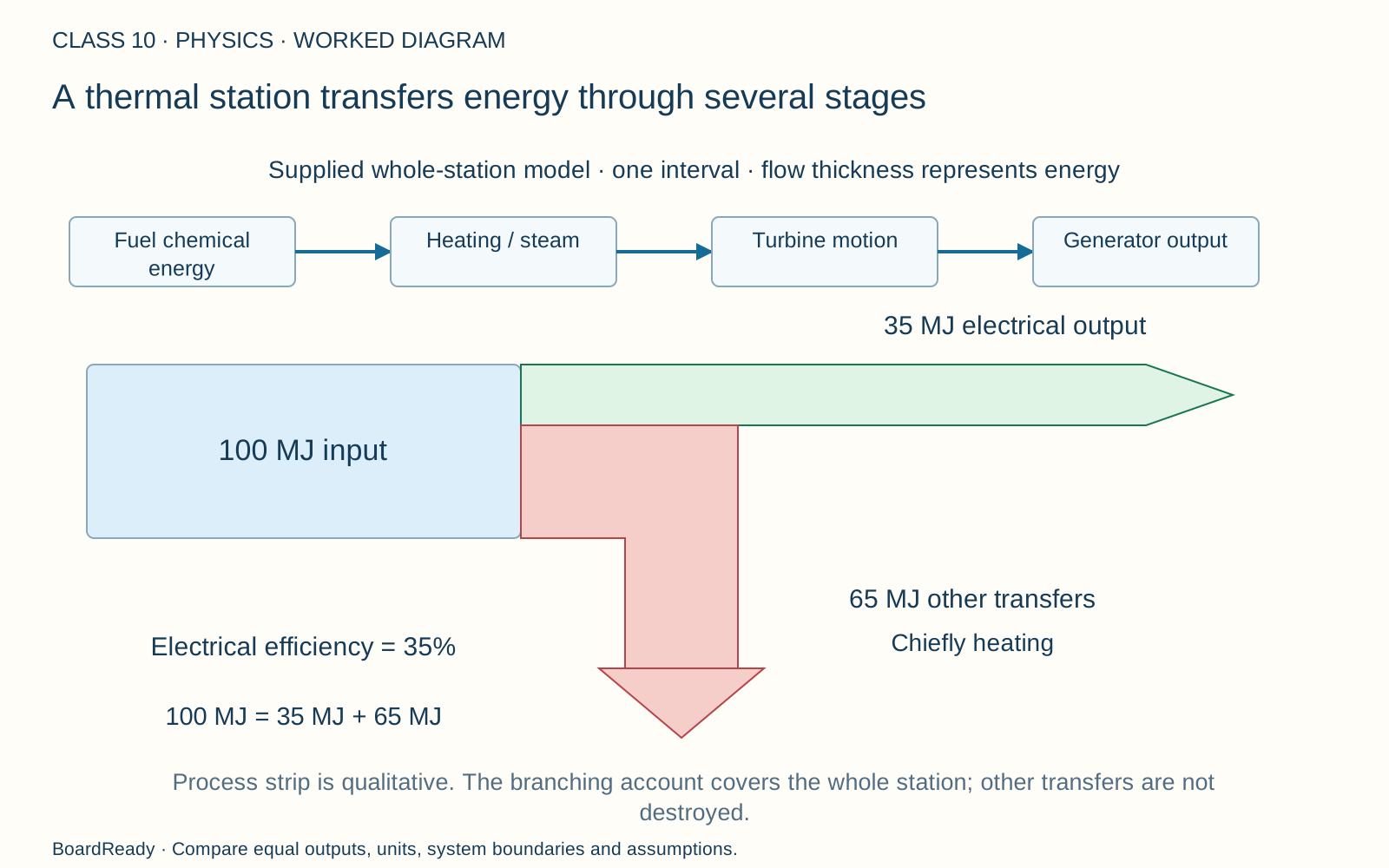
A whole-station energy account separates electrical output from other transfers. A supplied thermal-station model receives 100 MJ of fuel chemical energy and delivers 35 MJ of electrical energy in one interval. The remaining 65 MJ is accounted for in other transfers, chiefly heating cooling systems and surroundings; it is not destroyed. The qualitative process strip links fuel, heating and steam, turbine motion and generator output. A separate whole-station flow account has an incoming band 200 drawing units thick, a useful-output band 70 units thick and an other-transfer branch 130 units thick, representing the 100:35:65 energy ratios. The branching account does not locate each individual loss inside the plant. Electrical efficiency is 35/100 = 35%.Read the worked diagram
A supplied thermal-station model receives 100 MJ of fuel chemical energy and delivers 35 MJ of electrical energy in one interval. The remaining 65 MJ is accounted for in other transfers, chiefly heating cooling systems and surroundings; it is not destroyed. The qualitative process strip links fuel, heating and steam, turbine motion and generator output. A separate whole-station flow account has an incoming band 200 drawing units thick, a useful-output band 70 units thick and an other-transfer branch 130 units thick, representing the 100:35:65 energy ratios. The branching account does not locate each individual loss inside the plant. Electrical efficiency is 35/100 = 35%.Check: Electricity is an energy carrier. A generator receives mechanical input in this pathway; it does not directly convert all fuel chemical energy into electrical output.