Comparison map
Sources of Energy Review: relationships and examples
Compare energy sources using delivered energy, time variation and explicitly matched environmental boundaries. Renewable does not mean continuous or impact-free.Exam cue: These are supplied hypothetical inputs, not measured technology rankings. Compare equal delivered energy and the same lifecycle boundary; distinguish source, carrier and storage.
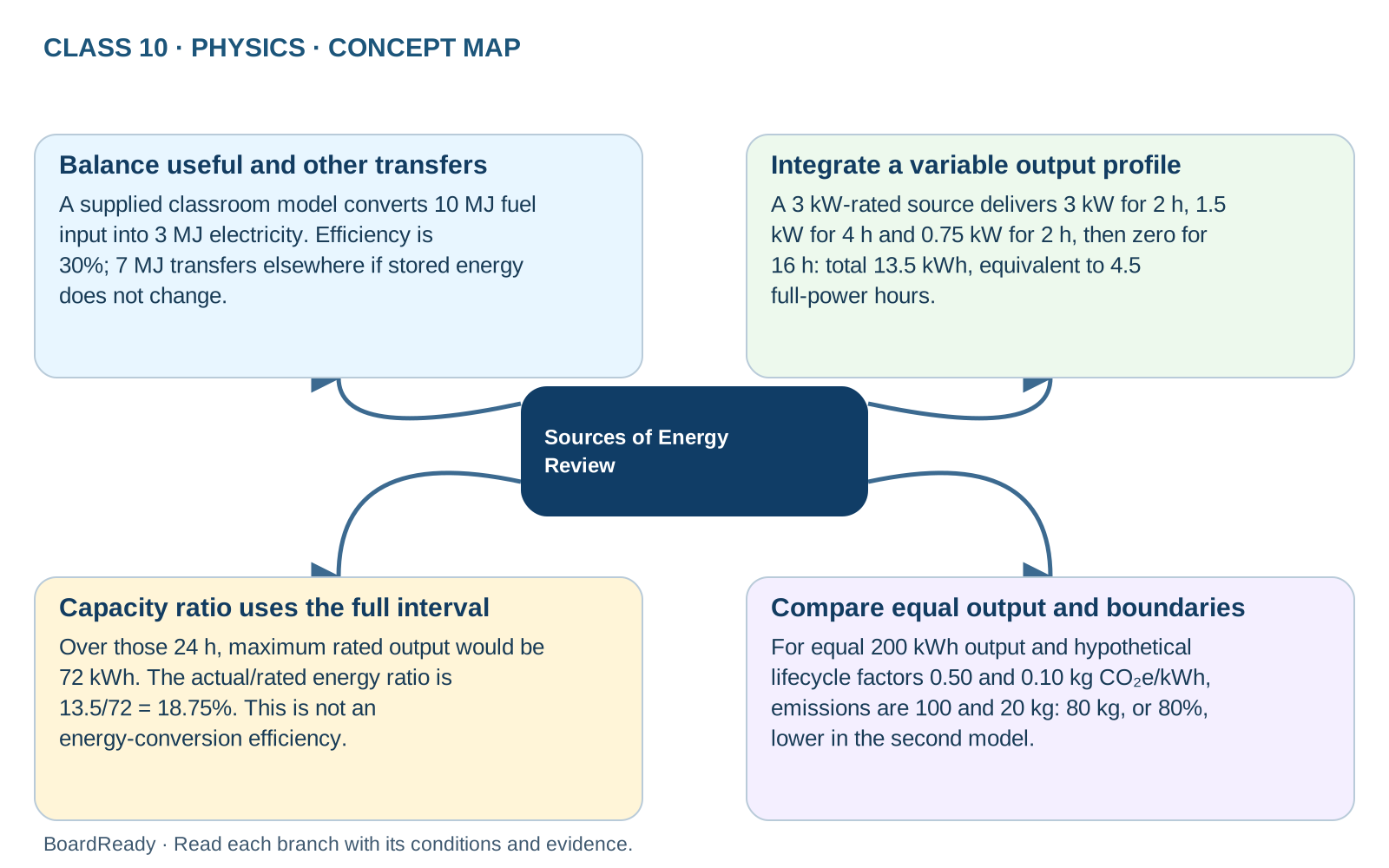
- 1Sources of Energy Review -> Balance useful and other transfers: A supplied classroom model converts 10 MJ fuel input into 3 MJ electricity. Efficiency is 30%; 7 MJ transfers elsewhere if stored energy does not change.
- 2Sources of Energy Review -> Integrate a variable output profile: A 3 kW-rated source delivers 3 kW for 2 h, 1.5 kW for 4 h and 0.75 kW for 2 h, then zero for 16 h: total 13.5 kWh, equivalent to 4.5 full-power hours.
- 3Sources of Energy Review -> Capacity ratio uses the full interval: Over those 24 h, maximum rated output would be 72 kWh. The actual/rated energy ratio is 13.5/72 = 18.75%. This is not an energy-conversion efficiency.
- 4Sources of Energy Review -> Compare equal output and boundaries: For equal 200 kWh output and hypothetical lifecycle factors 0.50 and 0.10 kg CO₂e/kWh, emissions are 100 and 20 kg: 80 kg, or 80%, lower in the second model.