Comparison map
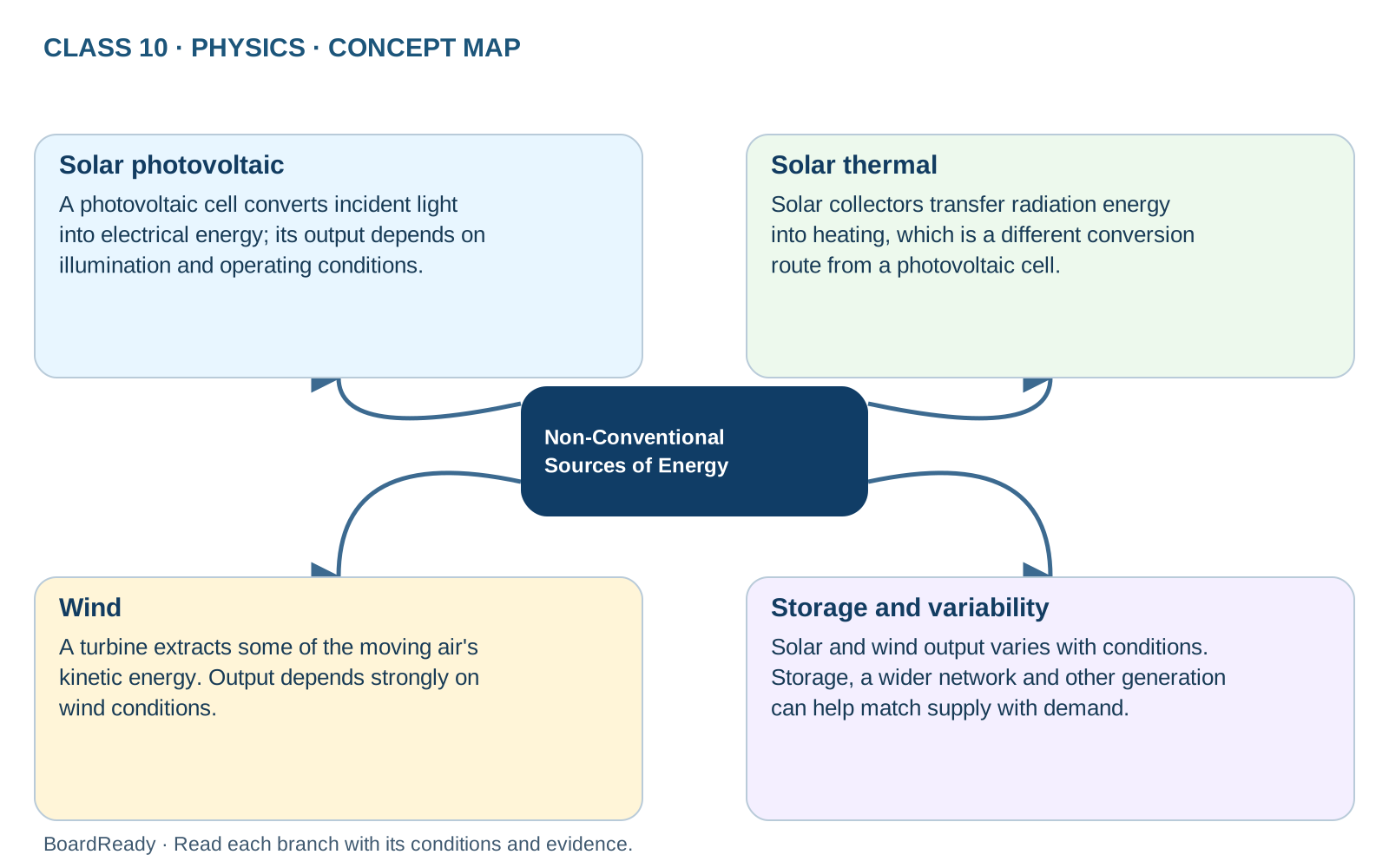
Non-Conventional Sources of Energy: relationships and examples
Renewable energy sources have different operating patterns. Compare availability, conversion method and storage needs rather than assuming continuous output.Exam cue: Renewability concerns replenishment of the resource. Output variability, construction materials and land use are separate considerations.
- 1Non-Conventional Sources of Energy -> Solar photovoltaic: A photovoltaic cell converts incident light into electrical energy; its output depends on illumination and operating conditions.
- 2Non-Conventional Sources of Energy -> Solar thermal: Solar collectors transfer radiation energy into heating, which is a different conversion route from a photovoltaic cell.
- 3Non-Conventional Sources of Energy -> Wind: A turbine extracts some of the moving air's kinetic energy. Output depends strongly on wind conditions.
- 4Non-Conventional Sources of Energy -> Storage and variability: Solar and wind output varies with conditions. Storage, a wider network and other generation can help match supply with demand.