DiagramStructure of the Nucleus
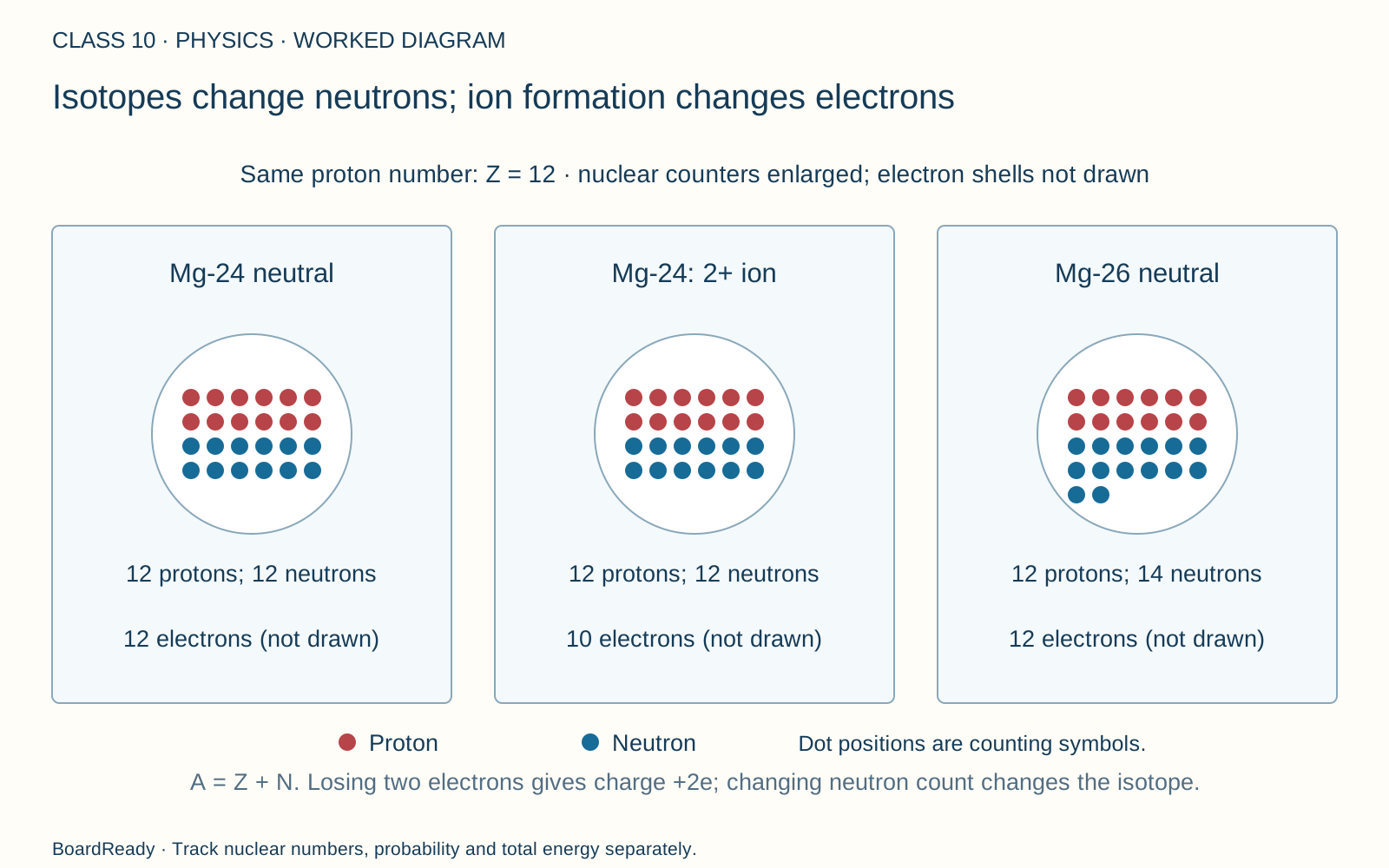
Isotopes change neutrons; ion formation changes electrons
Count protons, neutrons and electrons separately. Three magnesium examples compare a neutral magnesium-24 atom, its 2+ ion and a neutral magnesium-26 atom. All have 12 protons. Both magnesium-24 examples have 12 neutrons; magnesium-26 has 14 neutrons. The neutral atoms have 12 electrons each, while the 2+ ion has 10 electrons after losing two. The nuclear counters show exactly 12 proton dots and 12 or 14 neutron dots. Their positions are counting symbols, not measured arrangements or relative particle sizes; electrons and electron shells are not drawn. Ordinary ion formation in this example leaves the nucleus unchanged.Read the worked diagram
Three magnesium examples compare a neutral magnesium-24 atom, its 2+ ion and a neutral magnesium-26 atom. All have 12 protons. Both magnesium-24 examples have 12 neutrons; magnesium-26 has 14 neutrons. The neutral atoms have 12 electrons each, while the 2+ ion has 10 electrons after losing two. The nuclear counters show exactly 12 proton dots and 12 or 14 neutron dots. Their positions are counting symbols, not measured arrangements or relative particle sizes; electrons and electron shells are not drawn. Ordinary ion formation in this example leaves the nucleus unchanged.Check: Use A = Z + N and ion charge = proton count − electron count, in units of positive elementary charge. Changing neutron count makes an isotope; it does not by itself make an ion.