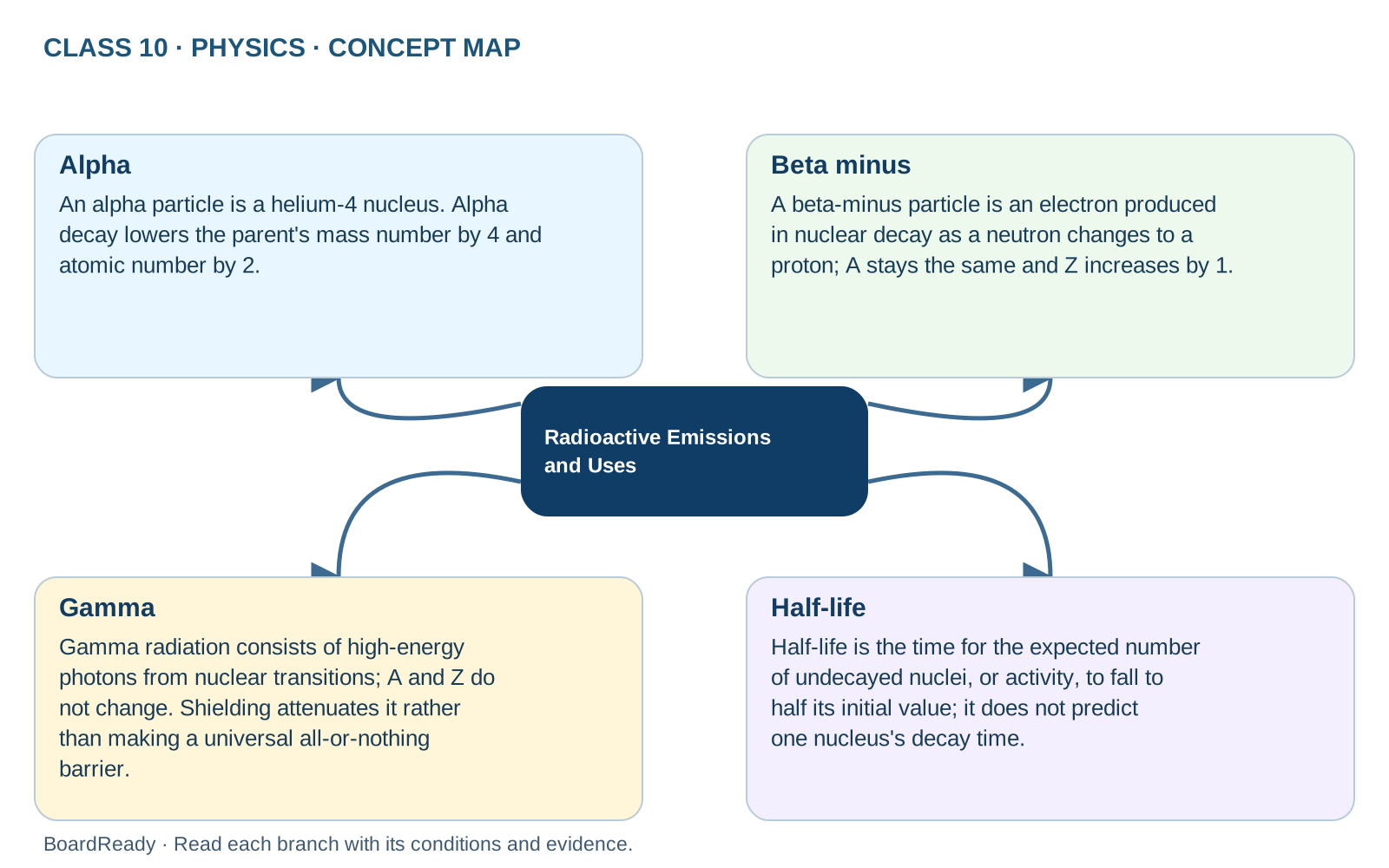
Comparison map
Radioactive Emissions and Uses: relationships and examples
Unstable nuclei can emit particles or photons. Identify an emission by its nuclear change and properties, not by penetration alone.Exam cue: Alpha emitters can cause serious internal exposure if inhaled or ingested. Low penetration is not the same as absence of hazard.
- 1Radioactive Emissions and Uses -> Alpha: An alpha particle is a helium-4 nucleus. Alpha decay lowers the parent's mass number by 4 and atomic number by 2.
- 2Radioactive Emissions and Uses -> Beta minus: A beta-minus particle is an electron produced in nuclear decay as a neutron changes to a proton; A stays the same and Z increases by 1.
- 3Radioactive Emissions and Uses -> Gamma: Gamma radiation consists of high-energy photons from nuclear transitions; A and Z do not change. Shielding attenuates it rather than making a universal all-or-nothing barrier.
- 4Radioactive Emissions and Uses -> Half-life: Half-life is the time for the expected number of undecayed nuclei, or activity, to fall to half its initial value; it does not predict one nucleus's decay time.