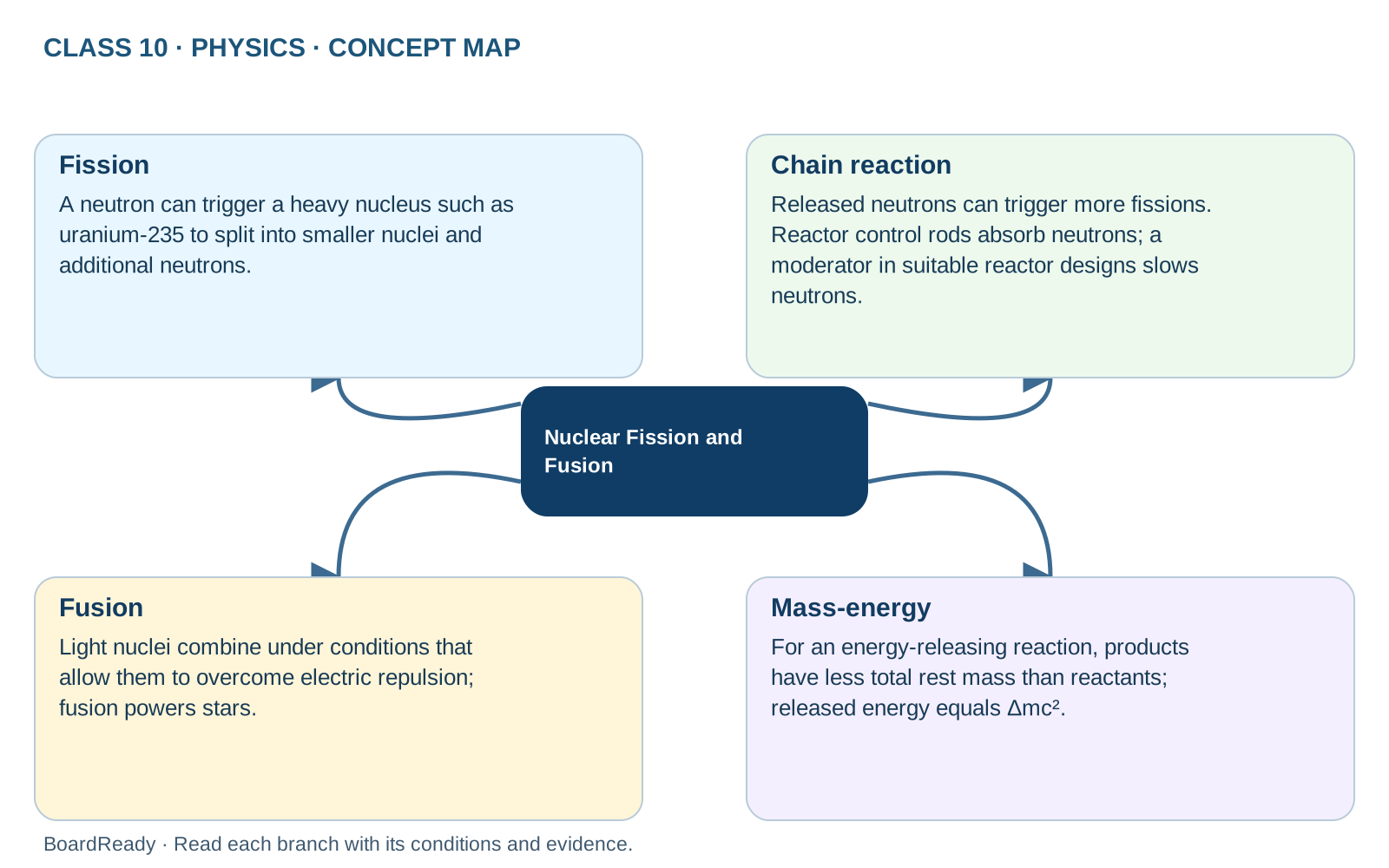
Comparison map
Nuclear Fission and Fusion: relationships and examples
Fission divides a heavy nucleus; fusion joins light nuclei. Energy release depends on the change in total mass-energy of the specified reaction.Exam cue: Control rods absorb neutrons to regulate the chain reaction. A moderator slows neutrons in reactor designs that use thermal neutrons.
- 1Nuclear Fission and Fusion -> Fission: A neutron can trigger a heavy nucleus such as uranium-235 to split into smaller nuclei and additional neutrons.
- 2Nuclear Fission and Fusion -> Chain reaction: Released neutrons can trigger more fissions. Reactor control rods absorb neutrons; a moderator in suitable reactor designs slows neutrons.
- 3Nuclear Fission and Fusion -> Fusion: Light nuclei combine under conditions that allow them to overcome electric repulsion; fusion powers stars.
- 4Nuclear Fission and Fusion -> Mass-energy: For an energy-releasing reaction, products have less total rest mass than reactants; released energy equals Δmc².