DiagramHuman Eye and Vision Defects
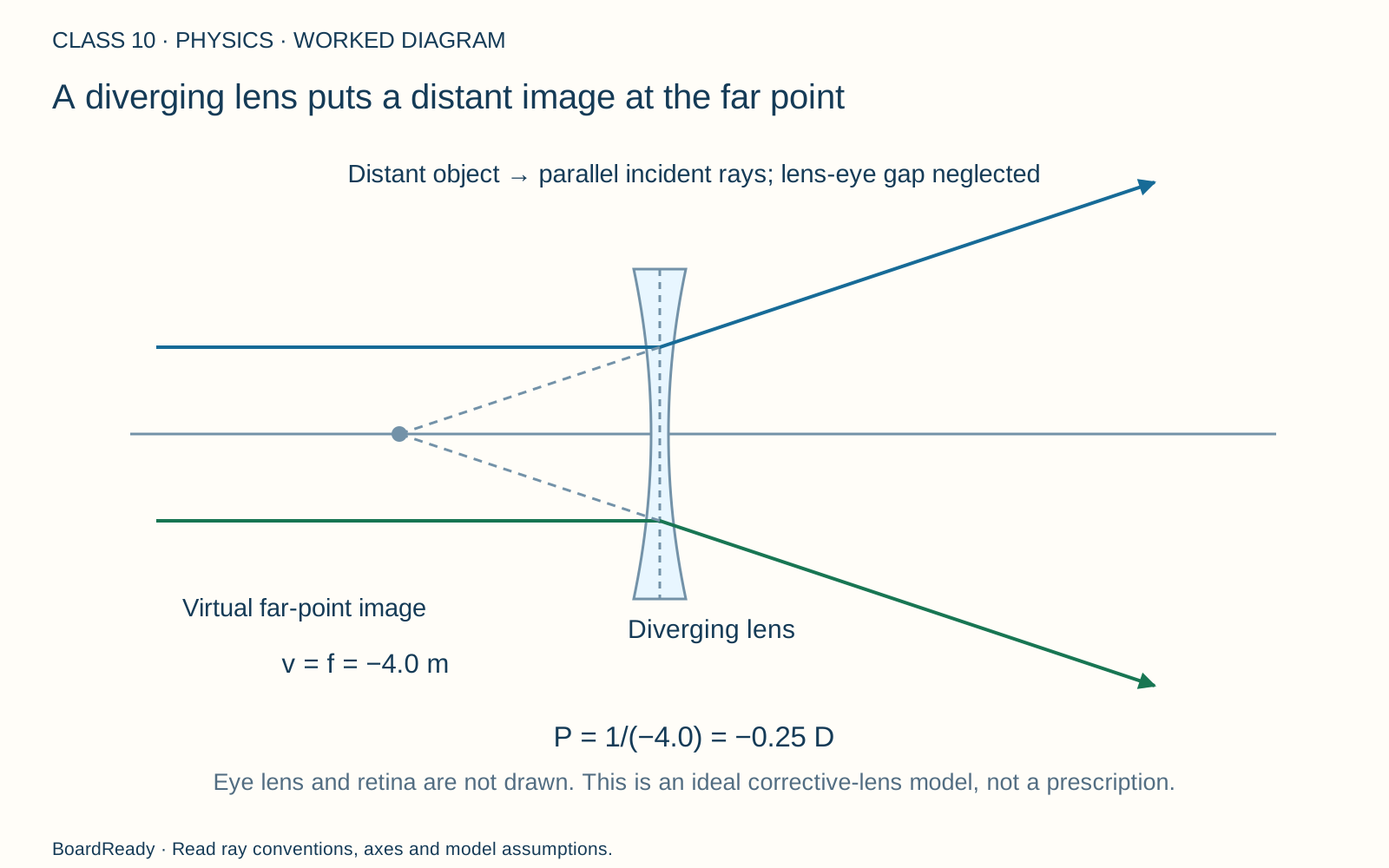
A diverging lens puts a distant image at the far point
Backward extensions locate the corrective-lens image at the eye’s far point. For a myopic far point 4.0 m in front of the eye, a distant object supplies parallel incident rays. Ignoring lens-eye separation, a correcting diverging lens must form a virtual image at v = −4.0 m, so f = −4.0 m and P = −0.25 D. Solid outgoing rays diverge; dashed backward extensions meet at the virtual far-point image. The eye’s own lens and retina are not drawn. This model places the correcting lens’s virtual image at the eye’s far point; it does not draw the subsequent retinal image or provide a clinical prescription.Read the worked diagram
For a myopic far point 4.0 m in front of the eye, a distant object supplies parallel incident rays. Ignoring lens-eye separation, a correcting diverging lens must form a virtual image at v = −4.0 m, so f = −4.0 m and P = −0.25 D. Solid outgoing rays diverge; dashed backward extensions meet at the virtual far-point image. The eye’s own lens and retina are not drawn. This model places the correcting lens’s virtual image at the eye’s far point; it does not draw the subsequent retinal image or provide a clinical prescription.Check: A virtual corrective-lens image can be the object for the eye, which then forms a real retinal image. Keep those two image-forming systems distinct.