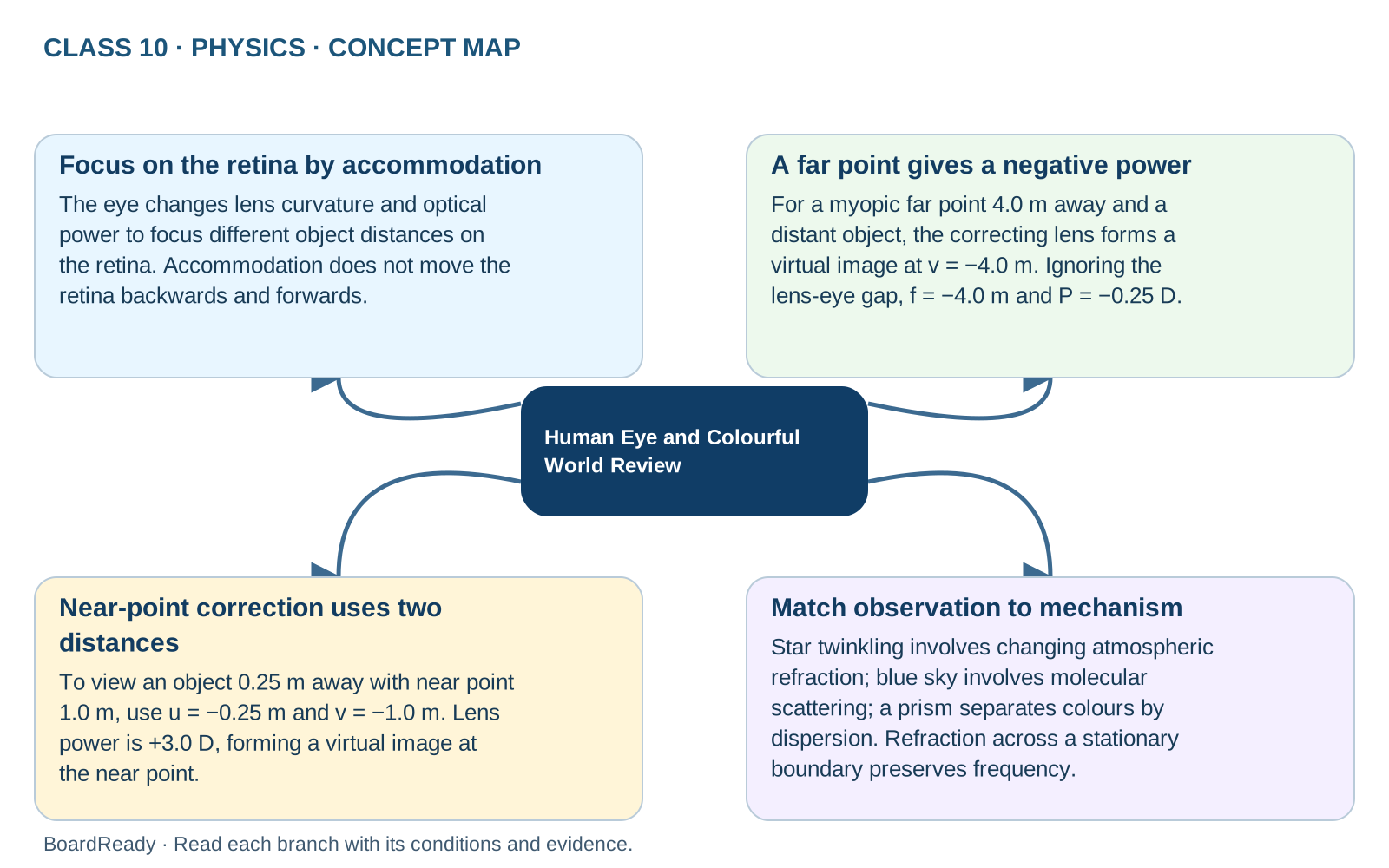
Comparison map
Human Eye and Colourful World Review: relationships and examples
Connect accommodation, corrective lens power and atmospheric optics while separating frequency, wavelength and the cause of an observation.Exam cue: Use ideal thin-lens models with negligible lens-eye separation, not clinical prescriptions. State why the corrective image must be virtual.
- 1Human Eye and Colourful World Review -> Focus on the retina by accommodation: The eye changes lens curvature and optical power to focus different object distances on the retina. Accommodation does not move the retina backwards and forwards.
- 2Human Eye and Colourful World Review -> A far point gives a negative power: For a myopic far point 4.0 m away and a distant object, the correcting lens forms a virtual image at v = −4.0 m. Ignoring the lens-eye gap, f = −4.0 m and P = −0.25 D.
- 3Human Eye and Colourful World Review -> Near-point correction uses two distances: To view an object 0.25 m away with near point 1.0 m, use u = −0.25 m and v = −1.0 m. Lens power is +3.0 D, forming a virtual image at the near point.
- 4Human Eye and Colourful World Review -> Match observation to mechanism: Star twinkling involves changing atmospheric refraction; blue sky involves molecular scattering; a prism separates colours by dispersion. Refraction across a stationary boundary preserves frequency.