Comparison map
Electric Current and Potential Difference: relationships and examples
Current is the rate of charge flow through a section; potential difference is energy transferred per unit charge between two points.Exam cue: In steady operation charge is conserved. The lamp transfers electrical energy while the same current enters and leaves its branch.
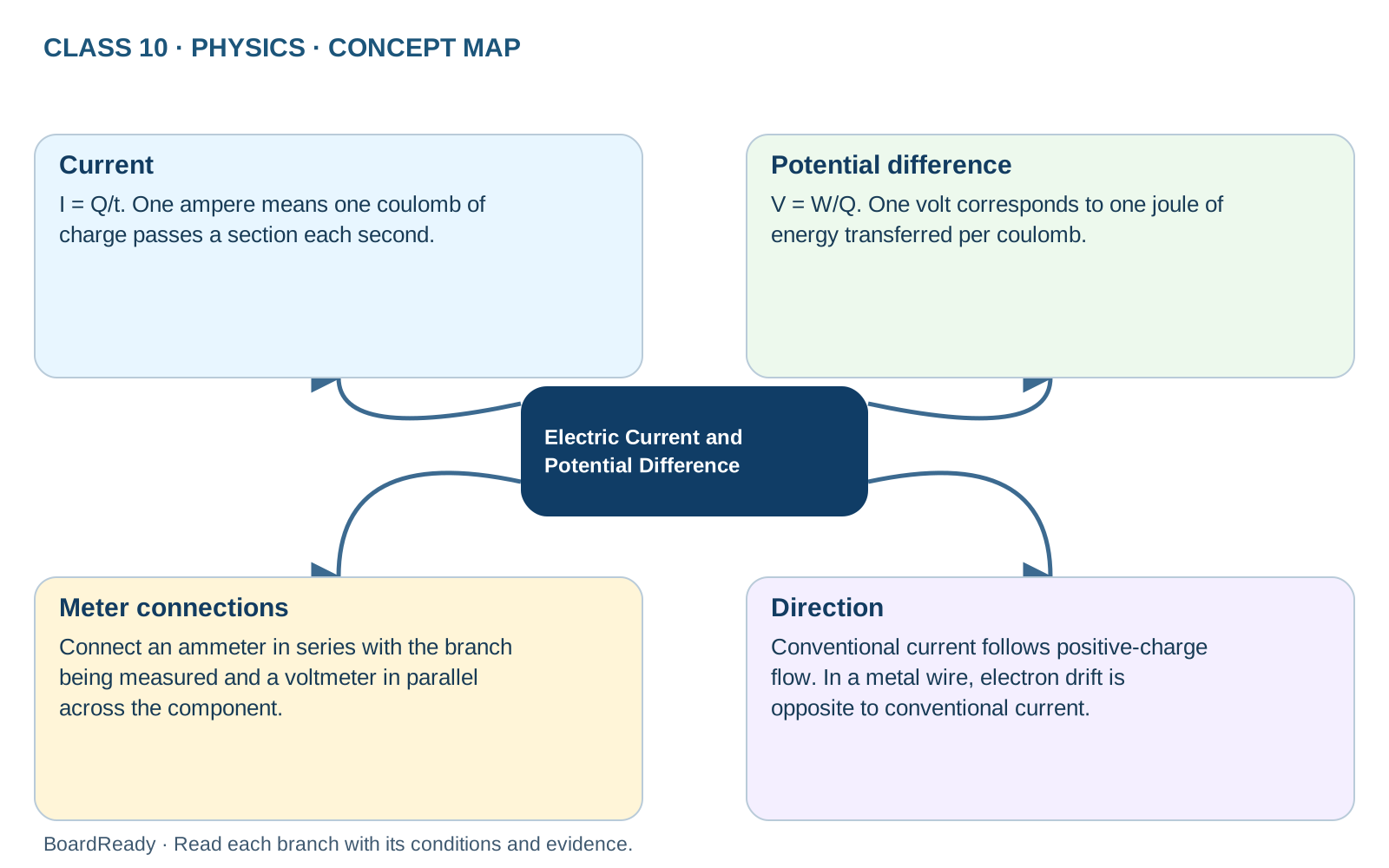
- 1Electric Current and Potential Difference -> Current: I = Q/t. One ampere means one coulomb of charge passes a section each second.
- 2Electric Current and Potential Difference -> Potential difference: V = W/Q. One volt corresponds to one joule of energy transferred per coulomb.
- 3Electric Current and Potential Difference -> Meter connections: Connect an ammeter in series with the branch being measured and a voltmeter in parallel across the component.
- 4Electric Current and Potential Difference -> Direction: Conventional current follows positive-charge flow. In a metal wire, electron drift is opposite to conventional current.