Comparison map
Dispersion and Atmospheric Refraction: relationships and examples
Dispersion, refraction through varying air and scattering are distinct processes that explain different colour and position effects.Exam cue: Refraction changes ray direction at or through an index change; dispersion separates wavelengths through index differences; scattering redirects light through interactions with particles or molecules.
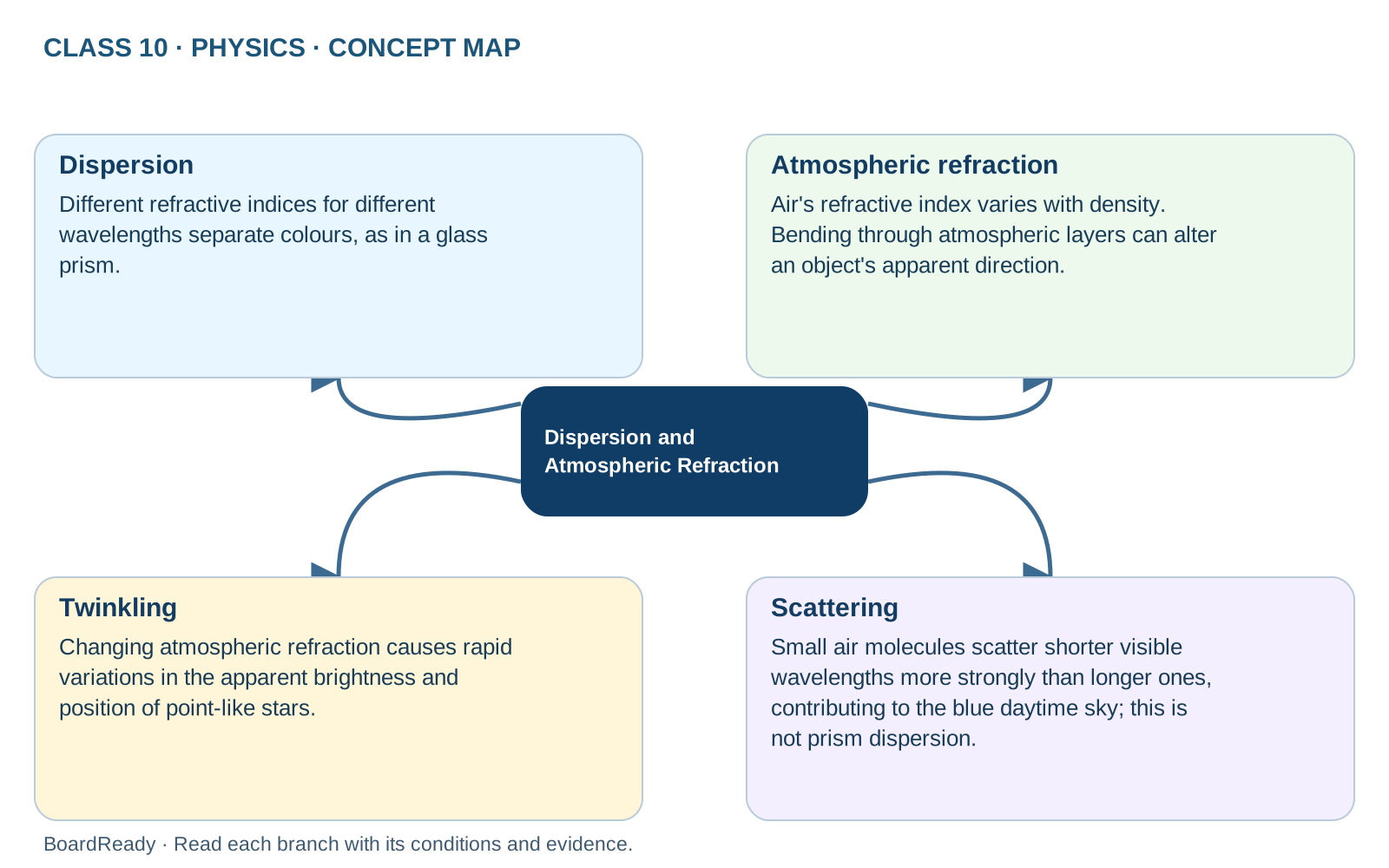
- 1Dispersion and Atmospheric Refraction -> Dispersion: Different refractive indices for different wavelengths separate colours, as in a glass prism.
- 2Dispersion and Atmospheric Refraction -> Atmospheric refraction: Air's refractive index varies with density. Bending through atmospheric layers can alter an object's apparent direction.
- 3Dispersion and Atmospheric Refraction -> Twinkling: Changing atmospheric refraction causes rapid variations in the apparent brightness and position of point-like stars.
- 4Dispersion and Atmospheric Refraction -> Scattering: Small air molecules scatter shorter visible wavelengths more strongly than longer ones, contributing to the blue daytime sky; this is not prism dispersion.