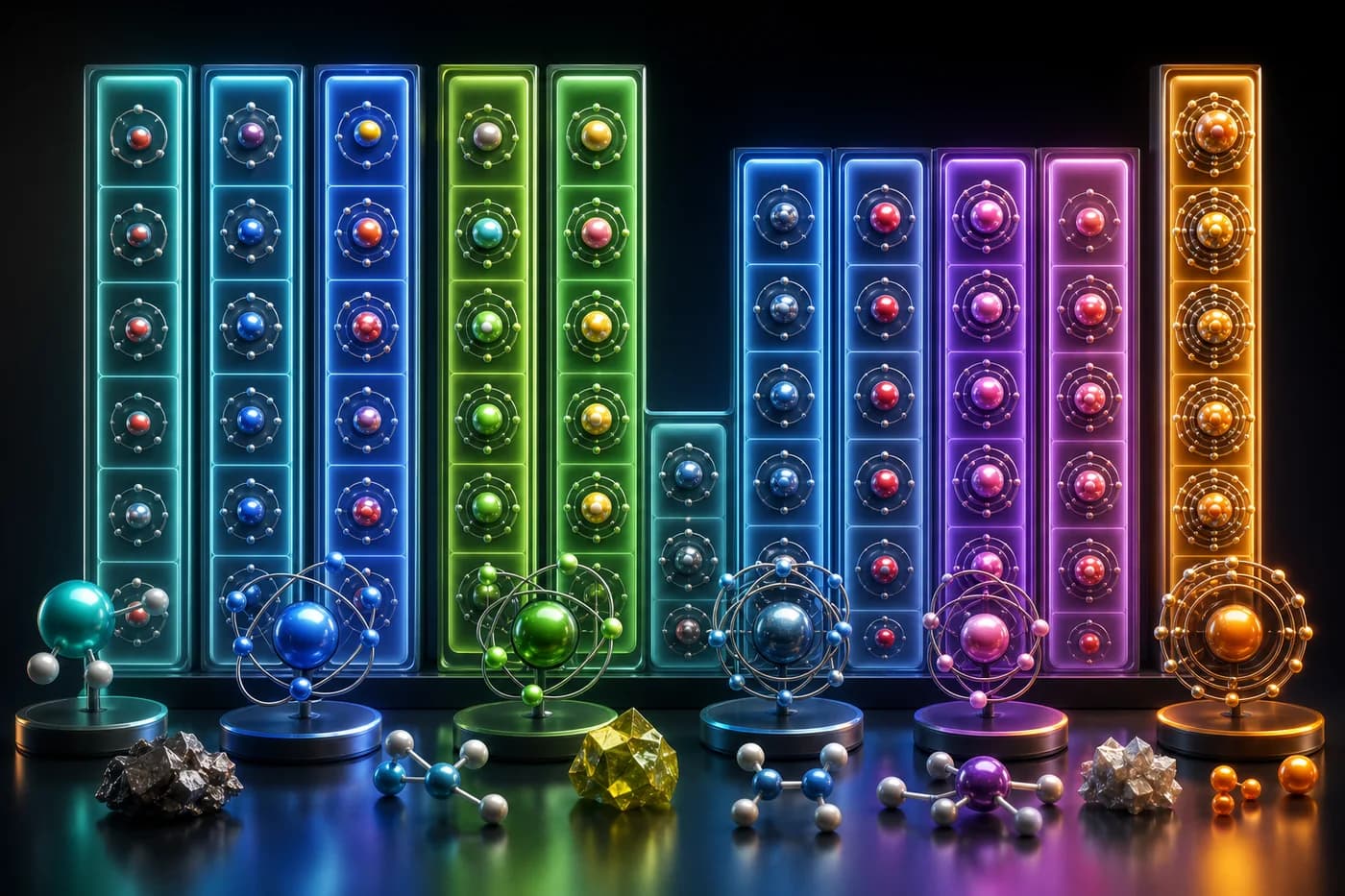
Groups and Families focuses on Groups and Families focuses on Groups and Families focuses on Study alkali metals, alkaline earth metals, halogens, noble gases, and transition elements at a basic level. Alkali metals are in Group 1 of the periodic table and have only one electron in their outermost shell, making them very reactive. Alkaline earth metals, found in Group 2, have two valence electrons which they lose to form +2 ions. When answering questions about group properties, always mention the reactivity trend and typical compounds formed by elements within that group. Common mistake: Confusing the properties of alkali metals with those of alkaline earth metals. Elements of Group 1 are highly reactive with water and other nonmetals. Elements in the same group show similar outer-electron patterns and therefore similar chemical behaviour. Groups and Families focuses on Study alkali metals, alkaline earth metals, halogens, noble gases, and transition elements at a basic level. Alkali metals are in Group 1 of the periodic table and have only one electron in their outermost shell, making them very reactive. Alkaline earth metals, found in Group 2, have two valence electrons which they lose to form +2 ions. When answering questions about group properties, always mention the reactivity trend and typical compounds formed by elements within that group. Common mistake: Confusing the properties of alkali metals with those of alkaline earth metals. Elements of Group 1 are highly reactive with water and other nonmetals. Alkali metals are in Group 1 of the periodic table and have only one electron in their outermost shell, making them very reactive. Alkaline earth metals, found in Group 2, have two valence electrons which they lose to form +2 ions. Groups and Families must be answered with exact chemistry vocabulary, not only general description. Elements in the same group show similar outer-electron patterns and therefore similar chemical behaviour. Groups and Families focuses on Groups and Families focuses on Study alkali metals, alkaline earth metals, halogens, noble gases, and transition elements at a basic level. Alkali metals are in Group 1 of the periodic table and have only one electron in their outermost shell, making them very reactive. Alkaline earth metals, found in Group 2, have two valence electrons which they lose to form +2 ions. When answering questions about group properties, always mention the reactivity trend and typical compounds formed by elements within that group. Common mistake: Confusing the properties of alkali metals with those of alkaline earth metals. Elements of Group 1 are highly reactive with water and other nonmetals. Elements in the same group show similar outer-electron patterns and therefore similar chemical behaviour. Groups and Families focuses on Study alkali metals, alkaline earth metals, halogens, noble gases, and transition elements at a basic level. Alkali metals are in Group 1 of the periodic table and have only one electron in their outermost shell, making them very reactive. Alkaline earth metals, found in Group 2, have two valence electrons which they lose to form +2 ions. When answering questions about group properties, always mention the reactivity trend and typical compounds formed by elements within that group. Common mistake: Confusing the properties of alkali metals with those of alkaline earth metals. Elements of Group 1 are highly reactive with water and other nonmetals. Alkali metals are in Group 1 of the periodic table and have only one electron in their outermost shell, making them very reactive. Alkaline earth metals, found in Group 2, have two valence electrons which they lose to form +2 ions. Groups and Families must be answered with exact chemistry vocabulary, not only general description. Elements in the same group show similar outer-electron patterns and therefore similar chemical behaviour. Groups and Families must be answered with exact chemistry vocabulary, not only general description.