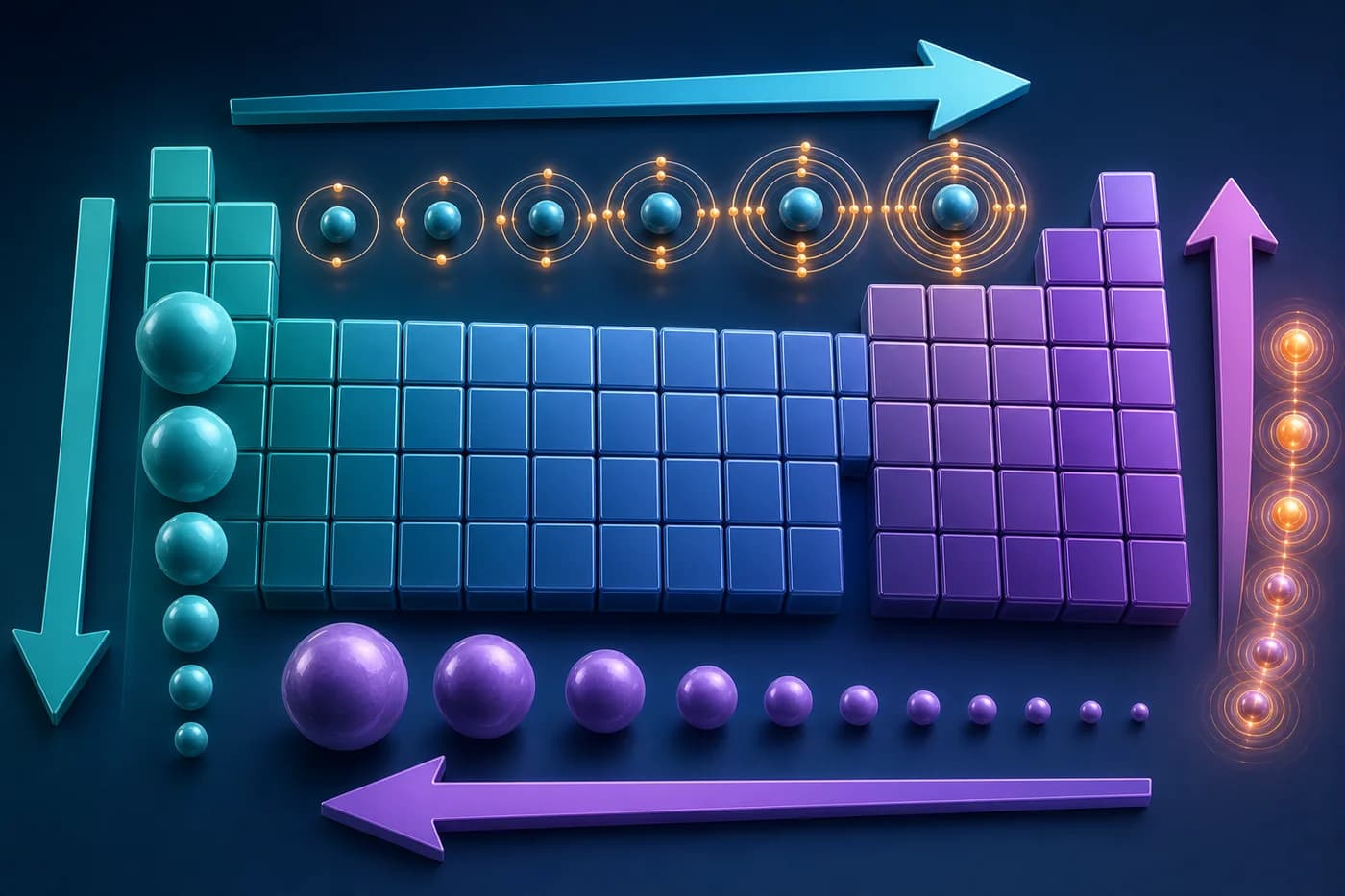
Periodic Trends focuses on Periodic Trends focuses on Periodic Trends focuses on Compare atomic size, metallic character, non-metallic character, valency, and electronegativity trends. Atomic size decreases across a period and increases down a group because of increasing nuclear charge and shielding effect respectively. When answering questions on periodic trends, always refer to specific elements or groups. Avoid broad statements without examples. Common mistakes include confusing atomic radius with ionic radius and misinterpreting the direction of trend changes (e.g., assuming electronegativity decreases across a period). Atomic size decreases across a period due to increasing nuclear charge attracting electrons closer. Down a group, atomic size increases because of added electron shells. Periodic trends compare how atomic size, metallic character, and reactivity change across periods and down groups. Periodic Trends focuses on Compare atomic size, metallic character, non-metallic character, valency, and electronegativity trends. Atomic size decreases across a period and increases down a group because of increasing nuclear charge and shielding effect respectively. When answering questions on periodic trends, always refer to specific elements or groups. Avoid broad statements without examples. Common mistakes include confusing atomic radius with ionic radius and misinterpreting the direction of trend changes (e.g., assuming electronegativity decreases across a period). Atomic size decreases across a period due to increasing nuclear charge attracting electrons closer. Down a group, atomic size increases because of added electron shells. Atomic size decreases across a period and increases down a group because of increasing nuclear charge and shielding effect respectively. Periodic Trends must be answered with exact chemistry vocabulary, not only general description. Periodic trends compare how atomic size, metallic character, and reactivity change across periods and down groups. Periodic Trends focuses on Periodic Trends focuses on Compare atomic size, metallic character, non-metallic character, valency, and electronegativity trends. Atomic size decreases across a period and increases down a group because of increasing nuclear charge and shielding effect respectively. When answering questions on periodic trends, always refer to specific elements or groups. Avoid broad statements without examples. Common mistakes include confusing atomic radius with ionic radius and misinterpreting the direction of trend changes (e.g., assuming electronegativity decreases across a period). Atomic size decreases across a period due to increasing nuclear charge attracting electrons closer. Down a group, atomic size increases because of added electron shells. Periodic trends compare how atomic size, metallic character, and reactivity change across periods and down groups. Periodic Trends focuses on Compare atomic size, metallic character, non-metallic character, valency, and electronegativity trends. Atomic size decreases across a period and increases down a group because of increasing nuclear charge and shielding effect respectively. When answering questions on periodic trends, always refer to specific elements or groups. Avoid broad statements without examples. Common mistakes include confusing atomic radius with ionic radius and misinterpreting the direction of trend changes (e.g., assuming electronegativity decreases across a period). Atomic size decreases across a period due to increasing nuclear charge attracting electrons closer. Down a group, atomic size increases because of added electron shells. Atomic size decreases across a period and increases down a group because of increasing nuclear charge and shielding effect respectively. Periodic Trends must be answered with exact chemistry vocabulary, not only general description. Periodic trends compare how atomic size, metallic character, and reactivity change across periods and down groups. Periodic Trends must be answered with exact chemistry vocabulary, not only general description.