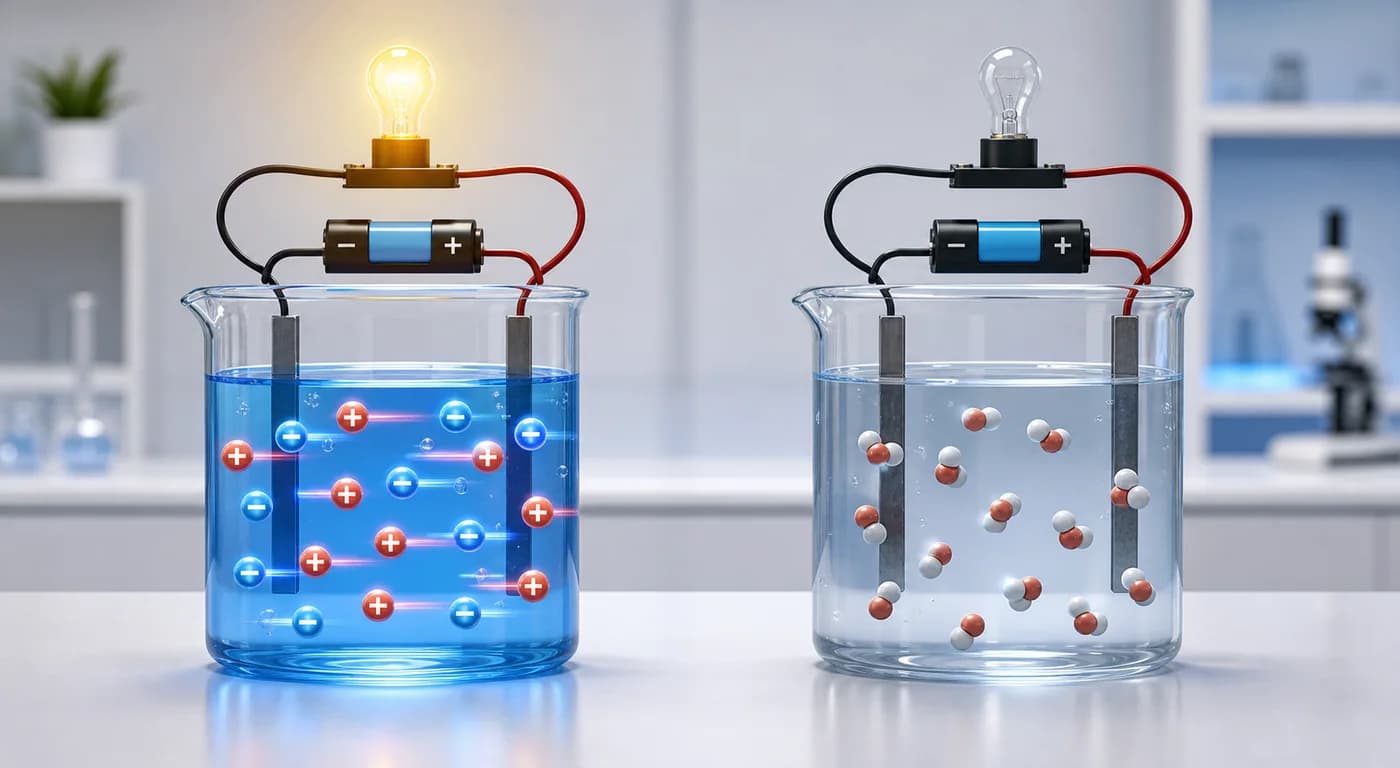
Electrolytes and Non-Electrolytes focuses on Electrolytes and Non-Electrolytes focuses on Electrolytes and Non-Electrolytes focuses on Compare electrolytes, non-electrolytes, strong and weak electrolytes, ions, and conductivity. Strong electrolytes have high conductivity due to complete ionization, while weak electrolytes show lower conductivity with partial ionization. Non-electrolytes do not conduct electricity at all. Questions often ask you to identify whether a substance is an electrolyte or non-electrolyte based on its behavior in solution. Remember, only substances that dissociate into ions can conduct electricity. An electrolyte is any substance that conducts electricity in aqueous solution or molten state. Electrolytes conduct electricity in molten or aqueous form because they have mobile ions, while non-electrolytes do not. Electrolytes and Non-Electrolytes focuses on Compare electrolytes, non-electrolytes, strong and weak electrolytes, ions, and conductivity. Strong electrolytes have high conductivity due to complete ionization, while weak electrolytes show lower conductivity with partial ionization. Non-electrolytes do not conduct electricity at all. Questions often ask you to identify whether a substance is an electrolyte or non-electrolyte based on its behavior in solution. Remember, only substances that dissociate into ions can conduct electricity. An electrolyte is any substance that conducts electricity in aqueous solution or molten state. Strong electrolytes have high conductivity due to complete ionization, while weak electrolytes show lower conductivity with partial ionization. Non-electrolytes do not conduct electricity at all. Electrolytes and Non-Electrolytes must be answered with exact chemistry vocabulary, not only general description. Electrolytes conduct electricity in molten or aqueous form because they have mobile ions, while non-electrolytes do not. Electrolytes and Non-Electrolytes focuses on Electrolytes and Non-Electrolytes focuses on Compare electrolytes, non-electrolytes, strong and weak electrolytes, ions, and conductivity. Strong electrolytes have high conductivity due to complete ionization, while weak electrolytes show lower conductivity with partial ionization. Non-electrolytes do not conduct electricity at all. Questions often ask you to identify whether a substance is an electrolyte or non-electrolyte based on its behavior in solution. Remember, only substances that dissociate into ions can conduct electricity. An electrolyte is any substance that conducts electricity in aqueous solution or molten state. Electrolytes conduct electricity in molten or aqueous form because they have mobile ions, while non-electrolytes do not. Electrolytes and Non-Electrolytes focuses on Compare electrolytes, non-electrolytes, strong and weak electrolytes, ions, and conductivity. Strong electrolytes have high conductivity due to complete ionization, while weak electrolytes show lower conductivity with partial ionization. Non-electrolytes do not conduct electricity at all. Questions often ask you to identify whether a substance is an electrolyte or non-electrolyte based on its behavior in solution. Remember, only substances that dissociate into ions can conduct electricity. An electrolyte is any substance that conducts electricity in aqueous solution or molten state. Strong electrolytes have high conductivity due to complete ionization, while weak electrolytes show lower conductivity with partial ionization. Non-electrolytes do not conduct electricity at all. Electrolytes and Non-Electrolytes must be answered with exact chemistry vocabulary, not only general description. Electrolytes conduct electricity in molten or aqueous form because they have mobile ions, while non-electrolytes do not. Electrolytes and Non-Electrolytes must be answered with exact chemistry vocabulary, not only general description.