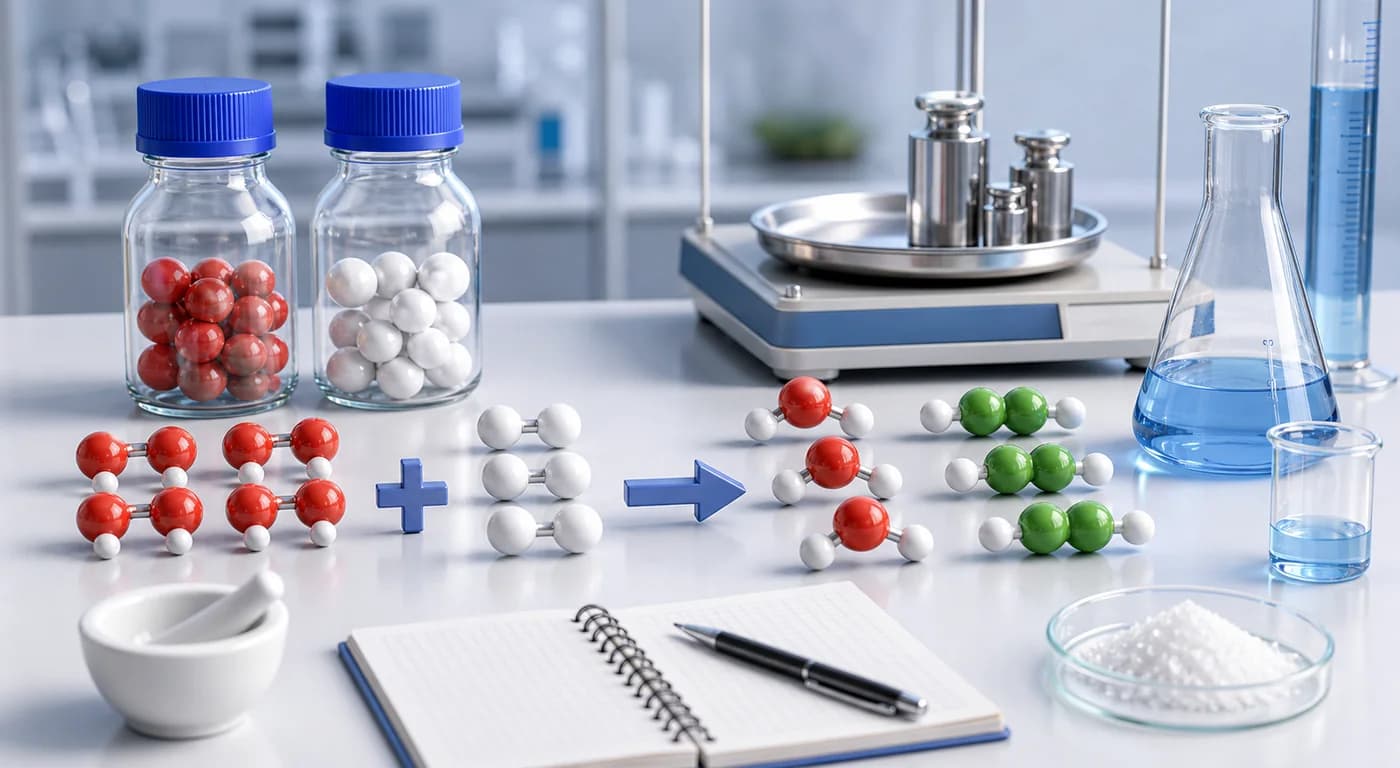
Stoichiometric Calculations focuses on Stoichiometric Calculations focuses on Stoichiometric Calculations focuses on Solve balanced-equation calculations involving mass, moles, volume, and limiting ideas at an introductory level. Always ensure the chemical equation is balanced before starting stoichiometric calculations. This ensures that the mole ratios used in calculations are correct. In exam questions, always identify and use limiting reagents to calculate maximum product yield accurately. Common mistakes include forgetting to balance equations or misinterpreting mole ratios. n=m/M, where n is moles, m is mass in grams, and M is molar mass. Stoichiometry uses balanced equations to convert one known quantity into another required quantity. Stoichiometric Calculations focuses on Solve balanced-equation calculations involving mass, moles, volume, and limiting ideas at an introductory level. Always ensure the chemical equation is balanced before starting stoichiometric calculations. This ensures that the mole ratios used in calculations are correct. In exam questions, always identify and use limiting reagents to calculate maximum product yield accurately. Common mistakes include forgetting to balance equations or misinterpreting mole ratios. n=m/M, where n is moles, m is mass in grams, and M is molar mass. Always ensure the chemical equation is balanced before starting stoichiometric calculations. This ensures that the mole ratios used in calculations are correct. Stoichiometric Calculations must be answered with exact chemistry vocabulary, not only general description. Stoichiometry uses balanced equations to convert one known quantity into another required quantity. Stoichiometric Calculations focuses on Stoichiometric Calculations focuses on Solve balanced-equation calculations involving mass, moles, volume, and limiting ideas at an introductory level. Always ensure the chemical equation is balanced before starting stoichiometric calculations. This ensures that the mole ratios used in calculations are correct. In exam questions, always identify and use limiting reagents to calculate maximum product yield accurately. Common mistakes include forgetting to balance equations or misinterpreting mole ratios. n=m/M, where n is moles, m is mass in grams, and M is molar mass. Stoichiometry uses balanced equations to convert one known quantity into another required quantity. Stoichiometric Calculations focuses on Solve balanced-equation calculations involving mass, moles, volume, and limiting ideas at an introductory level. Always ensure the chemical equation is balanced before starting stoichiometric calculations. This ensures that the mole ratios used in calculations are correct. In exam questions, always identify and use limiting reagents to calculate maximum product yield accurately. Common mistakes include forgetting to balance equations or misinterpreting mole ratios. n=m/M, where n is moles, m is mass in grams, and M is molar mass. Always ensure the chemical equation is balanced before starting stoichiometric calculations. This ensures that the mole ratios used in calculations are correct. Stoichiometric Calculations must be answered with exact chemistry vocabulary, not only general description. Stoichiometry uses balanced equations to convert one known quantity into another required quantity. Stoichiometric Calculations must be answered with exact chemistry vocabulary, not only general description.