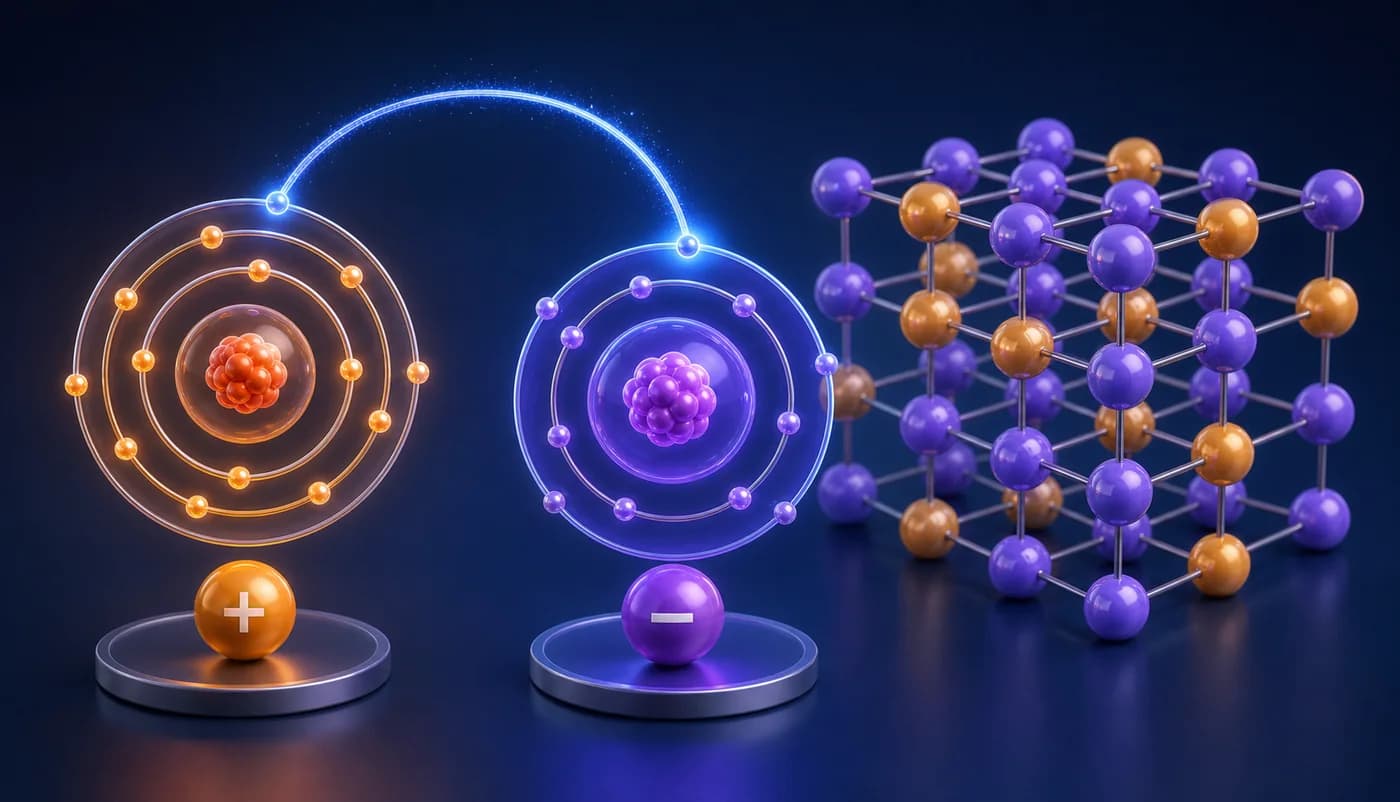
Ionic Bonding focuses on Ionic Bonding focuses on Ionic Bonding focuses on Explain electron transfer, ions, electrovalent compounds, lattice ideas, and properties of ionic compounds. Ionic compounds typically have high melting points due to strong ionic bonds. They are usually soluble in polar solvents like water and conduct electricity when dissolved or molten because they contain free-moving charged particles (ions). When answering questions about lattice energy, remember that it is directly proportional to the charge of the ions involved; greater charges lead to higher lattice energies. Common mistakes include confusing ionic and covalent bonding properties. A metal atom transfers electrons to a non-metal atom. Ionic bonding forms when electrons are transferred and oppositely charged ions attract each other. Ionic Bonding focuses on Explain electron transfer, ions, electrovalent compounds, lattice ideas, and properties of ionic compounds. Ionic compounds typically have high melting points due to strong ionic bonds. They are usually soluble in polar solvents like water and conduct electricity when dissolved or molten because they contain free-moving charged particles (ions). When answering questions about lattice energy, remember that it is directly proportional to the charge of the ions involved; greater charges lead to higher lattice energies. Common mistakes include confusing ionic and covalent bonding properties. A metal atom transfers electrons to a non-metal atom. Ionic compounds typically have high melting points due to strong ionic bonds. They are usually soluble in polar solvents like water and conduct electricity when dissolved or molten because they contain free-moving charged particles (ions). Ionic Bonding must be answered with exact chemistry vocabulary, not only general description. Ionic bonding forms when electrons are transferred and oppositely charged ions attract each other. Ionic Bonding focuses on Ionic Bonding focuses on Explain electron transfer, ions, electrovalent compounds, lattice ideas, and properties of ionic compounds. Ionic compounds typically have high melting points due to strong ionic bonds. They are usually soluble in polar solvents like water and conduct electricity when dissolved or molten because they contain free-moving charged particles (ions). When answering questions about lattice energy, remember that it is directly proportional to the charge of the ions involved; greater charges lead to higher lattice energies. Common mistakes include confusing ionic and covalent bonding properties. A metal atom transfers electrons to a non-metal atom. Ionic bonding forms when electrons are transferred and oppositely charged ions attract each other. Ionic Bonding focuses on Explain electron transfer, ions, electrovalent compounds, lattice ideas, and properties of ionic compounds. Ionic compounds typically have high melting points due to strong ionic bonds. They are usually soluble in polar solvents like water and conduct electricity when dissolved or molten because they contain free-moving charged particles (ions). When answering questions about lattice energy, remember that it is directly proportional to the charge of the ions involved; greater charges lead to higher lattice energies. Common mistakes include confusing ionic and covalent bonding properties. A metal atom transfers electrons to a non-metal atom. Ionic compounds typically have high melting points due to strong ionic bonds. They are usually soluble in polar solvents like water and conduct electricity when dissolved or molten because they contain free-moving charged particles (ions). Ionic Bonding must be answered with exact chemistry vocabulary, not only general description. Ionic bonding forms when electrons are transferred and oppositely charged ions attract each other. Ionic Bonding must be answered with exact chemistry vocabulary, not only general description.