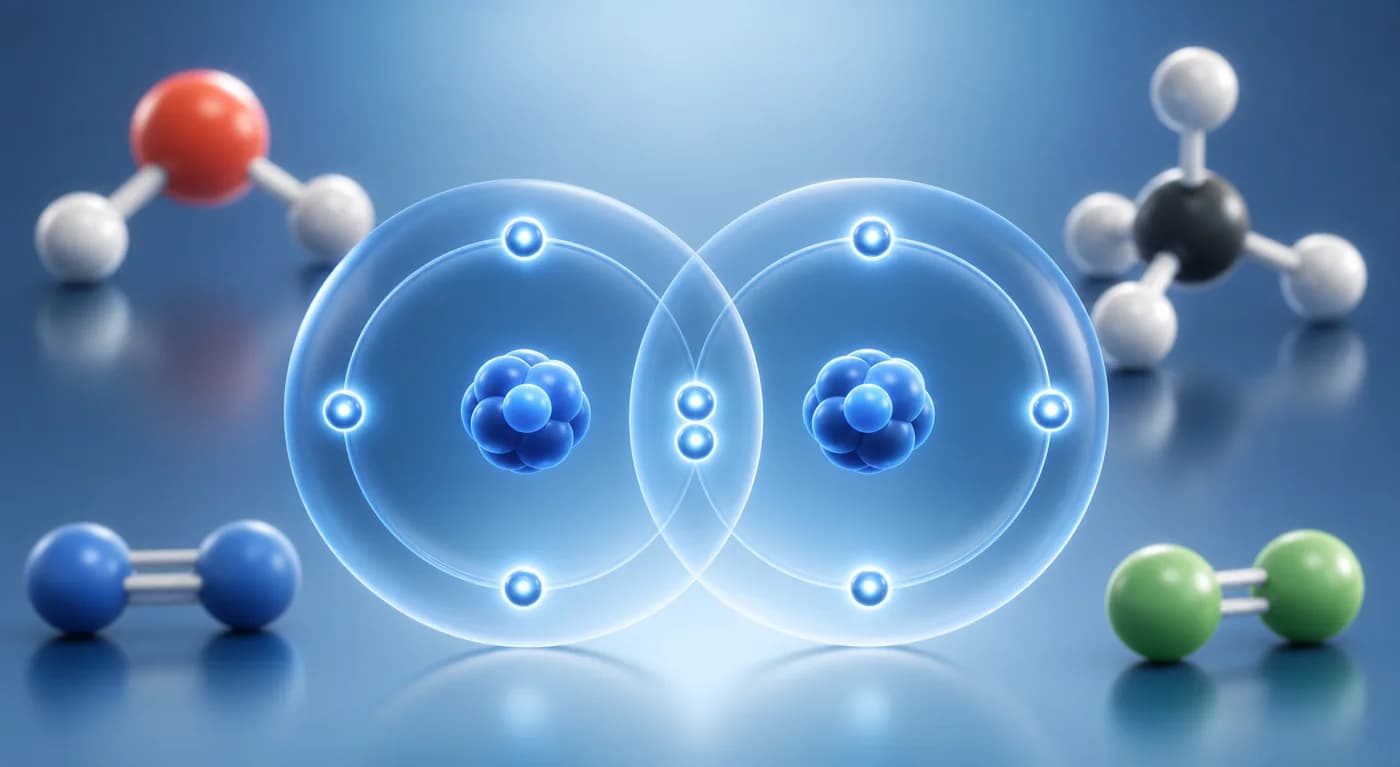
Covalent Bonding concept map
Use this concept map to connect covalent bonding with the most important chemistry cues.- 1Key term -> Condition: depends on
- 2Condition -> Observation: leads to
- 3Observation -> Reason: explained by
Checking progress account…
Opening your study space…
Lesson
Covalent Bonding focuses on Covalent Bonding focuses on Explain electron sharing, single/double/triple bonds, molecular structures, and properties of covalent compounds. Covalent compounds generally have low melting points due to weak intermolecular forces between molecules. They are often poor conductors of electricity because they lack free-moving ions or electrons. When answering questions on covalent bonding, ensure you can draw Lewis structures and predict molecular shapes using VSEPR theory. Avoid common mistakes like forgetting to count lone pairs in determining bond angles. One pair of electrons shared between two atoms. Covalent bonding forms when atoms share electron pairs to complete stable outer shells. Covalent Bonding focuses on Explain electron sharing, single/double/triple bonds, molecular structures, and properties of covalent compounds. Covalent compounds generally have low melting points due to weak intermolecular forces between molecules. They are often poor conductors of electricity because they lack free-moving ions or electrons. When answering questions on covalent bonding, ensure you can draw Lewis structures and predict molecular shapes using VSEPR theory. Avoid common mistakes like forgetting to count lone pairs in determining bond angles. One pair of electrons shared between two atoms. Covalent compounds generally have low melting points due to weak intermolecular forces between molecules. They are often poor conductors of electricity because they lack free-moving ions or electrons. Covalent Bonding must be answered with exact chemistry vocabulary, not only general description.
Learning objectives
State the exact idea behind Covalent Bonding.
Connect Covalent Bonding to the correct condition, reagent, structure, or equation.
Write short chemistry answers that combine observation with explanation.
Lesson
Ready to check what you remember?
Continue to revisionStudy path
Notes
Review the compact notes before moving into recall.
Open notesShowing 4 of 5 notes.
Diagrams

Practice
Choose one small set. The full bank opens only inside the practice session.
In this chapter
Now on Covalent Bonding. Next up: Coordinate Bonding and Structures.
Lesson progress
Save this lesson when done. Next: Coordinate Bonding and Structures.
Keep moving