CompareNumber Sets
Number Sets: relationships and examples
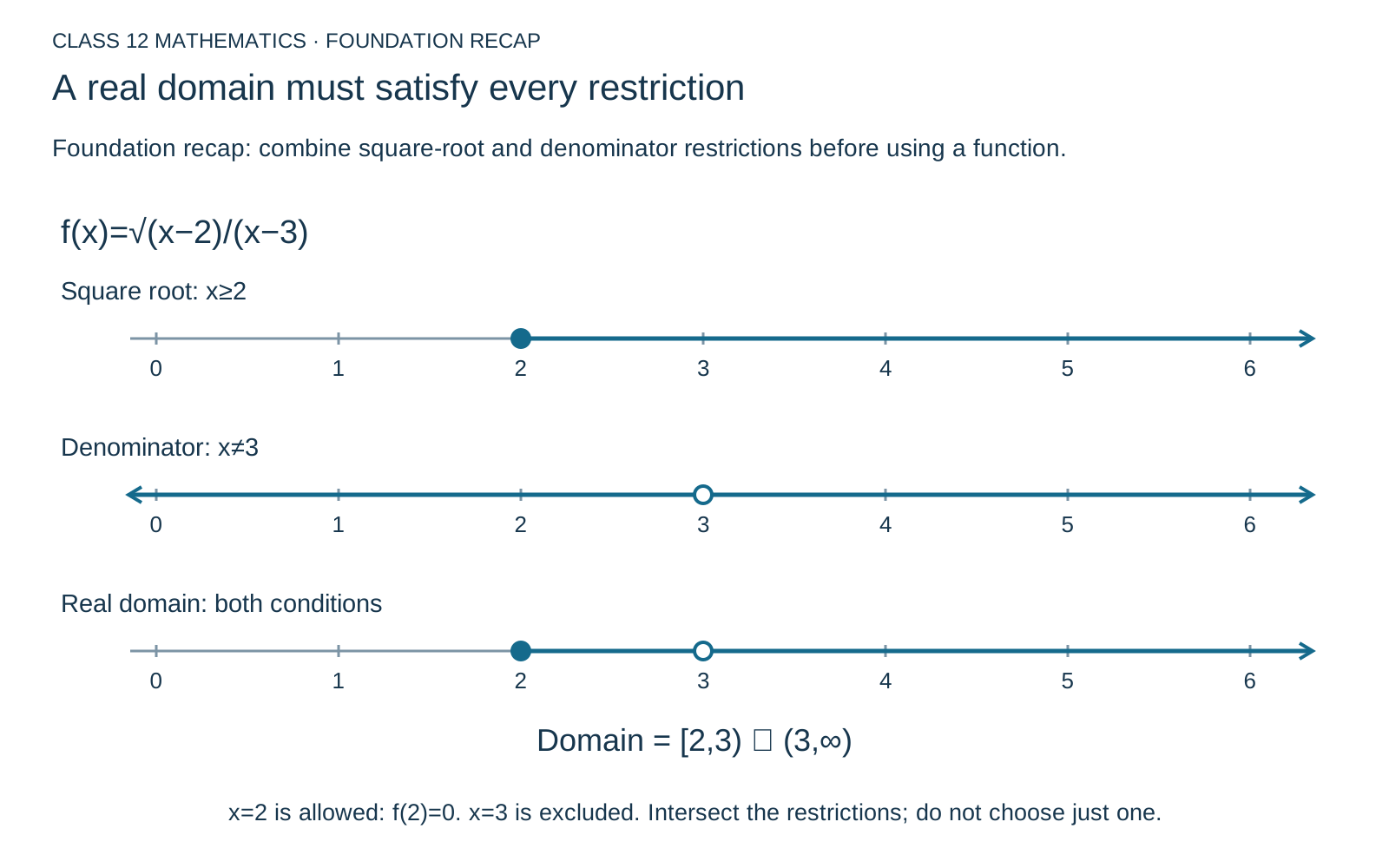
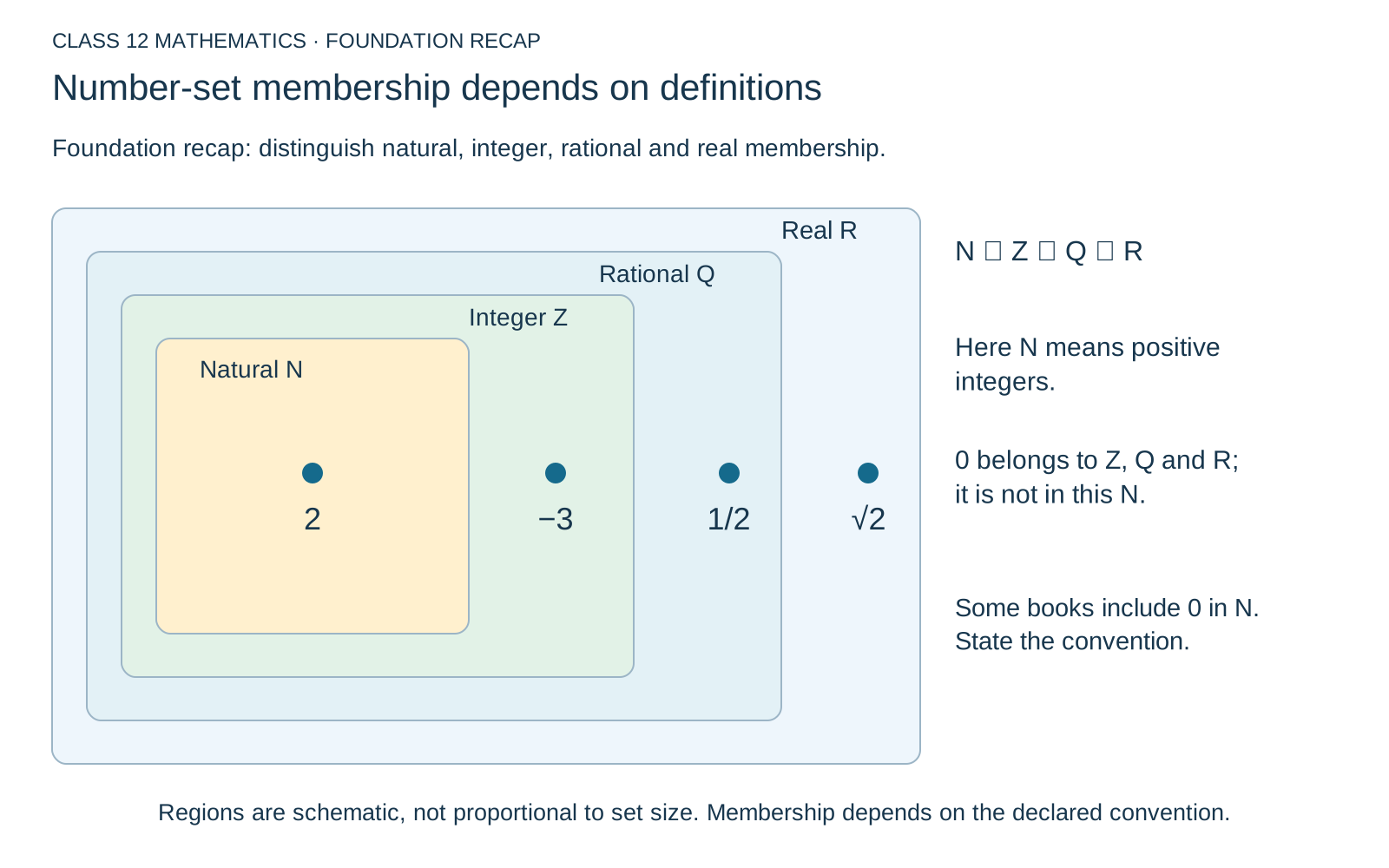
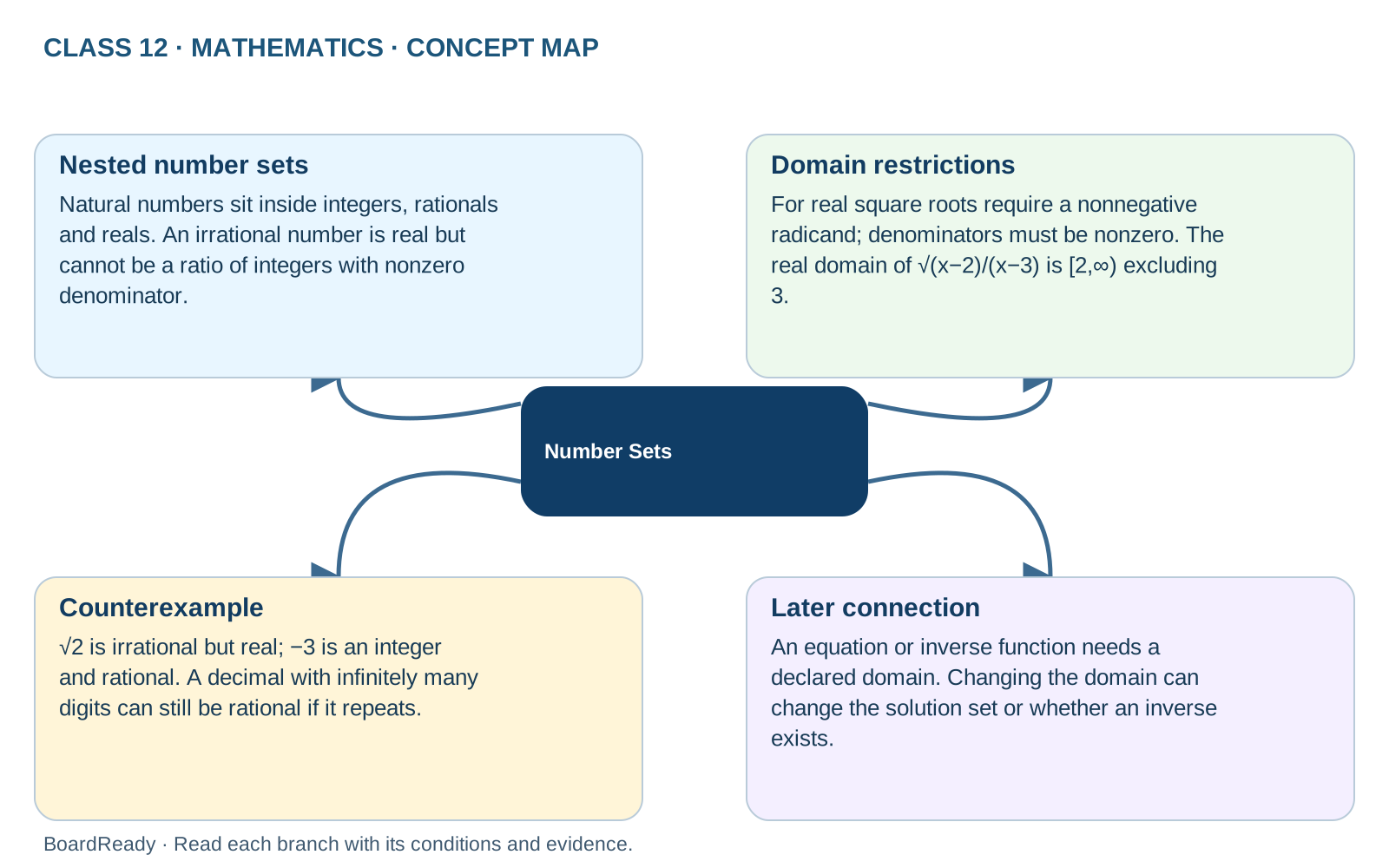
Prerequisite recap: set membership and number classifications support later domains and equations. Nested number sets: Natural numbers sit inside integers, rationals and reals. An irrational number is real but cannot be a ratio of integers with nonzero denominator. Domain restrictions: For real square roots require a nonnegative radicand; denominators must be nonzero. The real domain of √(x−2)/(x−3) is [2,∞) excluding 3. Counterexample: √2 is irrational but real; −3 is an integer and rational. A decimal with infinitely many digits can still be rational if it repeats. Later connection: An equation or inverse function needs a declared domain. Changing the domain can change the solution set or whether an inverse exists.Nested number sets
Natural numbers sit inside integers, rationals and reals. An irrational number is real but cannot be a ratio of integers with nonzero denominator.Domain restrictions
For real square roots require a nonnegative radicand; denominators must be nonzero. The real domain of √(x−2)/(x−3) is [2,∞) excluding 3.Check: This is foundation review within a legacy route, not a complete Class 12 topic. State the number universe before classifying.