Comparison map
Number Sets: relationships and examples
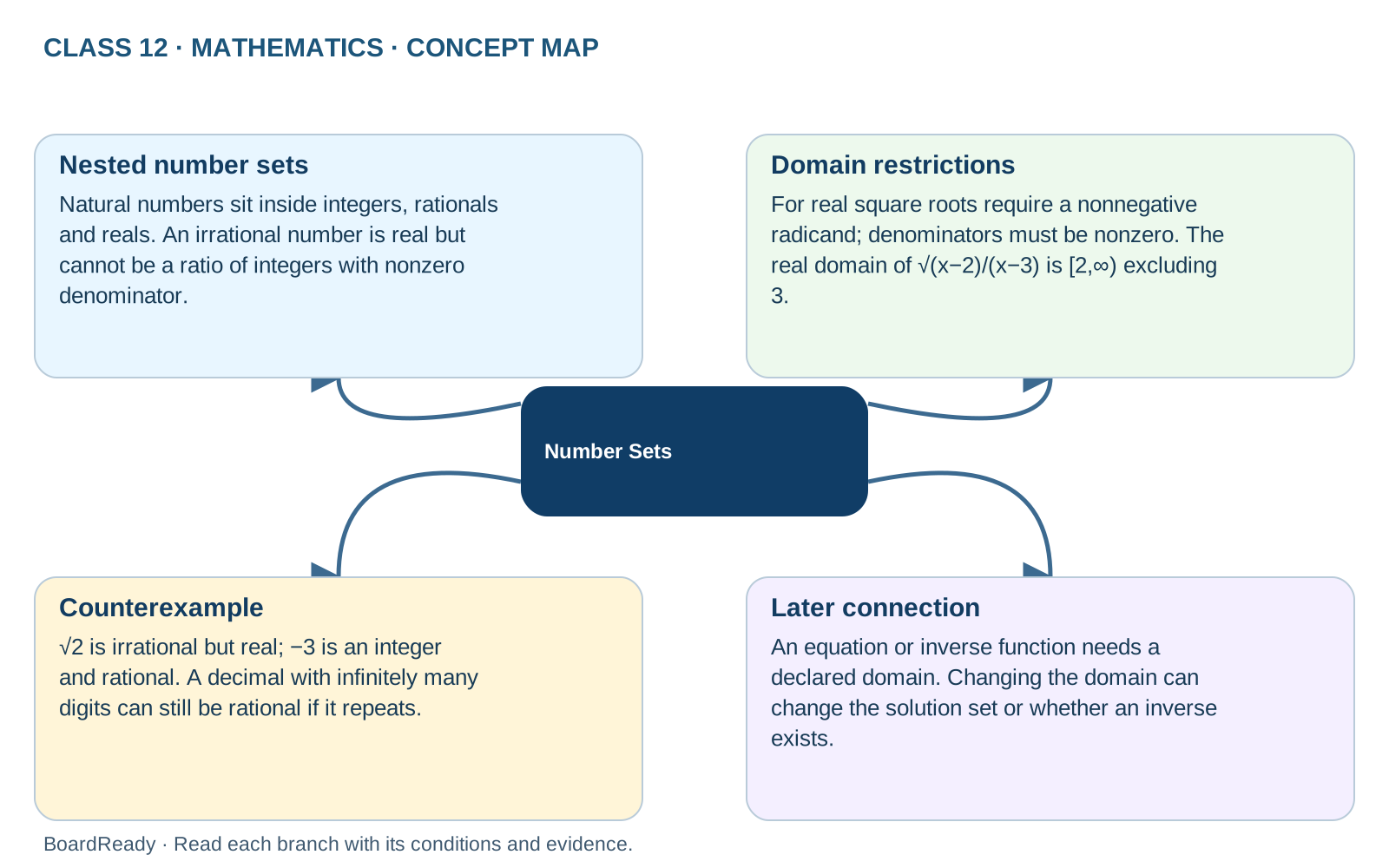
Prerequisite recap: set membership and number classifications support later domains and equations. Nested number sets: Natural numbers sit inside integers, rationals and reals. An irrational number is real but cannot be a ratio of integers with nonzero denominator. Domain restrictions: For real square roots require a nonnegative radicand; denominators must be nonzero. The real domain of √(x−2)/(x−3) is [2,∞) excluding 3. Counterexample: √2 is irrational but real; −3 is an integer and rational. A decimal with infinitely many digits can still be rational if it repeats. Later connection: An equation or inverse function needs a declared domain. Changing the domain can change the solution set or whether an inverse exists.Exam cue: This is foundation review within a legacy route, not a complete Class 12 topic. State the number universe before classifying.
- 1Number Sets -> Nested number sets: Natural numbers sit inside integers, rationals and reals. An irrational number is real but cannot be a ratio of integers with nonzero denominator.
- 2Number Sets -> Domain restrictions: For real square roots require a nonnegative radicand; denominators must be nonzero. The real domain of √(x−2)/(x−3) is [2,∞) excluding 3.
- 3Number Sets -> Counterexample: √2 is irrational but real; −3 is an integer and rational. A decimal with infinitely many digits can still be rational if it repeats.
- 4Number Sets -> Later connection: An equation or inverse function needs a declared domain. Changing the domain can change the solution set or whether an inverse exists.