DiagramCalorimetry and Method of Mixtures
A common final temperature needs a weighted energy balance
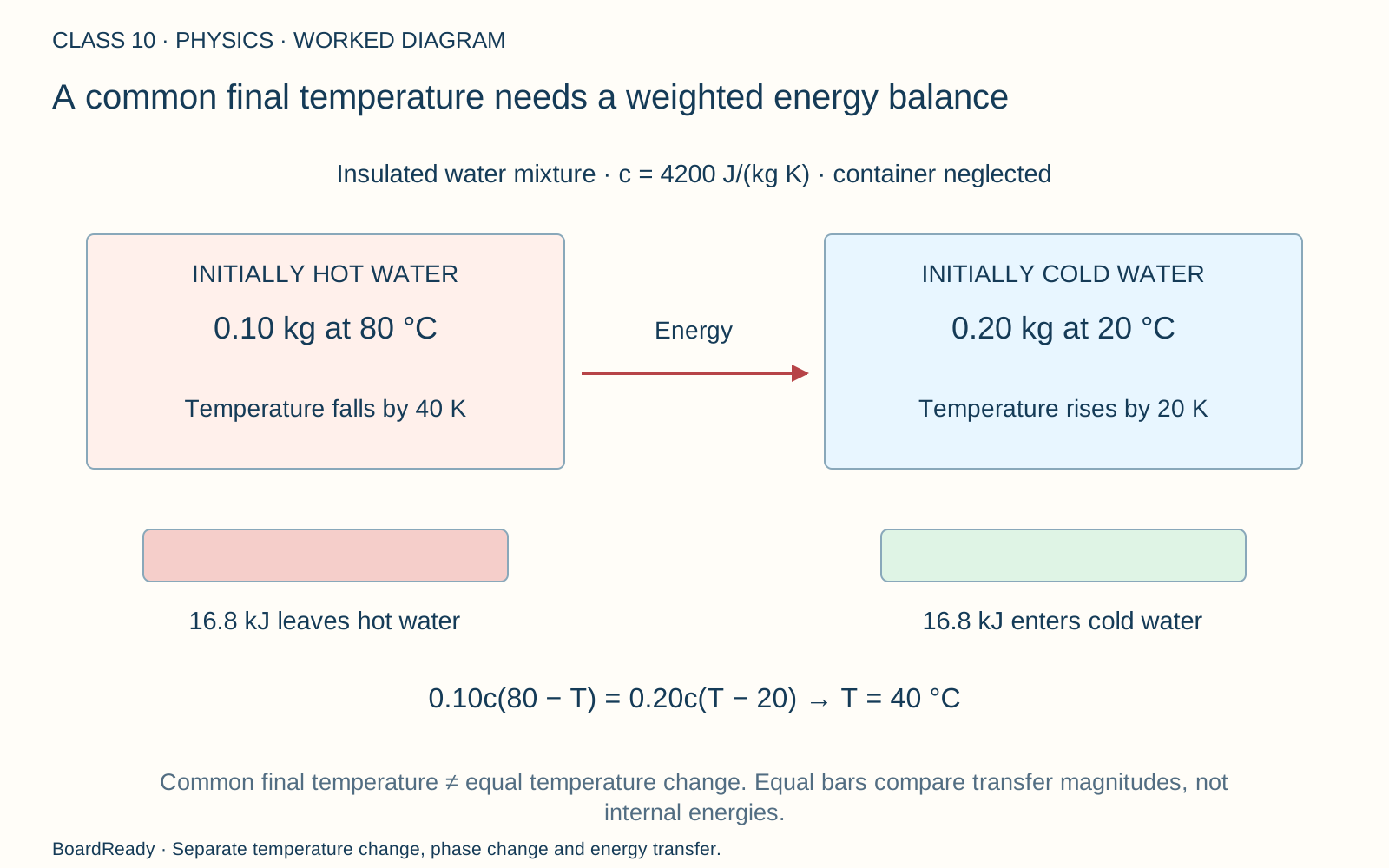
Unequal water masses do not give the unweighted midpoint temperature. Mix 0.10 kg water initially at 80 °C with 0.20 kg water initially at 20 °C. The insulated model neglects the container heat capacity and evaporation and assumes no phase change. With constant water specific heat capacity c = 4200 J/(kg K), 0.10c(80 − T) = 0.20c(T − 20) gives T = 40 °C. The hot sample loses 16.8 kJ and the cold sample gains 16.8 kJ. Equal-length transfer bars compare equal energy magnitudes; their arrows distinguish energy leaving and entering the samples. The two samples have unequal temperature changes, 40 K and 20 K. The figure does not assign absolute internal energies.Read the worked diagram
Mix 0.10 kg water initially at 80 °C with 0.20 kg water initially at 20 °C. The insulated model neglects the container heat capacity and evaporation and assumes no phase change. With constant water specific heat capacity c = 4200 J/(kg K), 0.10c(80 − T) = 0.20c(T − 20) gives T = 40 °C. The hot sample loses 16.8 kJ and the cold sample gains 16.8 kJ. Equal-length transfer bars compare equal energy magnitudes; their arrows distinguish energy leaving and entering the samples. The two samples have unequal temperature changes, 40 K and 20 K. The figure does not assign absolute internal energies.Check: A Celsius temperature difference has the same numerical size in kelvins. The simple midpoint 50 °C would require equal heat capacities, not merely the same substance.