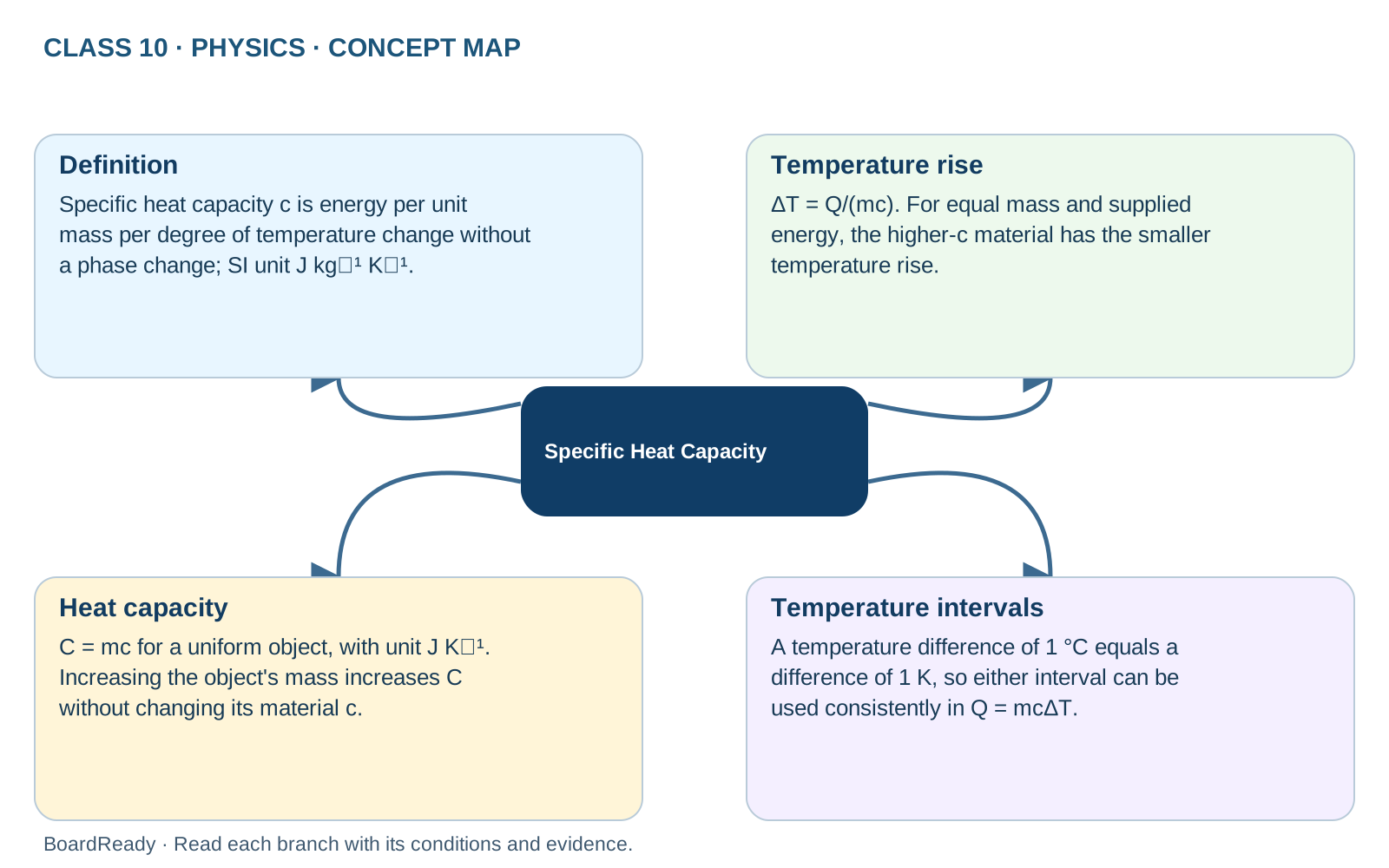
Comparison map
Specific Heat Capacity: relationships and examples
Specific heat capacity compares the energy needed to change a unit mass's temperature. Heat capacity describes a whole object.Exam cue: Specific heat capacity describes response to energy transfer, not the material's current temperature.
- 1Specific Heat Capacity -> Definition: Specific heat capacity c is energy per unit mass per degree of temperature change without a phase change; SI unit J kg⁻¹ K⁻¹.
- 2Specific Heat Capacity -> Temperature rise: ΔT = Q/(mc). For equal mass and supplied energy, the higher-c material has the smaller temperature rise.
- 3Specific Heat Capacity -> Heat capacity: C = mc for a uniform object, with unit J K⁻¹. Increasing the object's mass increases C without changing its material c.
- 4Specific Heat Capacity -> Temperature intervals: A temperature difference of 1 °C equals a difference of 1 K, so either interval can be used consistently in Q = mcΔT.