Comparison map
Average and Percentage: relationships and examples
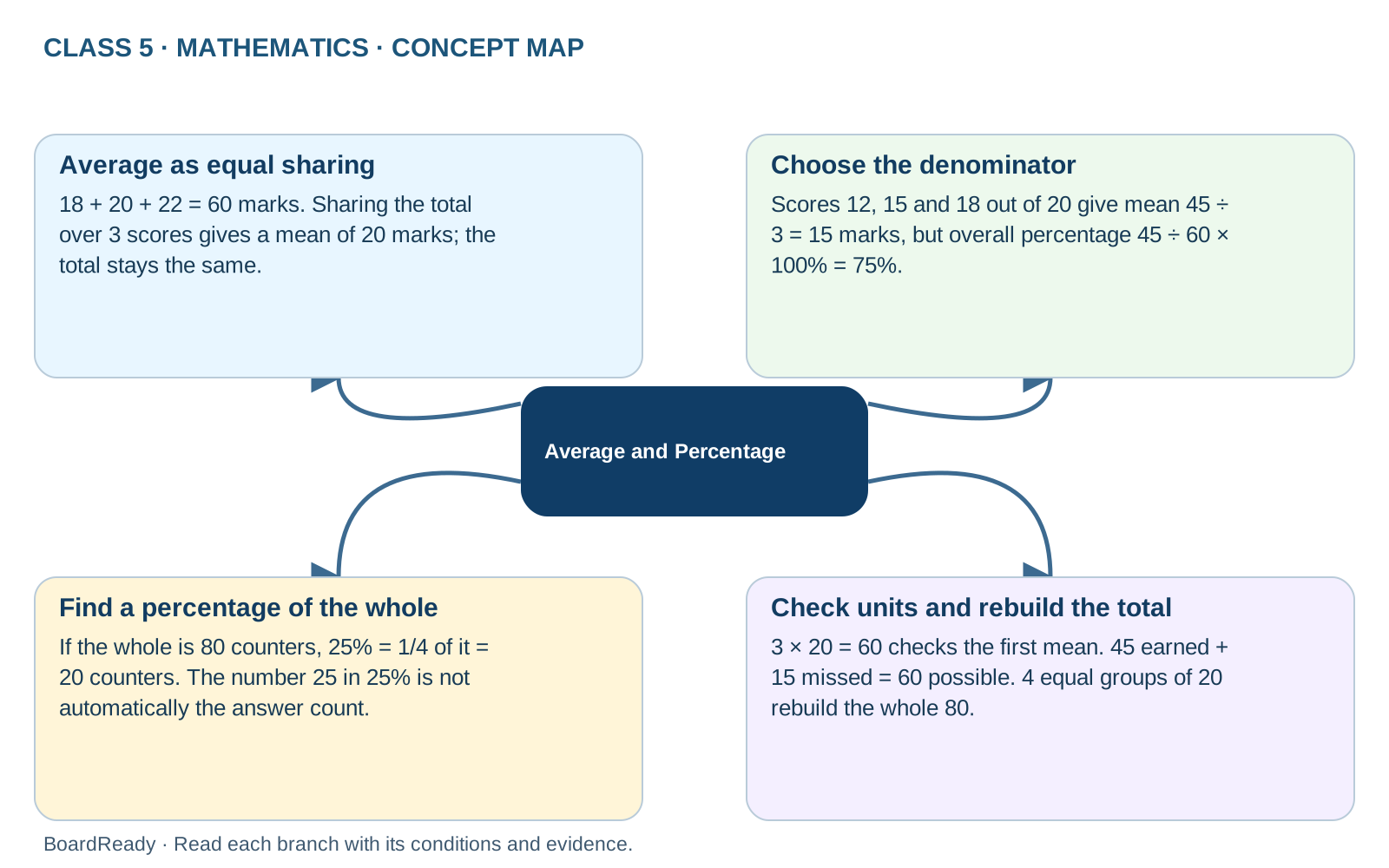
An average divides a total by its observation count. A percentage compares a part with a named whole. Average as equal sharing: 18 + 20 + 22 = 60 marks. Sharing the total over 3 scores gives a mean of 20 marks; the total stays the same. Choose the denominator: Scores 12, 15 and 18 out of 20 give mean 45 ÷ 3 = 15 marks, but overall percentage 45 ÷ 60 × 100% = 75%. Find a percentage of the whole: If the whole is 80 counters, 25% = 1/4 of it = 20 counters. The number 25 in 25% is not automatically the answer count. Check units and rebuild the total: 3 × 20 = 60 checks the first mean. 45 earned + 15 missed = 60 possible. 4 equal groups of 20 rebuild the whole 80.Exam cue: Decide whether the question asks for a mean, a percentage, or a count from a percentage. State the count or whole used in the denominator.
- 1Average and Percentage -> Average as equal sharing: 18 + 20 + 22 = 60 marks. Sharing the total over 3 scores gives a mean of 20 marks; the total stays the same.
- 2Average and Percentage -> Choose the denominator: Scores 12, 15 and 18 out of 20 give mean 45 ÷ 3 = 15 marks, but overall percentage 45 ÷ 60 × 100% = 75%.
- 3Average and Percentage -> Find a percentage of the whole: If the whole is 80 counters, 25% = 1/4 of it = 20 counters. The number 25 in 25% is not automatically the answer count.
- 4Average and Percentage -> Check units and rebuild the total: 3 × 20 = 60 checks the first mean. 45 earned + 15 missed = 60 possible. 4 equal groups of 20 rebuild the whole 80.