Comparison map
Linear Equations: relationships and examples
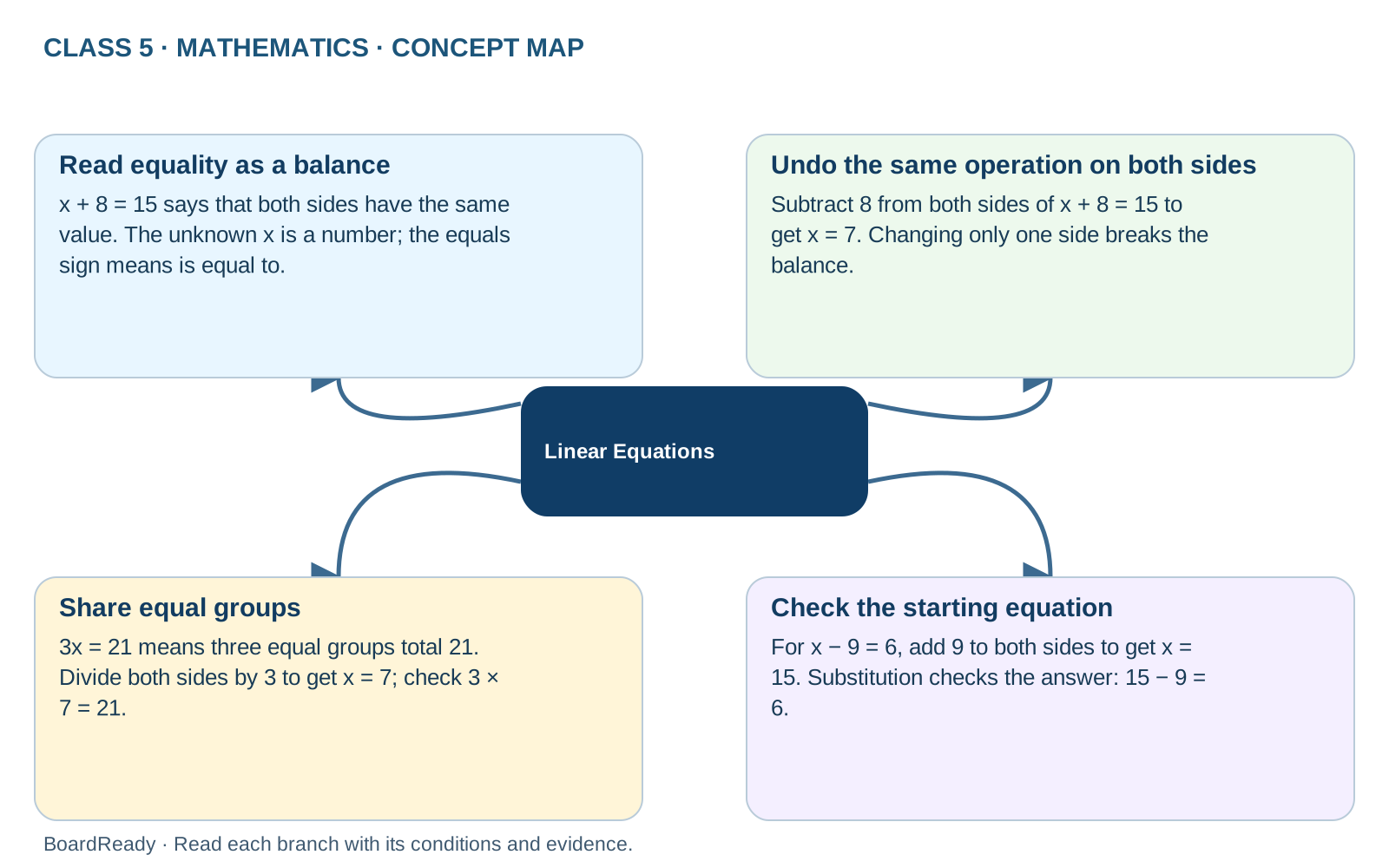
An equation compares equal values. Isolate the unknown with an inverse operation, then check in the original equation. Read equality as a balance: x + 8 = 15 says that both sides have the same value. The unknown x is a number; the equals sign means is equal to. Undo the same operation on both sides: Subtract 8 from both sides of x + 8 = 15 to get x = 7. Changing only one side breaks the balance. Share equal groups: 3x = 21 means three equal groups total 21. Divide both sides by 3 to get x = 7; check 3 × 7 = 21. Check the starting equation: For x − 9 = 6, add 9 to both sides to get x = 15. Substitution checks the answer: 15 − 9 = 6.Exam cue: Show one inverse-operation step per line and apply it to both sides. Finish by substituting your value into the original equation.
- 1Linear Equations -> Read equality as a balance: x + 8 = 15 says that both sides have the same value. The unknown x is a number; the equals sign means is equal to.
- 2Linear Equations -> Undo the same operation on both sides: Subtract 8 from both sides of x + 8 = 15 to get x = 7. Changing only one side breaks the balance.
- 3Linear Equations -> Share equal groups: 3x = 21 means three equal groups total 21. Divide both sides by 3 to get x = 7; check 3 × 7 = 21.
- 4Linear Equations -> Check the starting equation: For x − 9 = 6, add 9 to both sides to get x = 15. Substitution checks the answer: 15 − 9 = 6.