Comparison map
Patterns and Expressions: relationships and examples
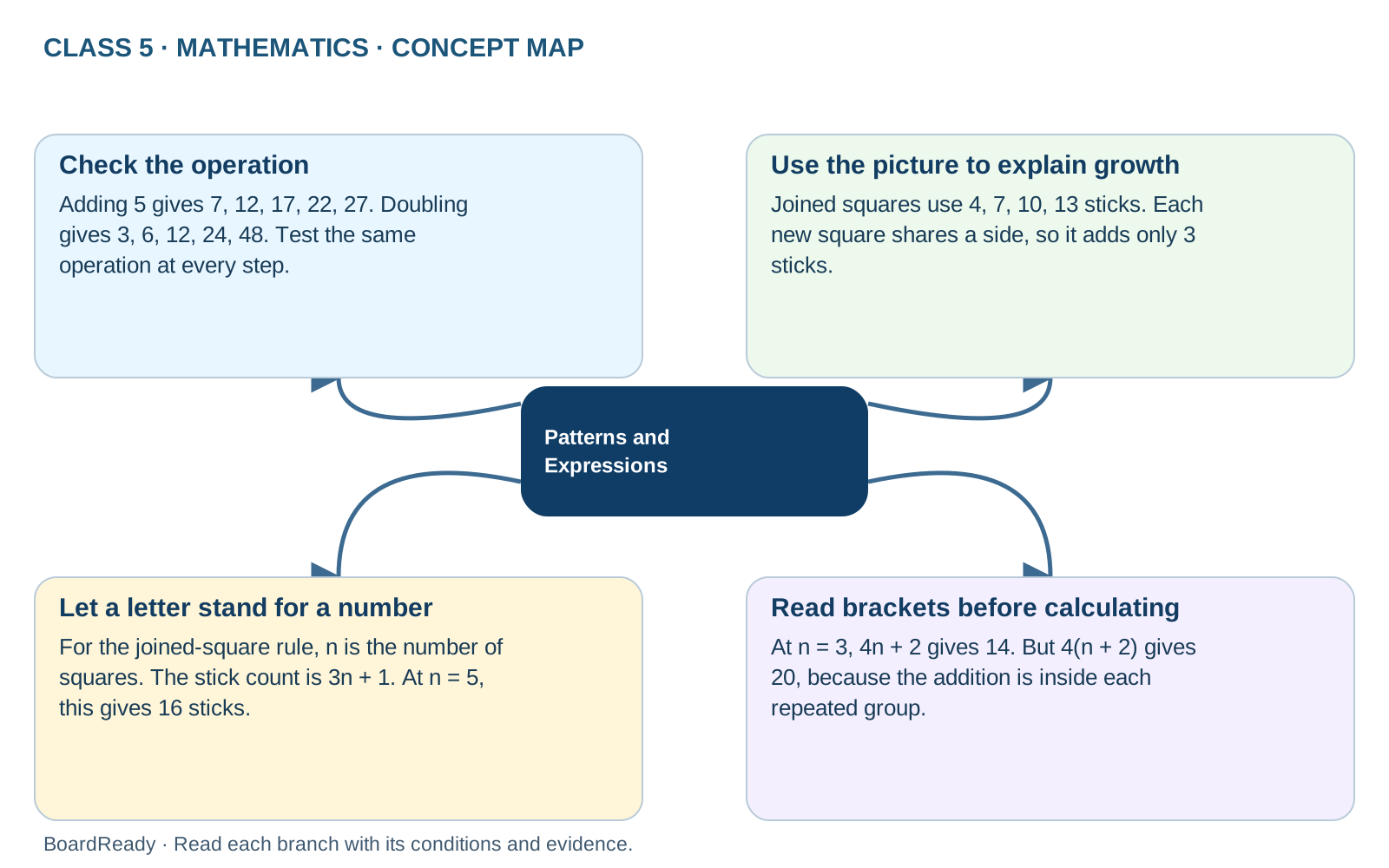
Explain the rule in words, check it with numbers and pictures, then substitute values carefully. Check the operation: Adding 5 gives 7, 12, 17, 22, 27. Doubling gives 3, 6, 12, 24, 48. Test the same operation at every step. Use the picture to explain growth: Joined squares use 4, 7, 10, 13 sticks. Each new square shares a side, so it adds only 3 sticks. Let a letter stand for a number: For the joined-square rule, n is the number of squares. The stick count is 3n + 1. At n = 5, this gives 16 sticks. Read brackets before calculating: At n = 3, 4n + 2 gives 14. But 4(n + 2) gives 20, because the addition is inside each repeated group.Exam cue: State the rule and check all supplied terms. A short list can fit more than one rule. Substitute a letter’s given value, then follow the grouping and order of operations.
- 1Patterns and Expressions -> Check the operation: Adding 5 gives 7, 12, 17, 22, 27. Doubling gives 3, 6, 12, 24, 48. Test the same operation at every step.
- 2Patterns and Expressions -> Use the picture to explain growth: Joined squares use 4, 7, 10, 13 sticks. Each new square shares a side, so it adds only 3 sticks.
- 3Patterns and Expressions -> Let a letter stand for a number: For the joined-square rule, n is the number of squares. The stick count is 3n + 1. At n = 5, this gives 16 sticks.
- 4Patterns and Expressions -> Read brackets before calculating: At n = 3, 4n + 2 gives 14. But 4(n + 2) gives 20, because the addition is inside each repeated group.