Comparison map
Profit, Loss, and Money: relationships and examples
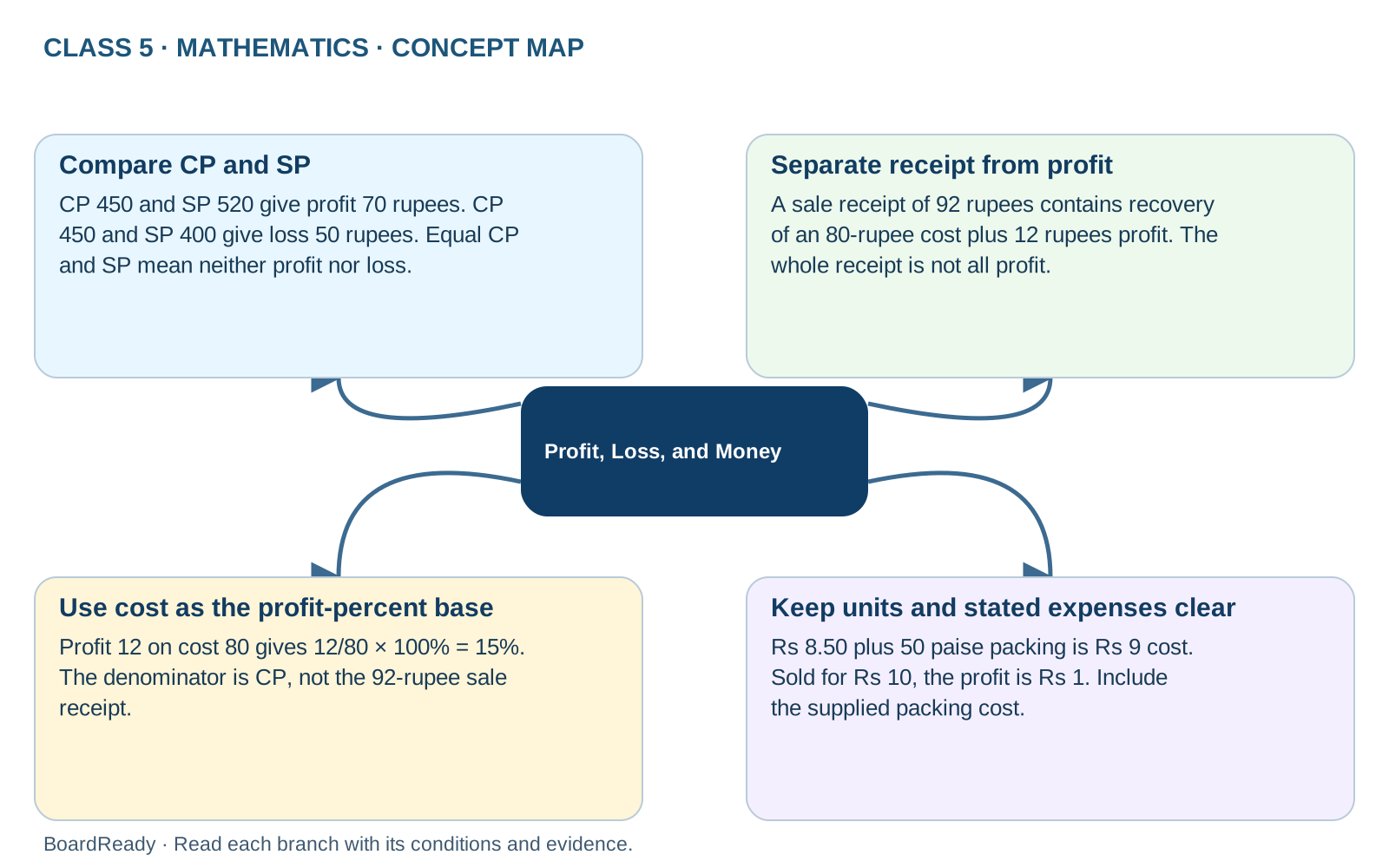
Identify cost and sale receipts, compare them in one unit, and use the stated base if a percentage is requested. Compare CP and SP: CP 450 and SP 520 give profit 70 rupees. CP 450 and SP 400 give loss 50 rupees. Equal CP and SP mean neither profit nor loss. Separate receipt from profit: A sale receipt of 92 rupees contains recovery of an 80-rupee cost plus 12 rupees profit. The whole receipt is not all profit. Use cost as the profit-percent base: Profit 12 on cost 80 gives 12/80 × 100% = 15%. The denominator is CP, not the 92-rupee sale receipt. Keep units and stated expenses clear: Rs 8.50 plus 50 paise packing is Rs 9 cost. Sold for Rs 10, the profit is Rs 1. Include the supplied packing cost.Exam cue: Decide profit or loss before subtracting. State rupees or paise, and calculate a percentage only when requested.
- 1Profit, Loss, and Money -> Compare CP and SP: CP 450 and SP 520 give profit 70 rupees. CP 450 and SP 400 give loss 50 rupees. Equal CP and SP mean neither profit nor loss.
- 2Profit, Loss, and Money -> Separate receipt from profit: A sale receipt of 92 rupees contains recovery of an 80-rupee cost plus 12 rupees profit. The whole receipt is not all profit.
- 3Profit, Loss, and Money -> Use cost as the profit-percent base: Profit 12 on cost 80 gives 12/80 × 100% = 15%. The denominator is CP, not the 92-rupee sale receipt.
- 4Profit, Loss, and Money -> Keep units and stated expenses clear: Rs 8.50 plus 50 paise packing is Rs 9 cost. Sold for Rs 10, the profit is Rs 1. Include the supplied packing cost.