Comparison map
Plants and Their Functions: relationships and examples
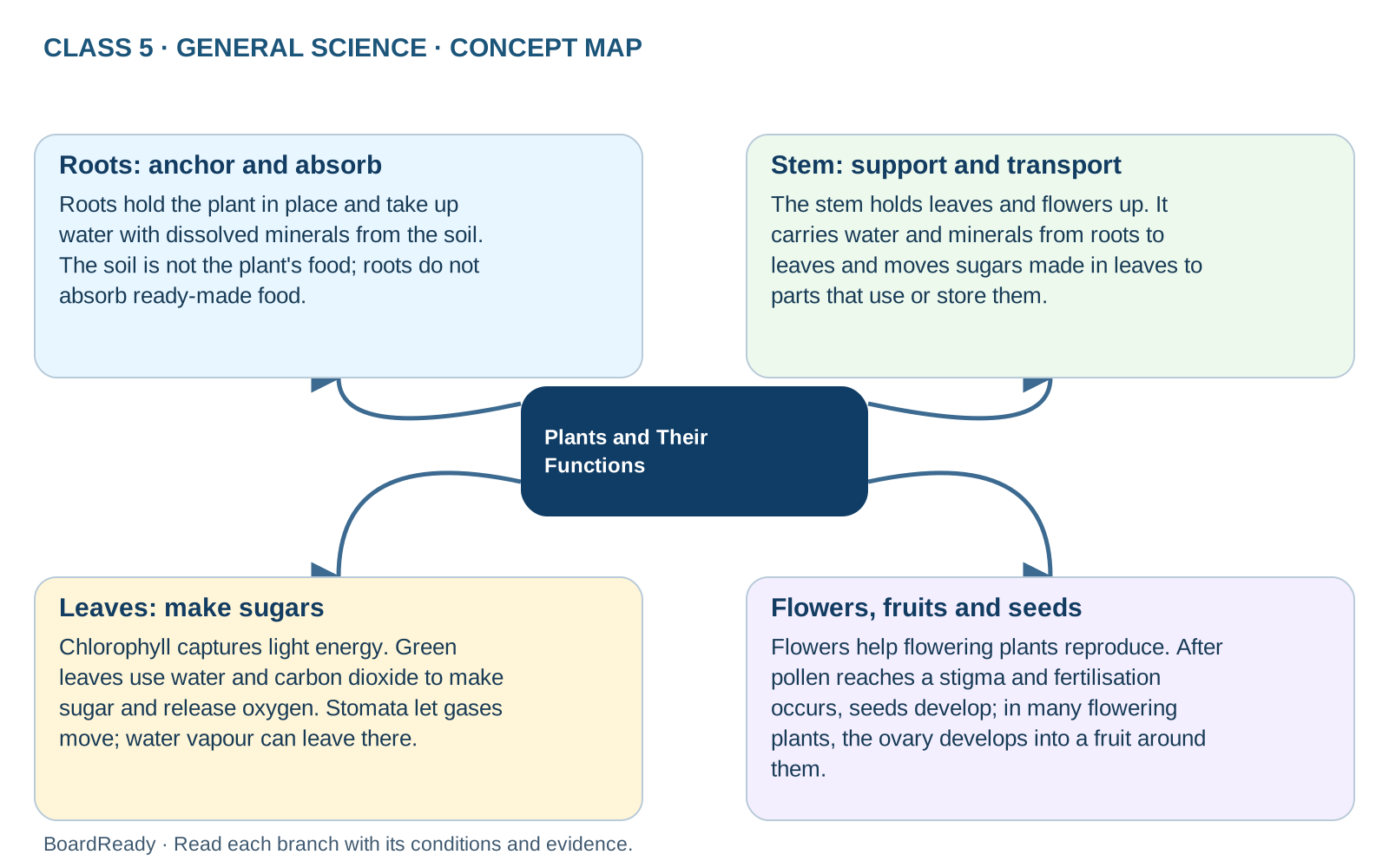
Follow the connected jobs of a flowering plant: roots take in water and minerals, stems support and transport, leaves make sugars using light, and flowers help form seeds. Roots: anchor and absorb: Roots hold the plant in place and take up water with dissolved minerals from the soil. The soil is not the plant's food; roots do not absorb ready-made food. Stem: support and transport: The stem holds leaves and flowers up. It carries water and minerals from roots to leaves and moves sugars made in leaves to parts that use or store them. Leaves: make sugars: Chlorophyll captures light energy. Green leaves use water and carbon dioxide to make sugar and release oxygen. Stomata let gases move; water vapour can leave there. Flowers, fruits and seeds: Flowers help flowering plants reproduce. After pollen reaches a stigma and fertilisation occurs, seeds develop; in many flowering plants, the ovary develops into a fruit around them.Exam cue: Trace a material and name each part's job. Photosynthesis makes sugar in green plant parts; soil minerals are not ready-made food.
- 1Plants and Their Functions -> Roots: anchor and absorb: Roots hold the plant in place and take up water with dissolved minerals from the soil. The soil is not the plant's food; roots do not absorb ready-made food.
- 2Plants and Their Functions -> Stem: support and transport: The stem holds leaves and flowers up. It carries water and minerals from roots to leaves and moves sugars made in leaves to parts that use or store them.
- 3Plants and Their Functions -> Leaves: make sugars: Chlorophyll captures light energy. Green leaves use water and carbon dioxide to make sugar and release oxygen. Stomata let gases move; water vapour can leave there.
- 4Plants and Their Functions -> Flowers, fruits and seeds: Flowers help flowering plants reproduce. After pollen reaches a stigma and fertilisation occurs, seeds develop; in many flowering plants, the ovary develops into a fruit around them.