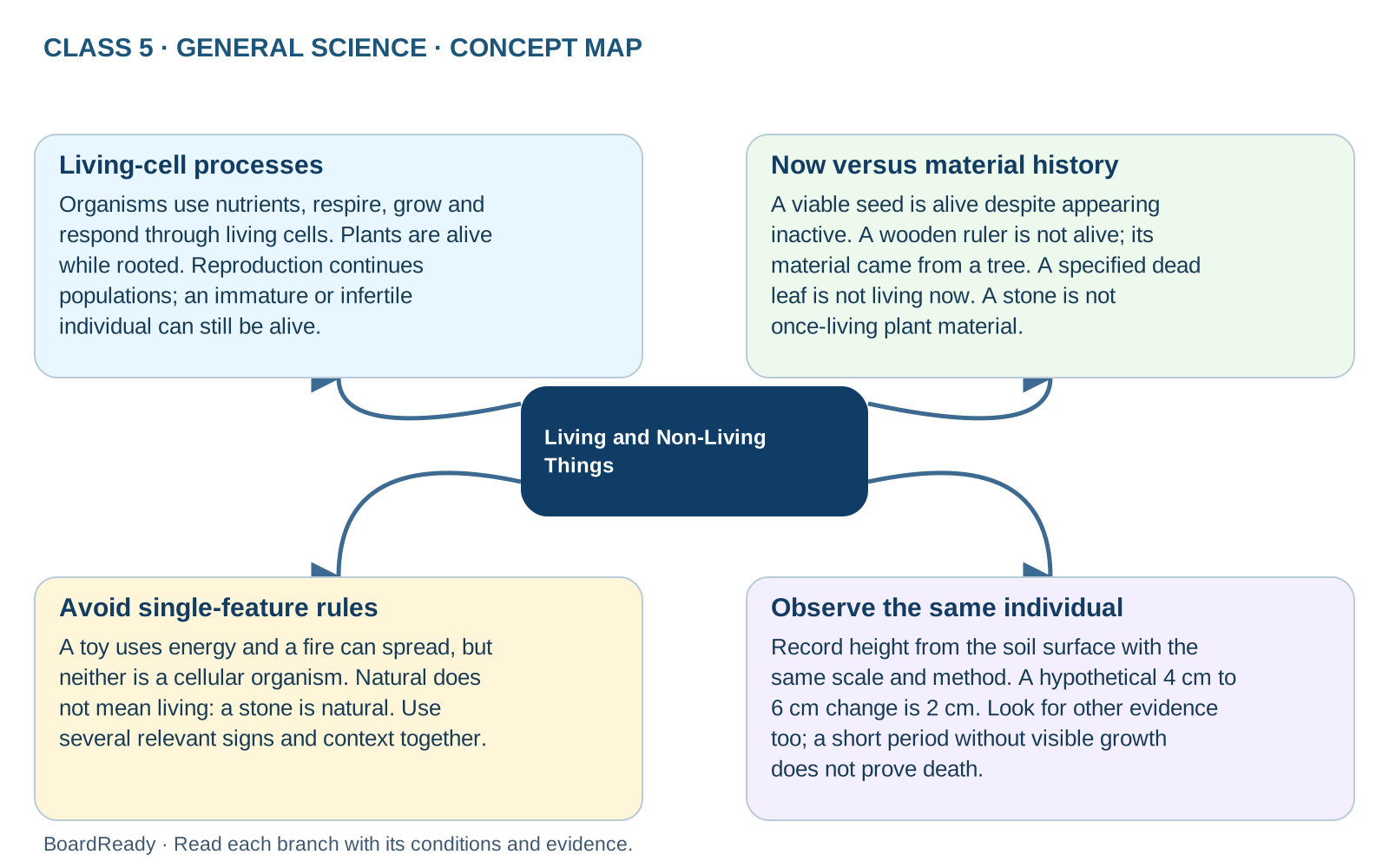
Comparison map
Living and Non-Living Things: relationships and examples
Classify with evidence from living cells, coordinated processes, material history and observations over time. Living-cell processes: Organisms use nutrients, respire, grow and respond through living cells. Plants are alive while rooted. Reproduction continues populations; an immature or infertile individual can still be alive. Now versus material history: A viable seed is alive despite appearing inactive. A wooden ruler is not alive; its material came from a tree. A specified dead leaf is not living now. A stone is not once-living plant material. Avoid single-feature rules: A toy uses energy and a fire can spread, but neither is a cellular organism. Natural does not mean living: a stone is natural. Use several relevant signs and context together. Observe the same individual: Record height from the soil surface with the same scale and method. A hypothetical 4 cm to 6 cm change is 2 cm. Look for other evidence too; a short period without visible growth does not prove death.Exam cue: Classify, give two relevant reasons, and distinguish a current organism from material that came from one.
- 1Living and Non-Living Things -> Living-cell processes: Organisms use nutrients, respire, grow and respond through living cells. Plants are alive while rooted. Reproduction continues populations; an immature or infertile individual can still be alive.
- 2Living and Non-Living Things -> Now versus material history: A viable seed is alive despite appearing inactive. A wooden ruler is not alive; its material came from a tree. A specified dead leaf is not living now. A stone is not once-living plant material.
- 3Living and Non-Living Things -> Avoid single-feature rules: A toy uses energy and a fire can spread, but neither is a cellular organism. Natural does not mean living: a stone is natural. Use several relevant signs and context together.
- 4Living and Non-Living Things -> Observe the same individual: Record height from the soil surface with the same scale and method. A hypothetical 4 cm to 6 cm change is 2 cm. Look for other evidence too; a short period without visible growth does not prove death.