Comparison map
Animals, Habitats, and Adaptations: relationships and examples
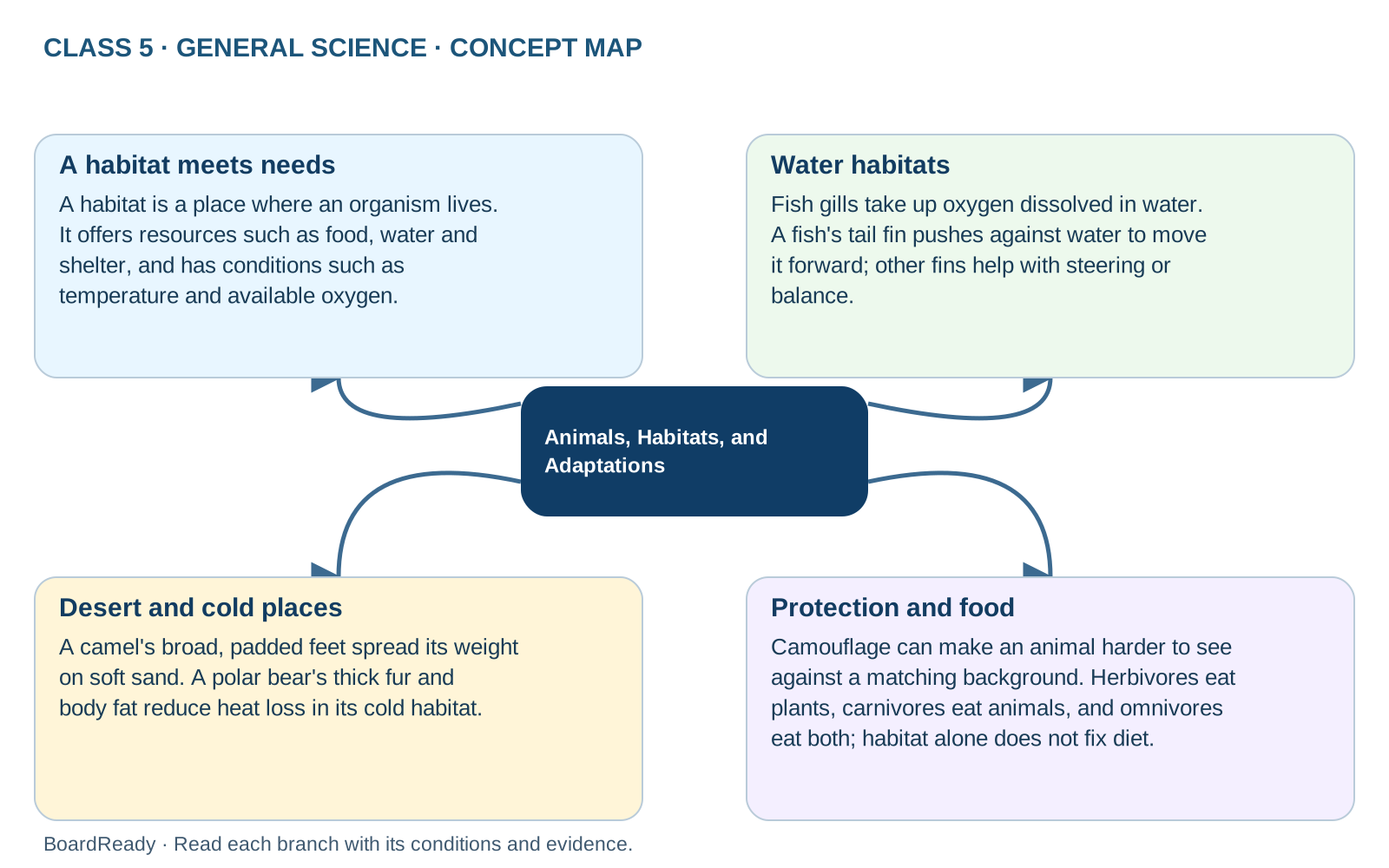
Connect a habitat's conditions to an animal feature or behaviour and then to the way it helps survival. A habitat meets needs: A habitat is a place where an organism lives. It offers resources such as food, water and shelter, and has conditions such as temperature and available oxygen. Water habitats: Fish gills take up oxygen dissolved in water. A fish's tail fin pushes against water to move it forward; other fins help with steering or balance. Desert and cold places: A camel's broad, padded feet spread its weight on soft sand. A polar bear's thick fur and body fat reduce heat loss in its cold habitat. Protection and food: Camouflage can make an animal harder to see against a matching background. Herbivores eat plants, carnivores eat animals, and omnivores eat both; habitat alone does not fix diet.Exam cue: Answer in a chain: name the habitat challenge, identify the feature or behaviour, and explain how it helps.
- 1Animals, Habitats, and Adaptations -> A habitat meets needs: A habitat is a place where an organism lives. It offers resources such as food, water and shelter, and has conditions such as temperature and available oxygen.
- 2Animals, Habitats, and Adaptations -> Water habitats: Fish gills take up oxygen dissolved in water. A fish's tail fin pushes against water to move it forward; other fins help with steering or balance.
- 3Animals, Habitats, and Adaptations -> Desert and cold places: A camel's broad, padded feet spread its weight on soft sand. A polar bear's thick fur and body fat reduce heat loss in its cold habitat.
- 4Animals, Habitats, and Adaptations -> Protection and food: Camouflage can make an animal harder to see against a matching background. Herbivores eat plants, carnivores eat animals, and omnivores eat both; habitat alone does not fix diet.