Comparison map
Ray Optics and Optical Instruments: relationships and examples
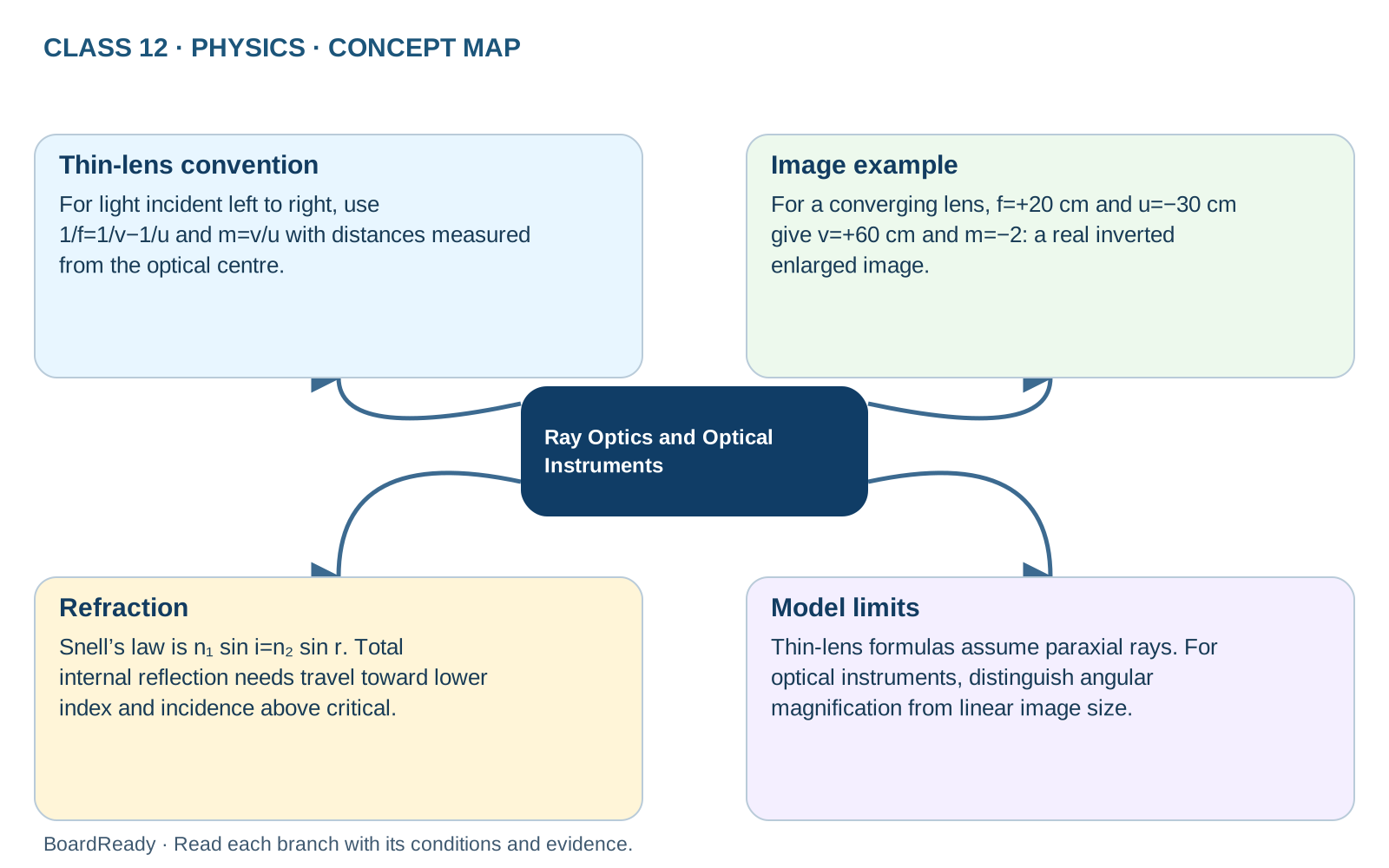
Combine ray geometry, a declared sign convention and image interpretation. Thin-lens convention: For light incident left to right, use 1/f=1/v−1/u and m=v/u with distances measured from the optical centre. Image example: For a converging lens, f=+20 cm and u=−30 cm give v=+60 cm and m=−2: a real inverted enlarged image. Refraction: Snell’s law is n₁ sin i=n₂ sin r. Total internal reflection needs travel toward lower index and incidence above critical. Model limits: Thin-lens formulas assume paraxial rays. For optical instruments, distinguish angular magnification from linear image size.Exam cue: Show the incident direction and origin before substituting signed distances.
- 1Ray Optics and Optical Instruments -> Thin-lens convention: For light incident left to right, use 1/f=1/v−1/u and m=v/u with distances measured from the optical centre.
- 2Ray Optics and Optical Instruments -> Image example: For a converging lens, f=+20 cm and u=−30 cm give v=+60 cm and m=−2: a real inverted enlarged image.
- 3Ray Optics and Optical Instruments -> Refraction: Snell’s law is n₁ sin i=n₂ sin r. Total internal reflection needs travel toward lower index and incidence above critical.
- 4Ray Optics and Optical Instruments -> Model limits: Thin-lens formulas assume paraxial rays. For optical instruments, distinguish angular magnification from linear image size.