Comparison map
Electromagnetic Waves: relationships and examples
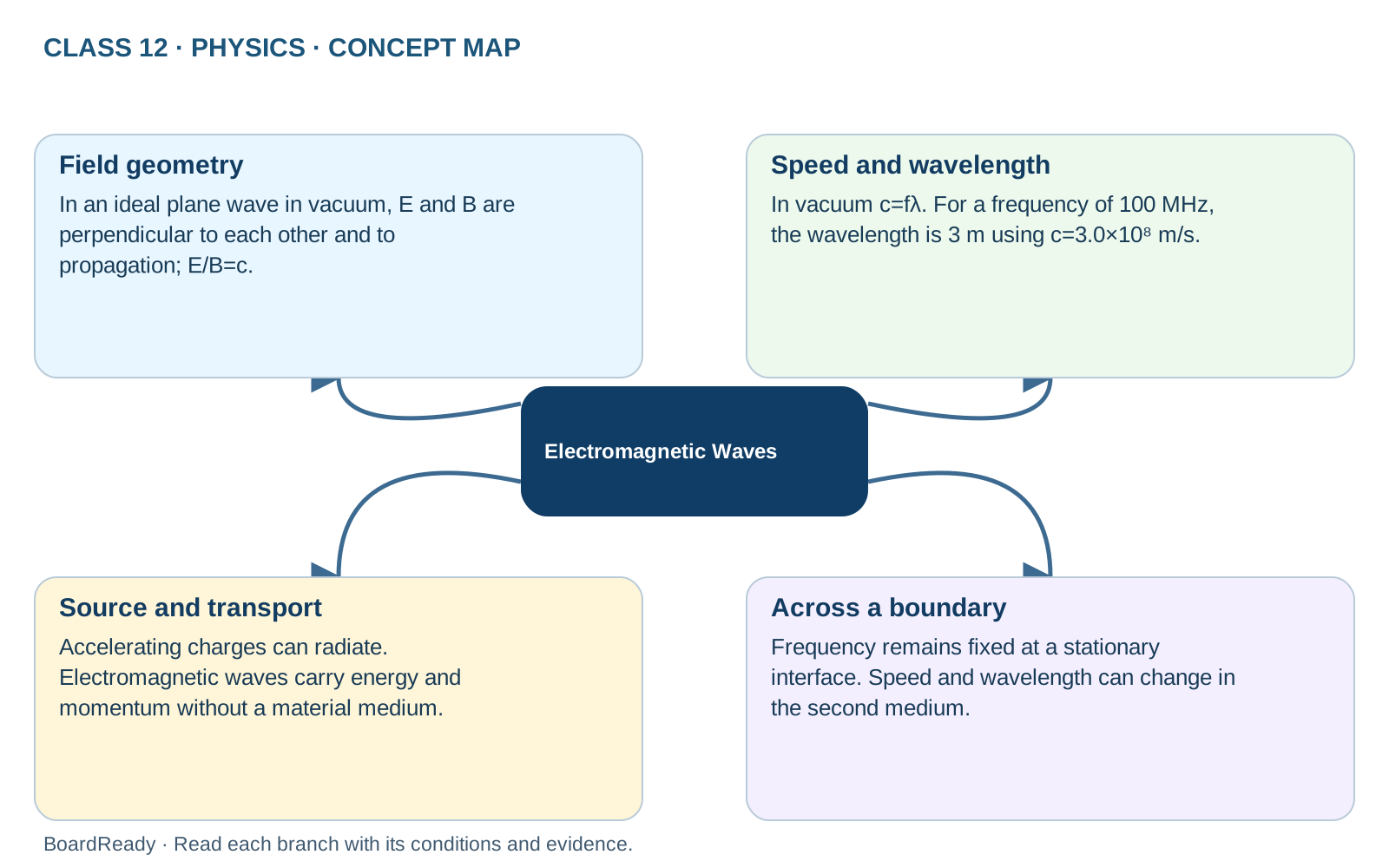
Connect transverse fields, propagation and frequency-dependent applications. Field geometry: In an ideal plane wave in vacuum, E and B are perpendicular to each other and to propagation; E/B=c. Speed and wavelength: In vacuum c=fλ. For a frequency of 100 MHz, the wavelength is 3 m using c=3.0×10⁸ m/s. Source and transport: Accelerating charges can radiate. Electromagnetic waves carry energy and momentum without a material medium. Across a boundary: Frequency remains fixed at a stationary interface. Speed and wavelength can change in the second medium.Exam cue: State the medium before using c, and do not confuse the transverse field direction with propagation.
- 1Electromagnetic Waves -> Field geometry: In an ideal plane wave in vacuum, E and B are perpendicular to each other and to propagation; E/B=c.
- 2Electromagnetic Waves -> Speed and wavelength: In vacuum c=fλ. For a frequency of 100 MHz, the wavelength is 3 m using c=3.0×10⁸ m/s.
- 3Electromagnetic Waves -> Source and transport: Accelerating charges can radiate. Electromagnetic waves carry energy and momentum without a material medium.
- 4Electromagnetic Waves -> Across a boundary: Frequency remains fixed at a stationary interface. Speed and wavelength can change in the second medium.