Comparison map
Wave Optics: relationships and examples
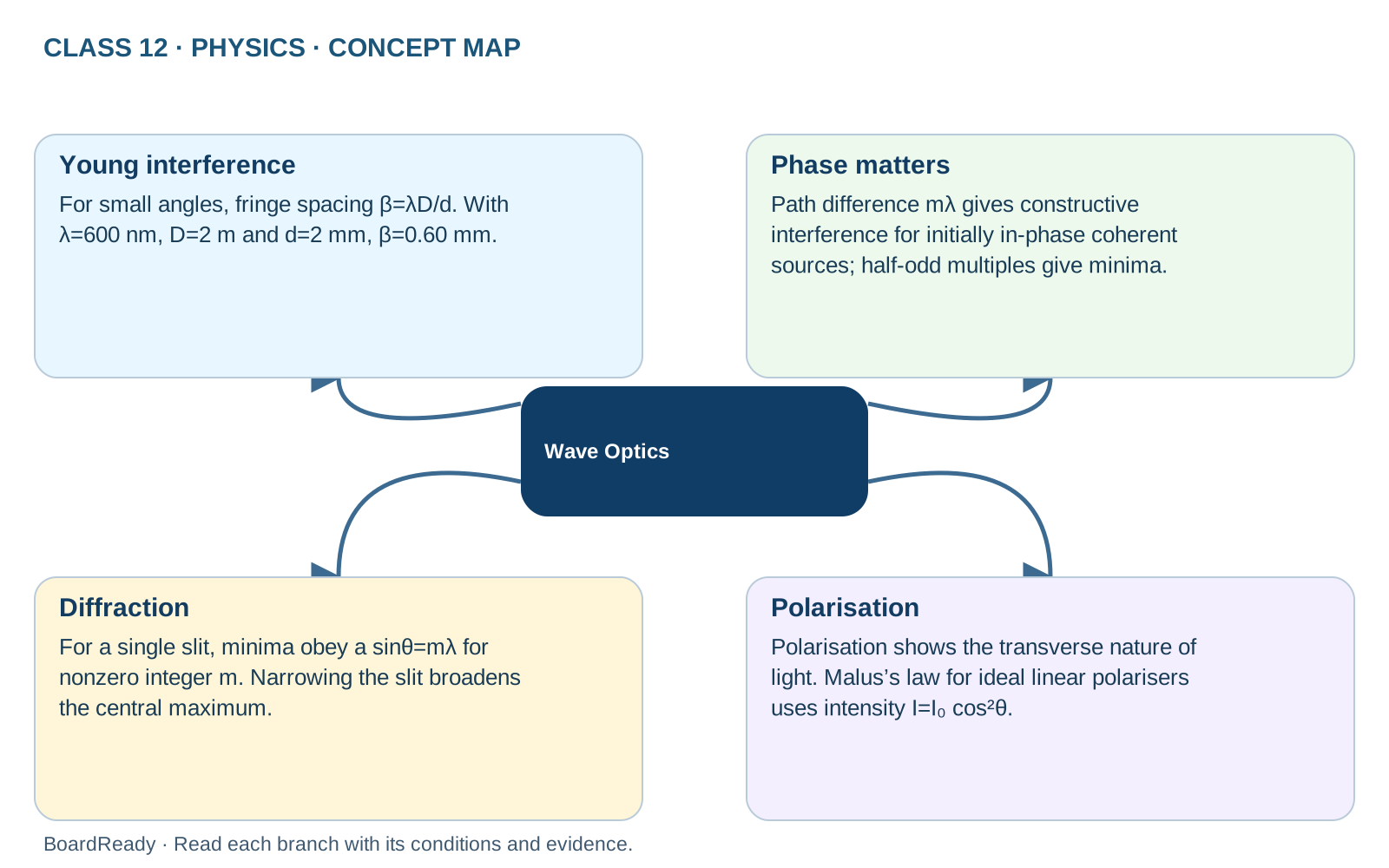
Use superposition and path difference while retaining coherence and geometry. Young interference: For small angles, fringe spacing β=λD/d. With λ=600 nm, D=2 m and d=2 mm, β=0.60 mm. Phase matters: Path difference mλ gives constructive interference for initially in-phase coherent sources; half-odd multiples give minima. Diffraction: For a single slit, minima obey a sinθ=mλ for nonzero integer m. Narrowing the slit broadens the central maximum. Polarisation: Polarisation shows the transverse nature of light. Malus’s law for ideal linear polarisers uses intensity I=I₀ cos²θ.Exam cue: Distinguish slit separation from slit width and intensity from field amplitude.
- 1Wave Optics -> Young interference: For small angles, fringe spacing β=λD/d. With λ=600 nm, D=2 m and d=2 mm, β=0.60 mm.
- 2Wave Optics -> Phase matters: Path difference mλ gives constructive interference for initially in-phase coherent sources; half-odd multiples give minima.
- 3Wave Optics -> Diffraction: For a single slit, minima obey a sinθ=mλ for nonzero integer m. Narrowing the slit broadens the central maximum.
- 4Wave Optics -> Polarisation: Polarisation shows the transverse nature of light. Malus’s law for ideal linear polarisers uses intensity I=I₀ cos²θ.