Comparison map
Dual Nature, Atoms, and Nuclei: relationships and examples
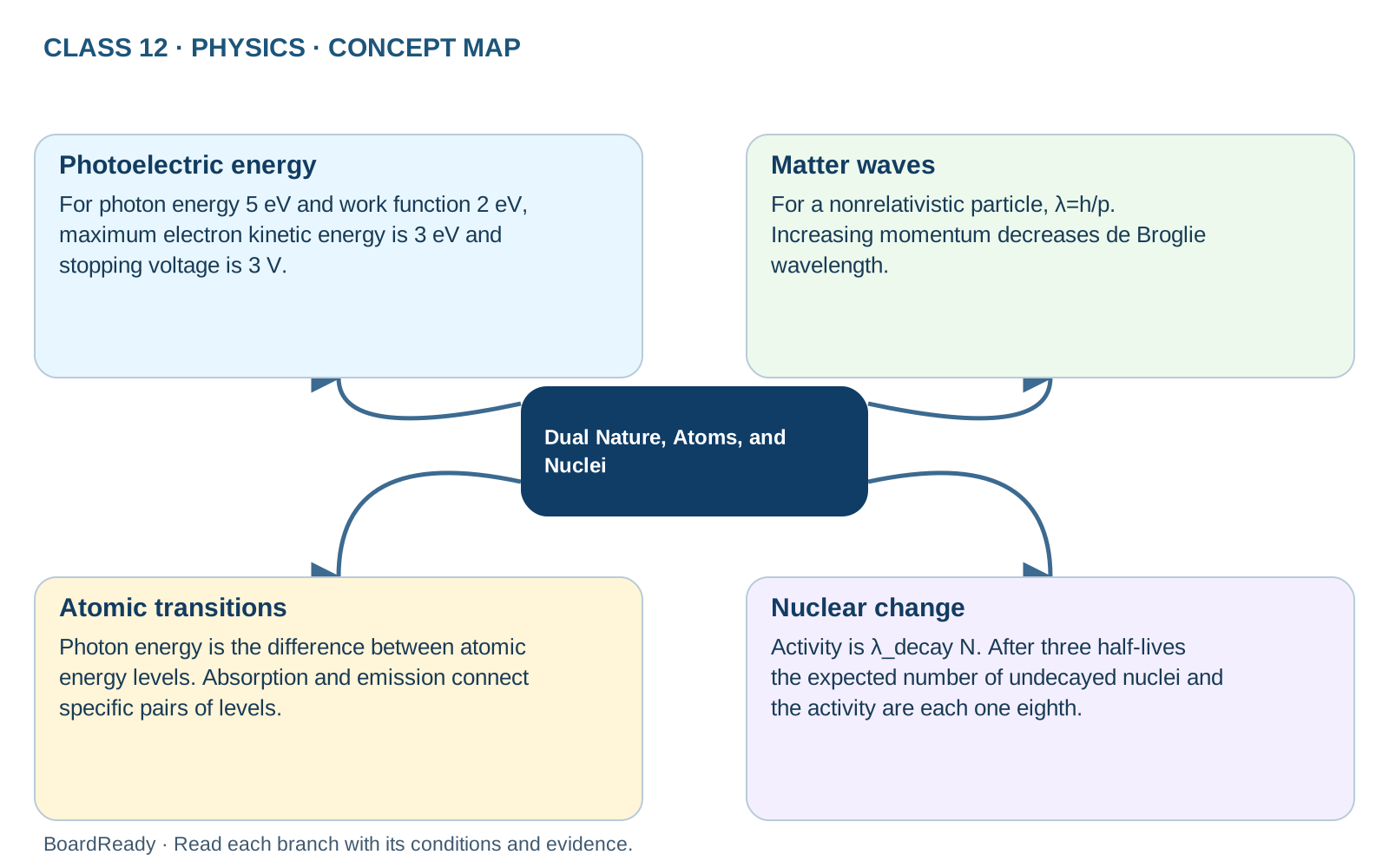
Choose the quantum or nuclear model appropriate to the observation. Photoelectric energy: For photon energy 5 eV and work function 2 eV, maximum electron kinetic energy is 3 eV and stopping voltage is 3 V. Matter waves: For a nonrelativistic particle, λ=h/p. Increasing momentum decreases de Broglie wavelength. Atomic transitions: Photon energy is the difference between atomic energy levels. Absorption and emission connect specific pairs of levels. Nuclear change: Activity is λ_decay N. After three half-lives the expected number of undecayed nuclei and the activity are each one eighth.Exam cue: Use different symbols for wavelength and decay constant. Half-life concerns a population, not a timer for one nucleus.
- 1Dual Nature, Atoms, and Nuclei -> Photoelectric energy: For photon energy 5 eV and work function 2 eV, maximum electron kinetic energy is 3 eV and stopping voltage is 3 V.
- 2Dual Nature, Atoms, and Nuclei -> Matter waves: For a nonrelativistic particle, λ=h/p. Increasing momentum decreases de Broglie wavelength.
- 3Dual Nature, Atoms, and Nuclei -> Atomic transitions: Photon energy is the difference between atomic energy levels. Absorption and emission connect specific pairs of levels.
- 4Dual Nature, Atoms, and Nuclei -> Nuclear change: Activity is λ_decay N. After three half-lives the expected number of undecayed nuclei and the activity are each one eighth.