Comparison map
Speed: relationships and examples
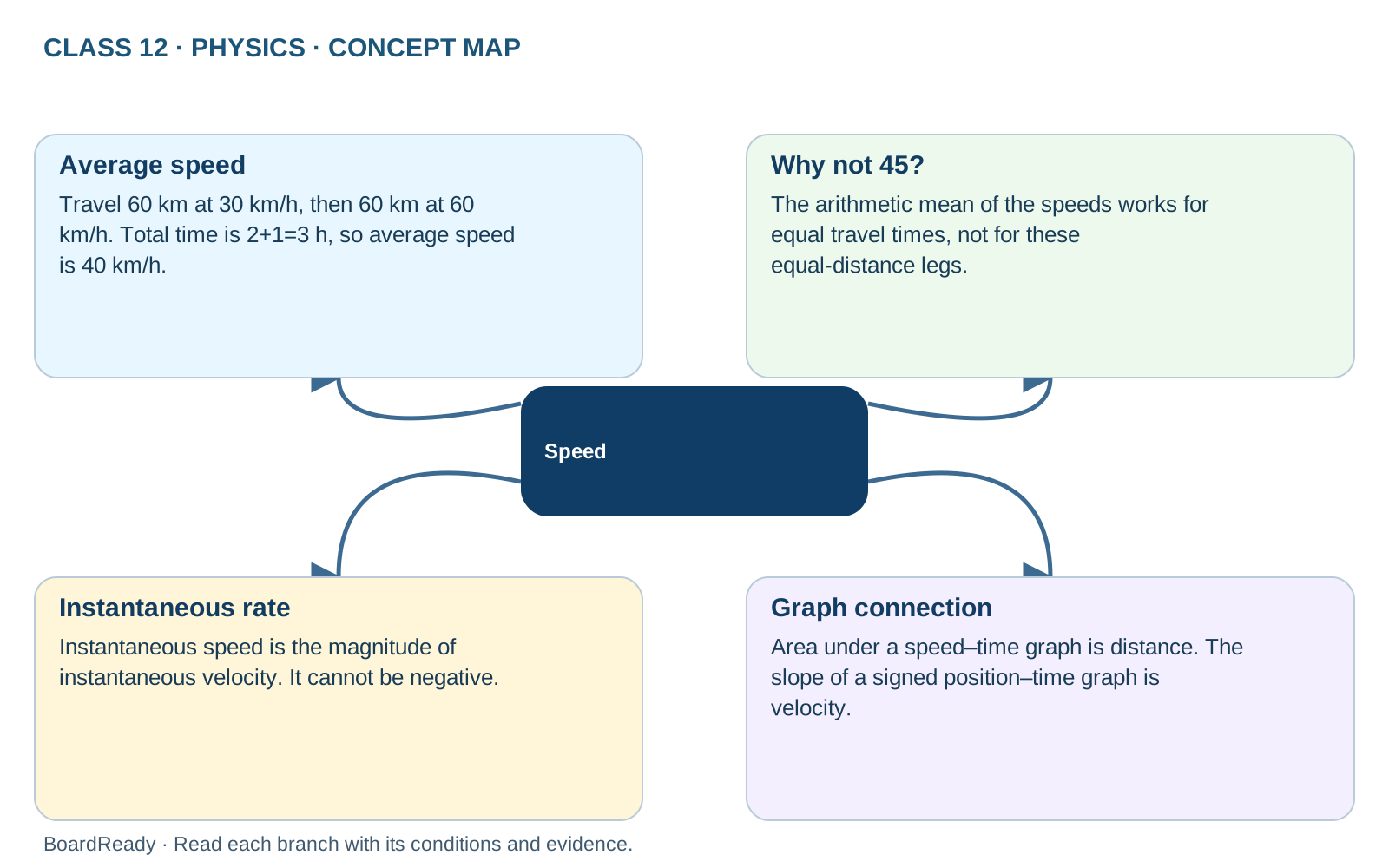
Prerequisite recap: average speed depends on total distance and total elapsed time. Average speed: Travel 60 km at 30 km/h, then 60 km at 60 km/h. Total time is 2+1=3 h, so average speed is 40 km/h. Why not 45?: The arithmetic mean of the speeds works for equal travel times, not for these equal-distance legs. Instantaneous rate: Instantaneous speed is the magnitude of instantaneous velocity. It cannot be negative. Graph connection: Area under a speed–time graph is distance. The slope of a signed position–time graph is velocity.Exam cue: Add distances and times separately before dividing; include stops in elapsed time when asked.
- 1Speed -> Average speed: Travel 60 km at 30 km/h, then 60 km at 60 km/h. Total time is 2+1=3 h, so average speed is 40 km/h.
- 2Speed -> Why not 45?: The arithmetic mean of the speeds works for equal travel times, not for these equal-distance legs.
- 3Speed -> Instantaneous rate: Instantaneous speed is the magnitude of instantaneous velocity. It cannot be negative.
- 4Speed -> Graph connection: Area under a speed–time graph is distance. The slope of a signed position–time graph is velocity.