Comparison map
Distance and Displacement: relationships and examples
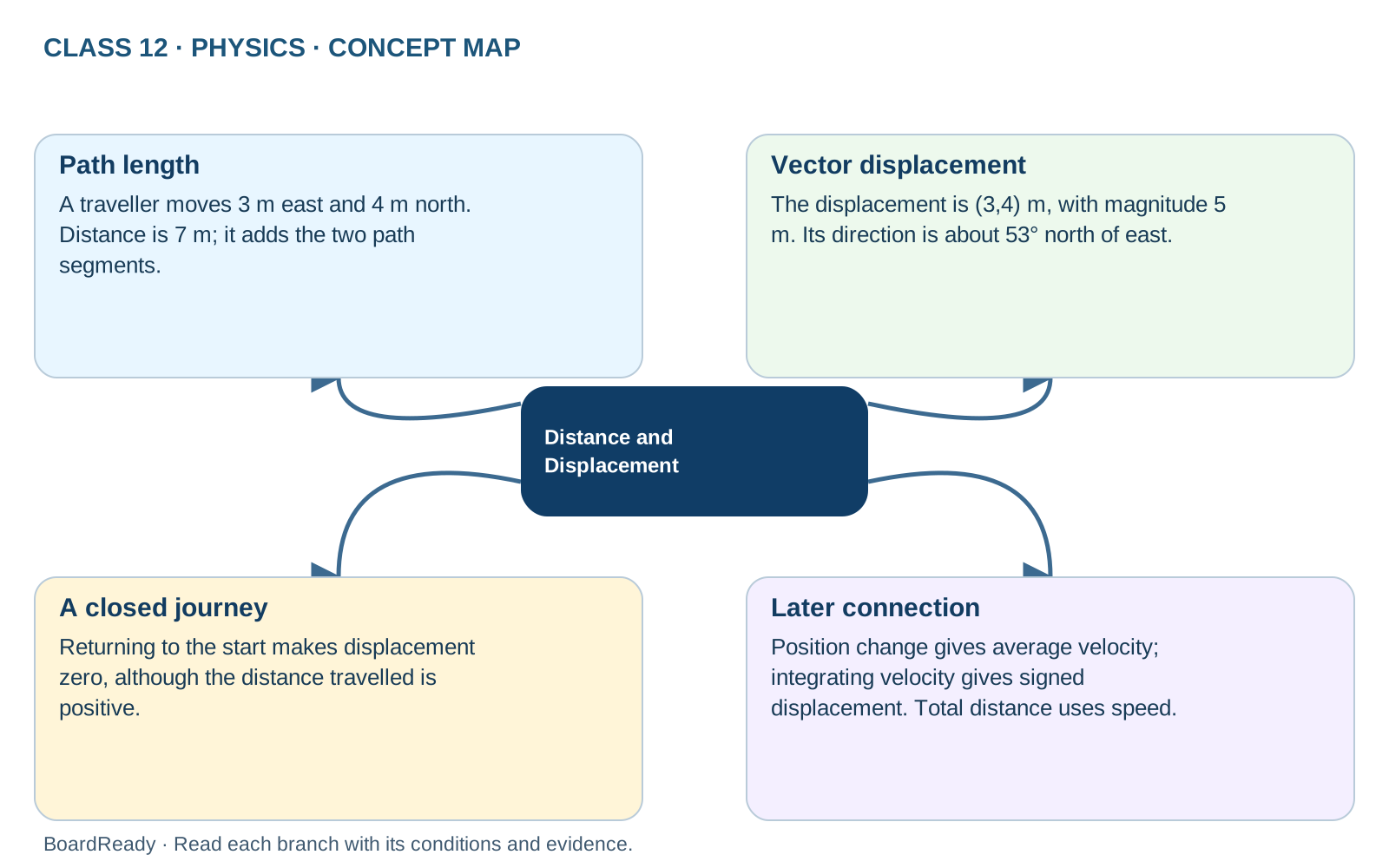
Prerequisite recap: distinguish a path from a signed change of position. Path length: A traveller moves 3 m east and 4 m north. Distance is 7 m; it adds the two path segments. Vector displacement: The displacement is (3,4) m, with magnitude 5 m. Its direction is about 53° north of east. A closed journey: Returning to the start makes displacement zero, although the distance travelled is positive. Later connection: Position change gives average velocity; integrating velocity gives signed displacement. Total distance uses speed.Exam cue: Declare a coordinate system and distinguish the displacement vector from its magnitude.
- 1Distance and Displacement -> Path length: A traveller moves 3 m east and 4 m north. Distance is 7 m; it adds the two path segments.
- 2Distance and Displacement -> Vector displacement: The displacement is (3,4) m, with magnitude 5 m. Its direction is about 53° north of east.
- 3Distance and Displacement -> A closed journey: Returning to the start makes displacement zero, although the distance travelled is positive.
- 4Distance and Displacement -> Later connection: Position change gives average velocity; integrating velocity gives signed displacement. Total distance uses speed.