Comparison map
Velocity: relationships and examples
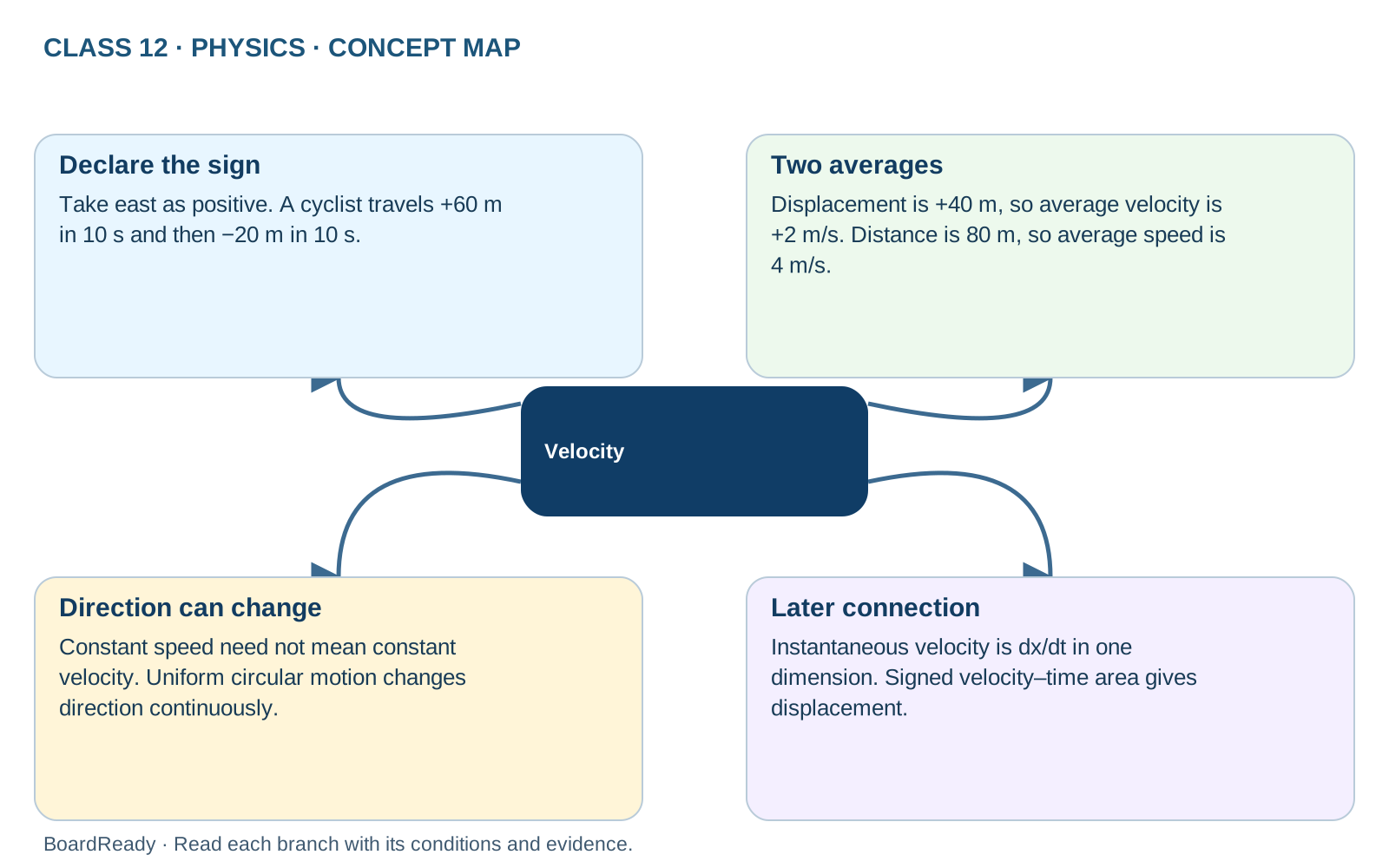
Prerequisite recap: velocity combines a rate with a direction. Declare the sign: Take east as positive. A cyclist travels +60 m in 10 s and then −20 m in 10 s. Two averages: Displacement is +40 m, so average velocity is +2 m/s. Distance is 80 m, so average speed is 4 m/s. Direction can change: Constant speed need not mean constant velocity. Uniform circular motion changes direction continuously. Later connection: Instantaneous velocity is dx/dt in one dimension. Signed velocity–time area gives displacement.Exam cue: A negative velocity specifies direction relative to your axis, not a negative speed.
- 1Velocity -> Declare the sign: Take east as positive. A cyclist travels +60 m in 10 s and then −20 m in 10 s.
- 2Velocity -> Two averages: Displacement is +40 m, so average velocity is +2 m/s. Distance is 80 m, so average speed is 4 m/s.
- 3Velocity -> Direction can change: Constant speed need not mean constant velocity. Uniform circular motion changes direction continuously.
- 4Velocity -> Later connection: Instantaneous velocity is dx/dt in one dimension. Signed velocity–time area gives displacement.