Comparison map
Probability: relationships and examples
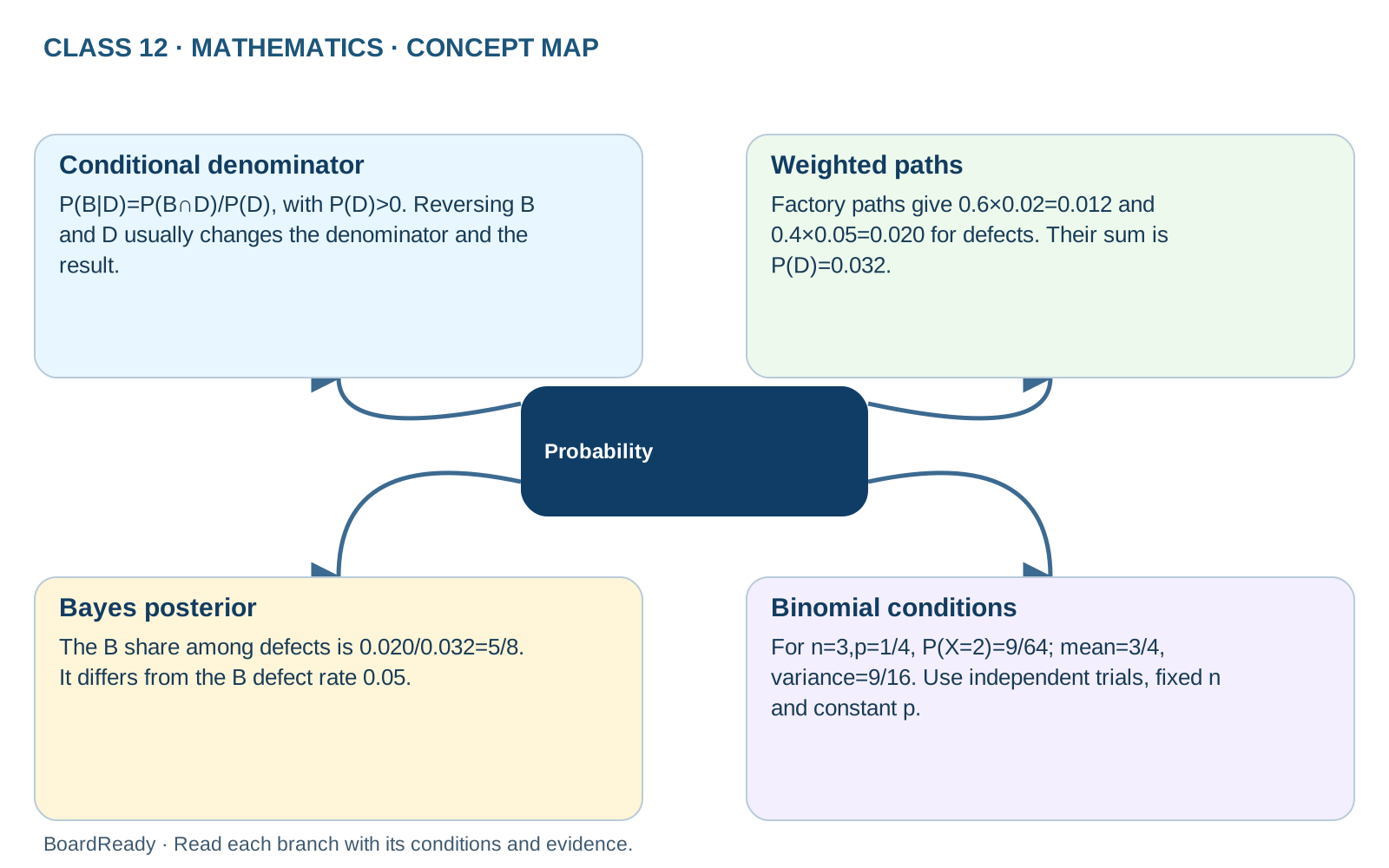
Conditioning, partition weights and model assumptions determine which probability rule applies. Conditional denominator: P(B|D)=P(B∩D)/P(D), with P(D)>0. Reversing B and D usually changes the denominator and the result. Weighted paths: Factory paths give 0.6×0.02=0.012 and 0.4×0.05=0.020 for defects. Their sum is P(D)=0.032. Bayes posterior: The B share among defects is 0.020/0.032=5/8. It differs from the B defect rate 0.05. Binomial conditions: For n=3,p=1/4, P(X=2)=9/64; mean=3/4, variance=9/16. Use independent trials, fixed n and constant p.Exam cue: Keep the existing Bayes tree. State the experiment and conditioning event before computing.
- 1Probability -> Conditional denominator: P(B|D)=P(B∩D)/P(D), with P(D)>0. Reversing B and D usually changes the denominator and the result.
- 2Probability -> Weighted paths: Factory paths give 0.6×0.02=0.012 and 0.4×0.05=0.020 for defects. Their sum is P(D)=0.032.
- 3Probability -> Bayes posterior: The B share among defects is 0.020/0.032=5/8. It differs from the B defect rate 0.05.
- 4Probability -> Binomial conditions: For n=3,p=1/4, P(X=2)=9/64; mean=3/4, variance=9/16. Use independent trials, fixed n and constant p.