Comparison map
Linear Programming: relationships and examples
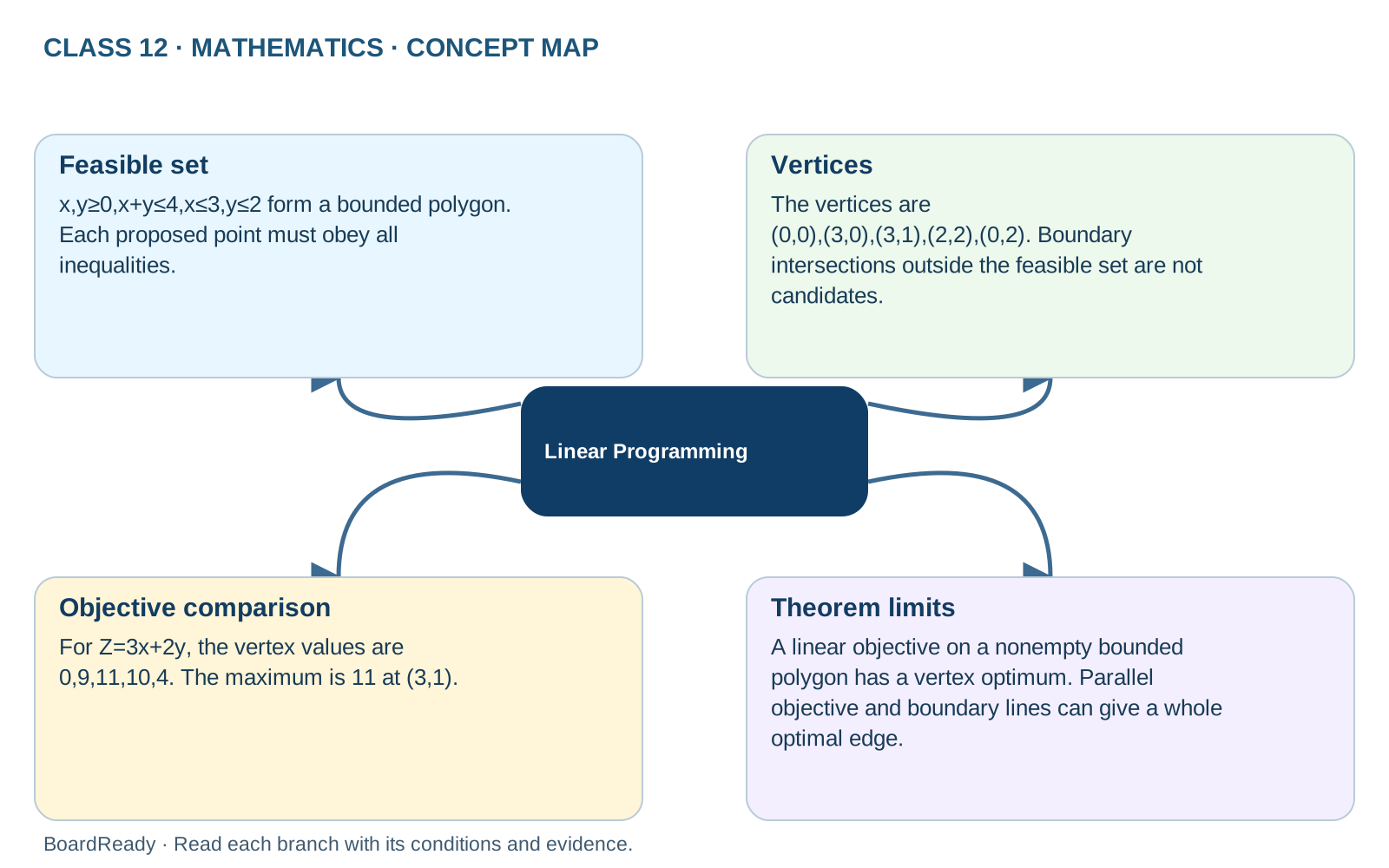
The feasible region is the intersection of all constraints; the objective selects a direction within it. Feasible set: x,y≥0,x+y≤4,x≤3,y≤2 form a bounded polygon. Each proposed point must obey all inequalities. Vertices: The vertices are (0,0),(3,0),(3,1),(2,2),(0,2). Boundary intersections outside the feasible set are not candidates. Objective comparison: For Z=3x+2y, the vertex values are 0,9,11,10,4. The maximum is 11 at (3,1). Theorem limits: A linear objective on a nonempty bounded polygon has a vertex optimum. Parallel objective and boundary lines can give a whole optimal edge.Exam cue: Draw or establish the feasible polygon before comparing vertex values; unbounded feasibility alone does not decide the objective.
- 1Linear Programming -> Feasible set: x,y≥0,x+y≤4,x≤3,y≤2 form a bounded polygon. Each proposed point must obey all inequalities.
- 2Linear Programming -> Vertices: The vertices are (0,0),(3,0),(3,1),(2,2),(0,2). Boundary intersections outside the feasible set are not candidates.
- 3Linear Programming -> Objective comparison: For Z=3x+2y, the vertex values are 0,9,11,10,4. The maximum is 11 at (3,1).
- 4Linear Programming -> Theorem limits: A linear objective on a nonempty bounded polygon has a vertex optimum. Parallel objective and boundary lines can give a whole optimal edge.