Comparison map
Solid State: relationships and examples
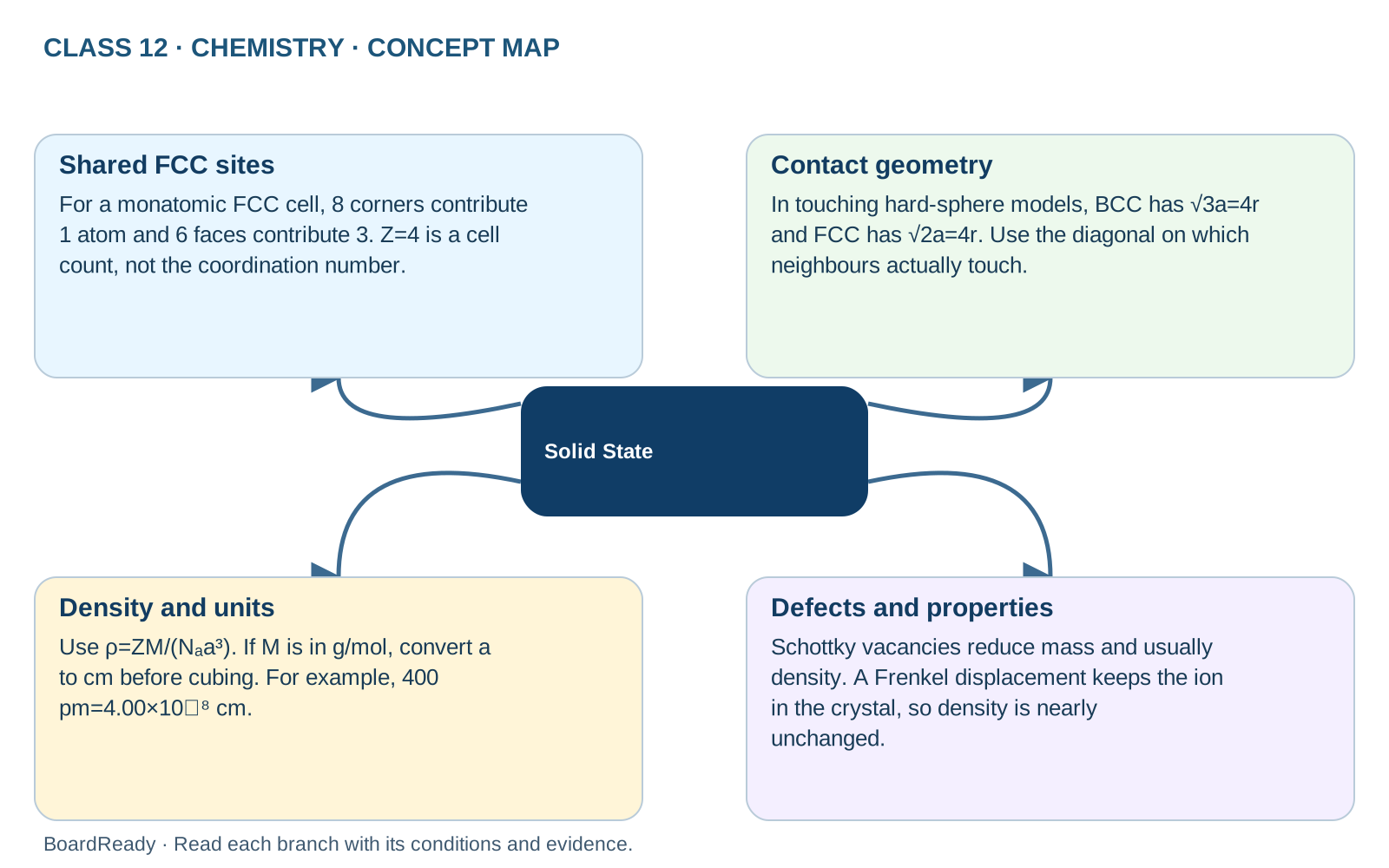
Connect shared lattice positions, contact geometry, density and crystal defects. Shared FCC sites: For a monatomic FCC cell, 8 corners contribute 1 atom and 6 faces contribute 3. Z=4 is a cell count, not the coordination number. Contact geometry: In touching hard-sphere models, BCC has √3a=4r and FCC has √2a=4r. Use the diagonal on which neighbours actually touch. Density and units: Use ρ=ZM/(Nₐa³). If M is in g/mol, convert a to cm before cubing. For example, 400 pm=4.00×10⁻⁸ cm. Defects and properties: Schottky vacancies reduce mass and usually density. A Frenkel displacement keeps the ion in the crystal, so density is nearly unchanged.Exam cue: Count shared contributions before calculating. Declare the structure, particle basis and unit system; distinguish cell occupancy from nearest-neighbour coordination.
- 1Solid State -> Shared FCC sites: For a monatomic FCC cell, 8 corners contribute 1 atom and 6 faces contribute 3. Z=4 is a cell count, not the coordination number.
- 2Solid State -> Contact geometry: In touching hard-sphere models, BCC has √3a=4r and FCC has √2a=4r. Use the diagonal on which neighbours actually touch.
- 3Solid State -> Density and units: Use ρ=ZM/(Nₐa³). If M is in g/mol, convert a to cm before cubing. For example, 400 pm=4.00×10⁻⁸ cm.
- 4Solid State -> Defects and properties: Schottky vacancies reduce mass and usually density. A Frenkel displacement keeps the ion in the crystal, so density is nearly unchanged.