Comparison map
Solutions: relationships and examples
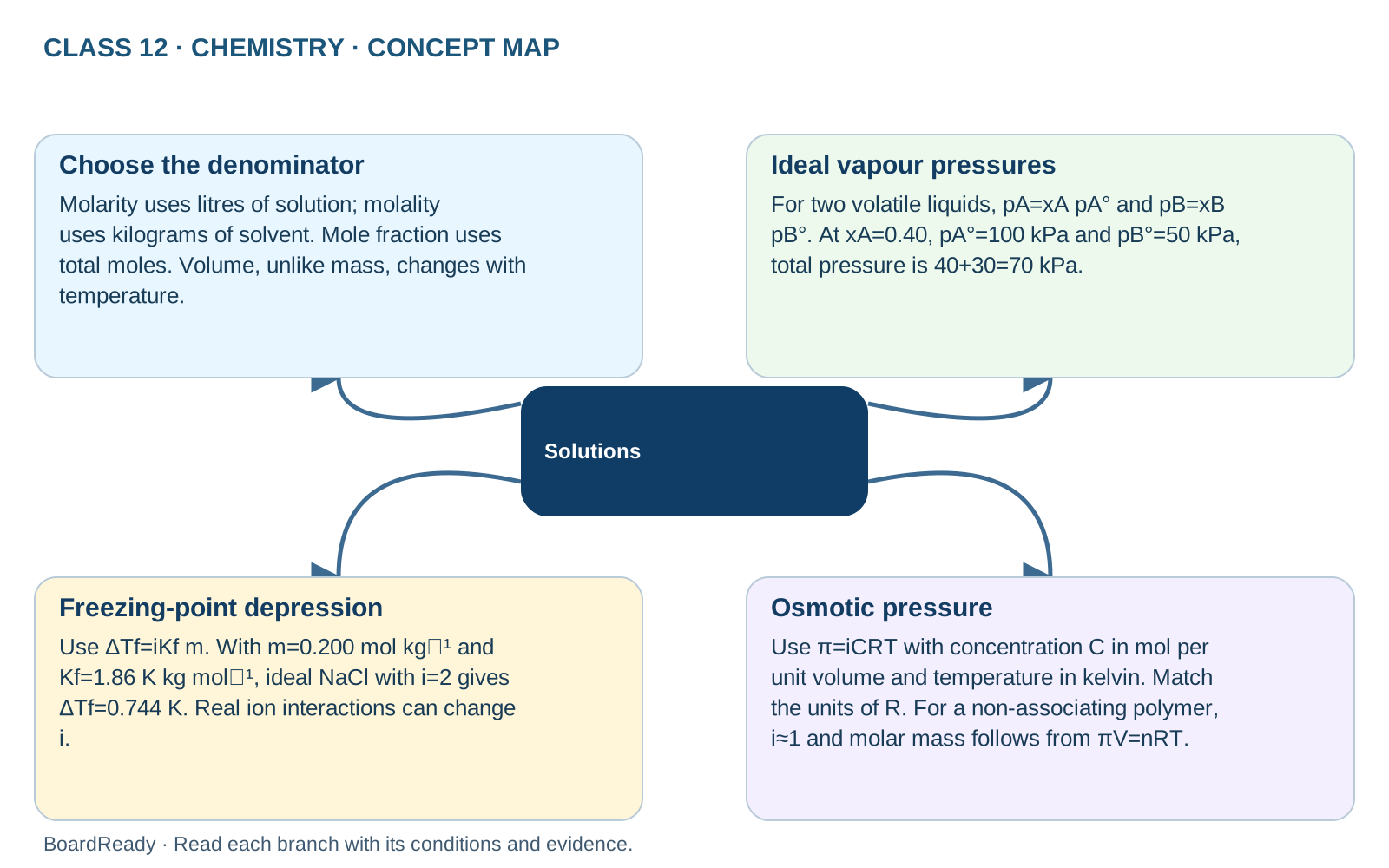
Connect composition, vapour pressure and particle-count effects using the correct denominator and model. Choose the denominator: Molarity uses litres of solution; molality uses kilograms of solvent. Mole fraction uses total moles. Volume, unlike mass, changes with temperature. Ideal vapour pressures: For two volatile liquids, pA=xA pA° and pB=xB pB°. At xA=0.40, pA°=100 kPa and pB°=50 kPa, total pressure is 40+30=70 kPa. Freezing-point depression: Use ΔTf=iKf m. With m=0.200 mol kg⁻¹ and Kf=1.86 K kg mol⁻¹, ideal NaCl with i=2 gives ΔTf=0.744 K. Real ion interactions can change i. Osmotic pressure: Use π=iCRT with concentration C in mol per unit volume and temperature in kelvin. Match the units of R. For a non-associating polymer, i≈1 and molar mass follows from πV=nRT.Exam cue: State whether each component is volatile, specify the ideal or dilute model, and keep solution volume separate from solvent mass. Use the positive temperature depression to subtract from the pure-solvent freezing point.
- 1Solutions -> Choose the denominator: Molarity uses litres of solution; molality uses kilograms of solvent. Mole fraction uses total moles. Volume, unlike mass, changes with temperature.
- 2Solutions -> Ideal vapour pressures: For two volatile liquids, pA=xA pA° and pB=xB pB°. At xA=0.40, pA°=100 kPa and pB°=50 kPa, total pressure is 40+30=70 kPa.
- 3Solutions -> Freezing-point depression: Use ΔTf=iKf m. With m=0.200 mol kg⁻¹ and Kf=1.86 K kg mol⁻¹, ideal NaCl with i=2 gives ΔTf=0.744 K. Real ion interactions can change i.
- 4Solutions -> Osmotic pressure: Use π=iCRT with concentration C in mol per unit volume and temperature in kelvin. Match the units of R. For a non-associating polymer, i≈1 and molar mass follows from πV=nRT.