Comparison map
Electrochemistry: relationships and examples
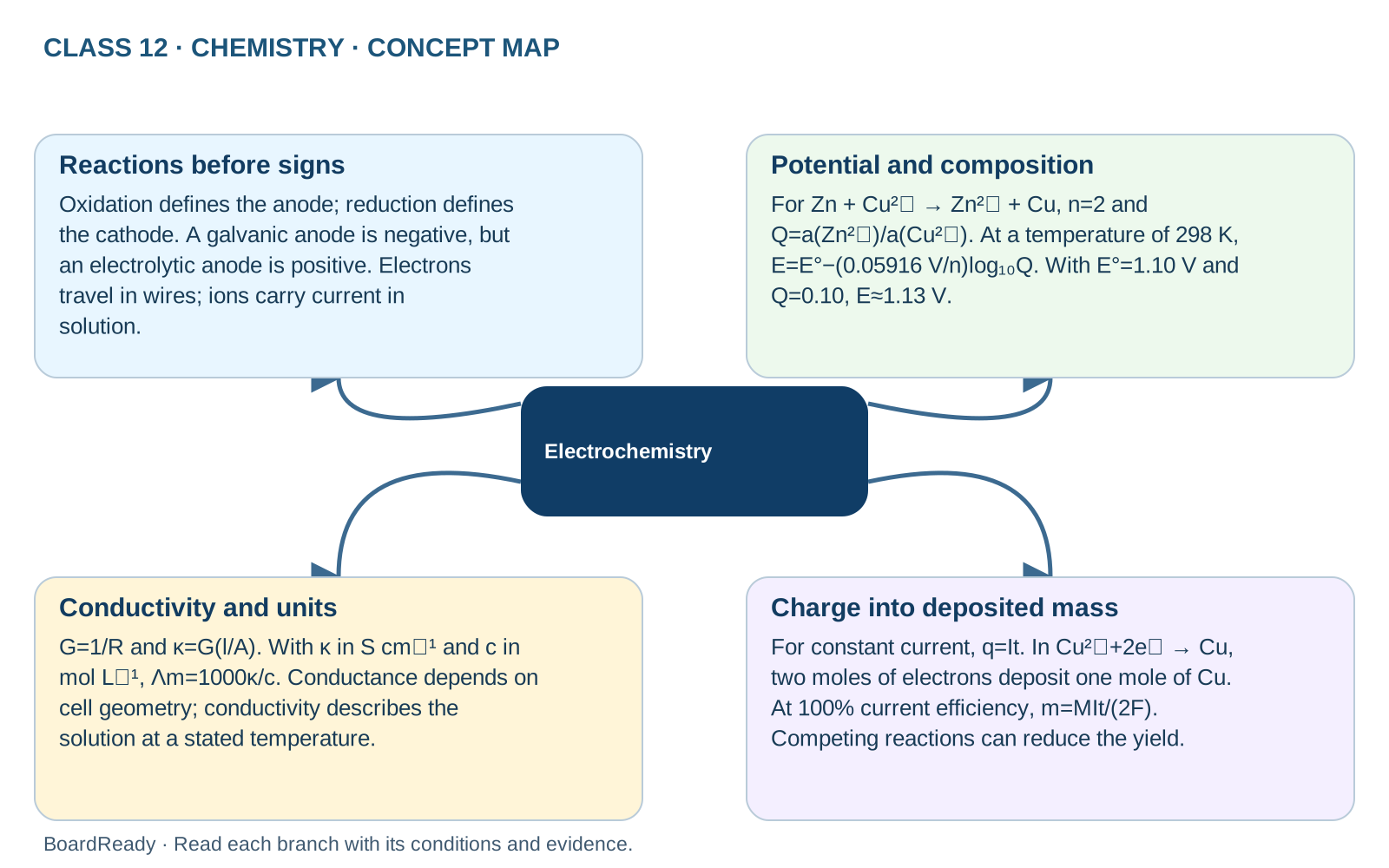
Connect electrode reactions, reaction quotient, conductivity and charge accounting without mixing their units. Reactions before signs: Oxidation defines the anode; reduction defines the cathode. A galvanic anode is negative, but an electrolytic anode is positive. Electrons travel in wires; ions carry current in solution. Potential and composition: For Zn + Cu²⁺ → Zn²⁺ + Cu, n=2 and Q=a(Zn²⁺)/a(Cu²⁺). At a temperature of 298 K, E=E°−(0.05916 V/n)log₁₀Q. With E°=1.10 V and Q=0.10, E≈1.13 V. Conductivity and units: G=1/R and κ=G(l/A). With κ in S cm⁻¹ and c in mol L⁻¹, Λm=1000κ/c. Conductance depends on cell geometry; conductivity describes the solution at a stated temperature. Charge into deposited mass: For constant current, q=It. In Cu²⁺+2e⁻ → Cu, two moles of electrons deposit one mole of Cu. At 100% current efficiency, m=MIt/(2F). Competing reactions can reduce the yield.Exam cue: Balance the half-reactions and count electrons first. Keep reaction quotient Q separate from charge q, use reduction potentials consistently, and state temperature, units and current efficiency.
- 1Electrochemistry -> Reactions before signs: Oxidation defines the anode; reduction defines the cathode. A galvanic anode is negative, but an electrolytic anode is positive. Electrons travel in wires; ions carry current in solution.
- 2Electrochemistry -> Potential and composition: For Zn + Cu²⁺ → Zn²⁺ + Cu, n=2 and Q=a(Zn²⁺)/a(Cu²⁺). At a temperature of 298 K, E=E°−(0.05916 V/n)log₁₀Q. With E°=1.10 V and Q=0.10, E≈1.13 V.
- 3Electrochemistry -> Conductivity and units: G=1/R and κ=G(l/A). With κ in S cm⁻¹ and c in mol L⁻¹, Λm=1000κ/c. Conductance depends on cell geometry; conductivity describes the solution at a stated temperature.
- 4Electrochemistry -> Charge into deposited mass: For constant current, q=It. In Cu²⁺+2e⁻ → Cu, two moles of electrons deposit one mole of Cu. At 100% current efficiency, m=MIt/(2F). Competing reactions can reduce the yield.