Comparison map
Chemical Kinetics and Surface Chemistry: relationships and examples
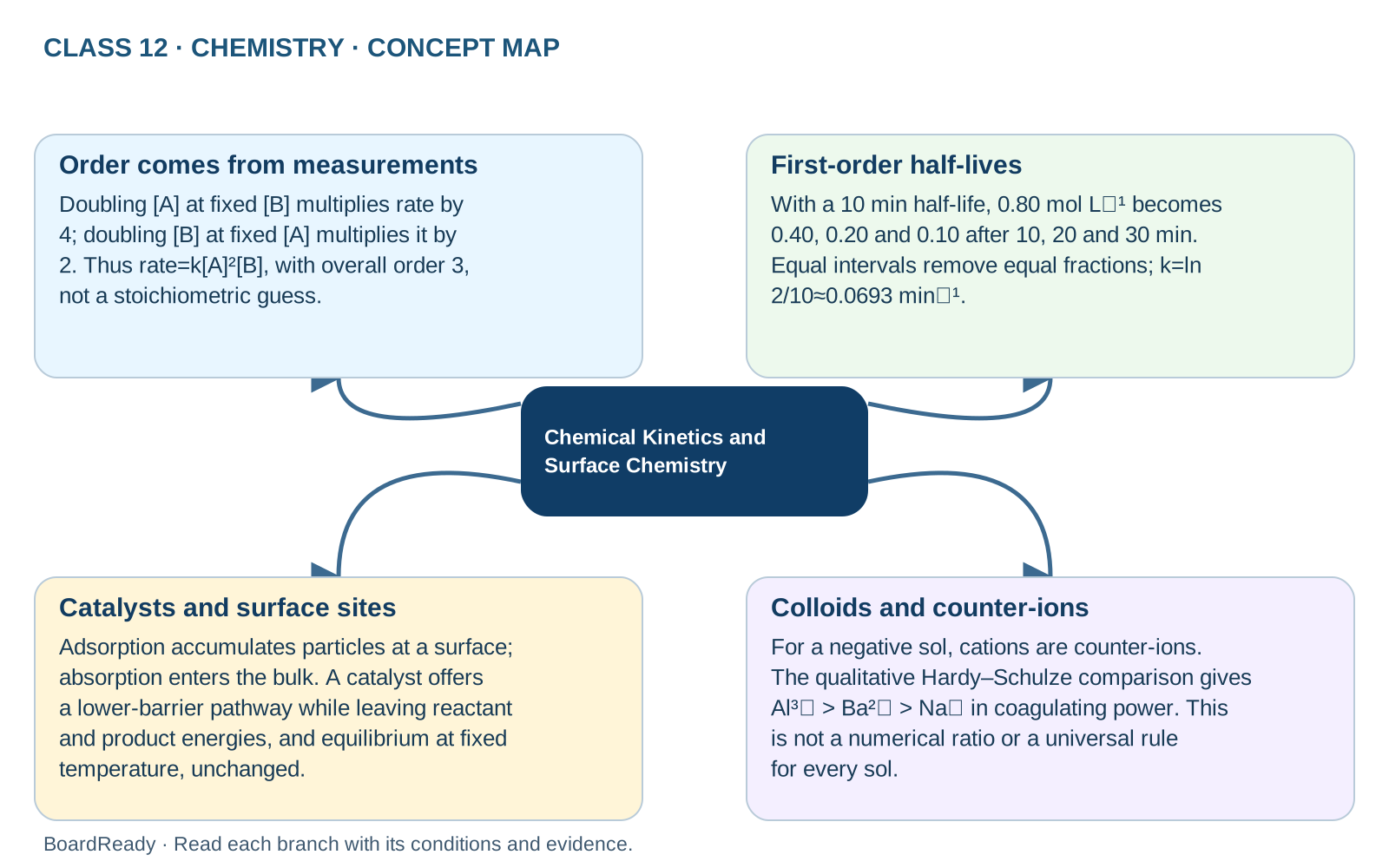
Link measured rate changes, time-dependent concentration, catalytic surfaces and colloid stability. Order comes from measurements: Doubling [A] at fixed [B] multiplies rate by 4; doubling [B] at fixed [A] multiplies it by 2. Thus rate=k[A]²[B], with overall order 3, not a stoichiometric guess. First-order half-lives: With a 10 min half-life, 0.80 mol L⁻¹ becomes 0.40, 0.20 and 0.10 after 10, 20 and 30 min. Equal intervals remove equal fractions; k=ln 2/10≈0.0693 min⁻¹. Catalysts and surface sites: Adsorption accumulates particles at a surface; absorption enters the bulk. A catalyst offers a lower-barrier pathway while leaving reactant and product energies, and equilibrium at fixed temperature, unchanged. Colloids and counter-ions: For a negative sol, cations are counter-ions. The qualitative Hardy–Schulze comparison gives Al³⁺ > Ba²⁺ > Na⁺ in coagulating power. This is not a numerical ratio or a universal rule for every sol.Exam cue: Keep temperature and other conditions fixed when comparing rates. Distinguish experimental order from molecularity, equal fractions from equal amounts, and faster equilibration from a changed equilibrium constant.
- 1Chemical Kinetics and Surface Chemistry -> Order comes from measurements: Doubling [A] at fixed [B] multiplies rate by 4; doubling [B] at fixed [A] multiplies it by 2. Thus rate=k[A]²[B], with overall order 3, not a stoichiometric guess.
- 2Chemical Kinetics and Surface Chemistry -> First-order half-lives: With a 10 min half-life, 0.80 mol L⁻¹ becomes 0.40, 0.20 and 0.10 after 10, 20 and 30 min. Equal intervals remove equal fractions; k=ln 2/10≈0.0693 min⁻¹.
- 3Chemical Kinetics and Surface Chemistry -> Catalysts and surface sites: Adsorption accumulates particles at a surface; absorption enters the bulk. A catalyst offers a lower-barrier pathway while leaving reactant and product energies, and equilibrium at fixed temperature, unchanged.
- 4Chemical Kinetics and Surface Chemistry -> Colloids and counter-ions: For a negative sol, cations are counter-ions. The qualitative Hardy–Schulze comparison gives Al³⁺ > Ba²⁺ > Na⁺ in coagulating power. This is not a numerical ratio or a universal rule for every sol.